
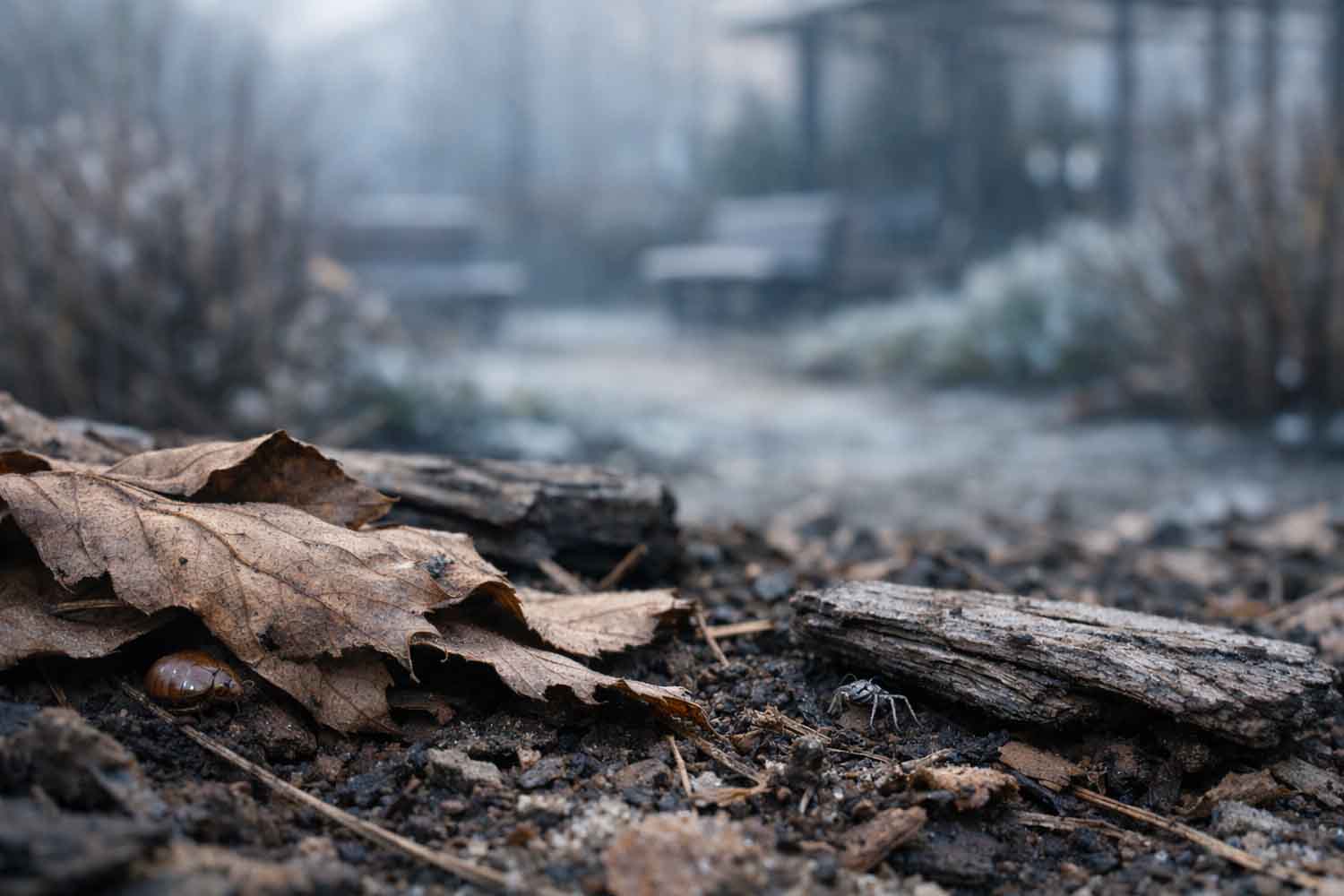
Every year, more or less without realizing it, the same thing happens. The cold weather arrives, we close the windows, turn on the heating and the house suddenly becomes silent. No more mosquitoes disturbing your sleep, no midges around fruit. And a reassuring thought arises within us: “finally some respite”.
The point is that insects don’t really disappear in winter. They simply change pace. It’s like they turn down the volume, but don’t turn off the music.
Many species enter a phase of profound slowdown, diapause, a sort of biological pause that allows them to survive the cold while consuming very little energy. Solitary bees taking refuge in the ground, butterflies hidden among the dry leaves, ladybugs stuck in the cracks in the walls. Nature, from this point of view, is much better organized than us.
Yet, in recent years, that winter silence seems thicker than usual. Less vibrations, less life. And it’s not just a feeling.
When the silence lasts too long
In 2019, a study much cited in the scientific world, signed by Francisco Sánchez-Bayo and Kris AG Wyckhuys, put in black and white a reality that is difficult to ignore: almost half of insect species are in decline globally.
It is not a study that talks about winter in the strict sense, but it helps to understand why today winter seems emptier to us. If insect populations are already small to begin with, the period in which they hide or slow down becomes even more evident. It’s not just seasonal rest, it’s a fragility that accumulates.
The causes are not mysterious and have nothing abstract: increasingly intensive fields, pesticides, cities that are expanding, habitats that are breaking up, seasons that no longer follow the calendar they once did. All this weighs heavily even when we don’t see the insects, when they seem to be “on pause”.
Why some insects enter the house in winter (and they don’t do it out of spite)
Then there is a detail that many immediately recognize: while everything seems to be still outside, inside the house something is moving. A silver fish that crosses the bathroom at night, a tiny insect in the closet, a scutigera that suddenly appears and disappears even more quickly.
It is not an invasion nor a plot against our domestic tranquility. It’s an adaptation. Our homes are stable, warm environments, with a little humidity and a thousand hiding places. In an increasingly less predictable outside world, they become perfect shelters to survive the winter.
This behavior is also linked to increasingly confusing seasons. Mild winters, temperature changes, natural cycles that jump. Some insects are no longer able to “sleep” as they once did and are looking for alternative solutions. Sometimes, we are that solution.
Observing what happens to insects in winter is a bit like looking at a litmus test of the environment around us. When we no longer see them, it’s not automatically good news. When someone enters your home, it’s not automatically a problem.
Insects are not an annoying detail to eliminate, but a presence that has always been with us and that reacts, silently, to the changes we impose on ecosystems. Their winter, today, tells a lot about our present with a clarity that is worth listening to.
You might also be interested in:
