Even though we all know that they are not exactly a healthy food, spreadable creams continue to often appear on our tables: for breakfast, as a snack, or to fill desserts and various snacks. There are now dozens of versions, which vary in taste, consistency, ingredients and price. But are there better and worse products?
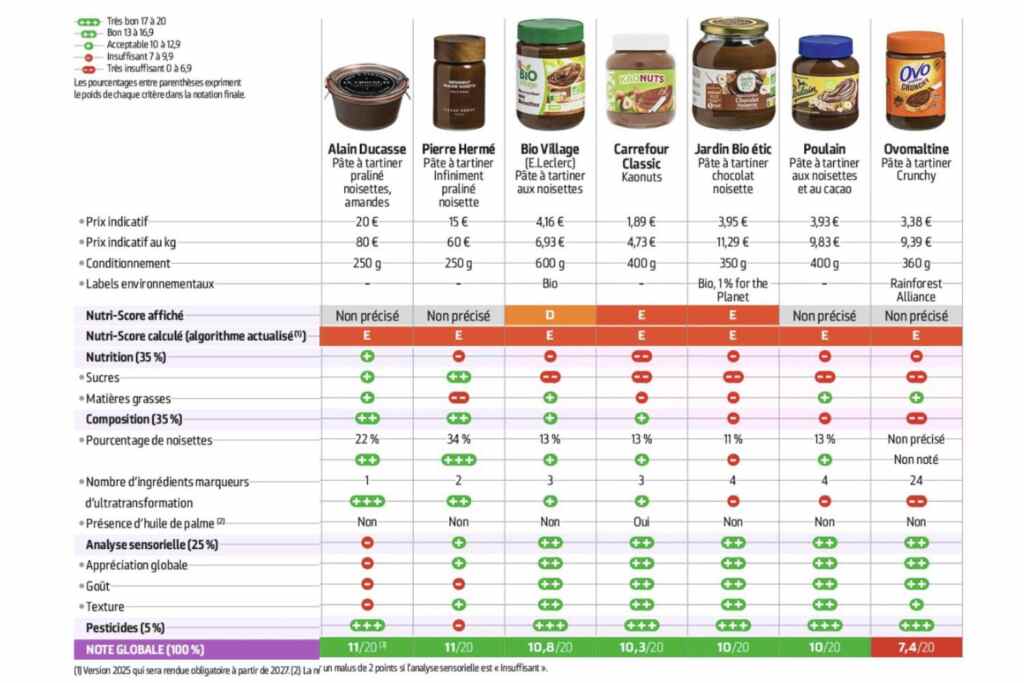
A recent test conducted by 60 Millions de Consumersthe French consumer magazine, compared 15 jars, some typical of the French market, others also distributed in Italy, to understand differences and similarities between the various references.
In fact, the world of spreads is an ever-expanding universe: there are over 70 varieties in France alone, where famous brands such as Lindt, Bonne Maman and a myriad of organic, vegan and palm oil-free alternatives crowd alongside Ferrero’s Nutella giant. But what is really hidden in these jars?
The nutritional profile of spreadable creams
An important element analyzed in the test was the nutritional profile, which considered in particular the quantity of sugars and fats per portion. A standard serving of 15 grams of spread, about three teaspoons, can provide up to 8 to 17 percent of the recommended daily amount of free sugars, according to the World Health Organization.
Creams such as Nutella, Choco Nussa and Poulain are among the richest, with values close to the upper extreme, while Pierre Hermé contains slightly lower sugars.
On the fat front, the values vary less, with some creams reaching 8 grams per portion, others around 5, and only Funkie Veggie Bio stands out for being free of added fats.
Applying the Nutri-Score, the traffic light nutritional labeling system adopted in several European countries which classifies foods from A (best) to E (worst), almost all the creams analyzed obtain an E rating, the lowest. This score reflects the high sugar and fat content that characterizes this category of products.
The ingredients
In addition to nutritional values, the test analyzed the quality of the ingredients, a parameter often overlooked by consumers.
Almost all creams have sugar as the first ingredient, with a few exceptions such as Pierre Hermé and Funkie Veggie Bio. The percentage of hazelnuts, however, varies considerably: Pierre Hermé contains up to 34%, while many other creams are around 13%.
The origin of hazelnuts is also rarely indicated; in the case of the French brands that declare it, they come from Lot-et-Garonne, while elsewhere they are probably imported from Türkiye, the world’s main supplier.
Vegetable fats are another sticking point. Palm oil has been penalized for its environmental impact, better those brands that use more neutral oils such as sunflower, rapeseed or complex blends of vegetable oils, sometimes in combination with shea butter.
In the end, considering everything, I am “compositions that leave much to be desired“, write the French experts.
What about pesticides?
Another parameter considered was the possible presence of pesticides in hazelnuts, a topic of growing attention among consumers. The results are reassuring: almost all the products were free of residues, except for the Pierre Hermé cream, in which a residue of fluopicolide, a fungicide authorized in the EU, was detected.
The ranking of spreadable creams
Despite sugars, fats and industrial ingredients, the overall ranking of the test is not as dramatic as one would expect. Most of the products ultimately obtained a green score, considering all parameters, indicating that, if consumed in great moderation, these creams are “acceptable”. Only one can received a red rating (7.4 points).
However, it should be noted that if only the Nutri-Score were considered, practically all creams would be rejected. By applying the new algorithm in force since March 2025, which is more severe especially on sugars, almost all products receive an E rating, the lowest. The only exception is Funkie Veggie Bio.
The test of 60 Millions de Consumers instead it used a more detailed evaluation, also considering other factors such as the percentage of hazelnuts, the presence of palm oil, industrial ingredients and pesticide residues, to give a more complete and less drastic picture.
In the end, the best spreadable cream turns out to be Lindt with a score of 13.1 out of 20, Rigoni D’Asiago gets 12.4 points, Nutella is even lower with 11.4 points.
The worst cream, with only 7.4 points, is Ovomaltine.