
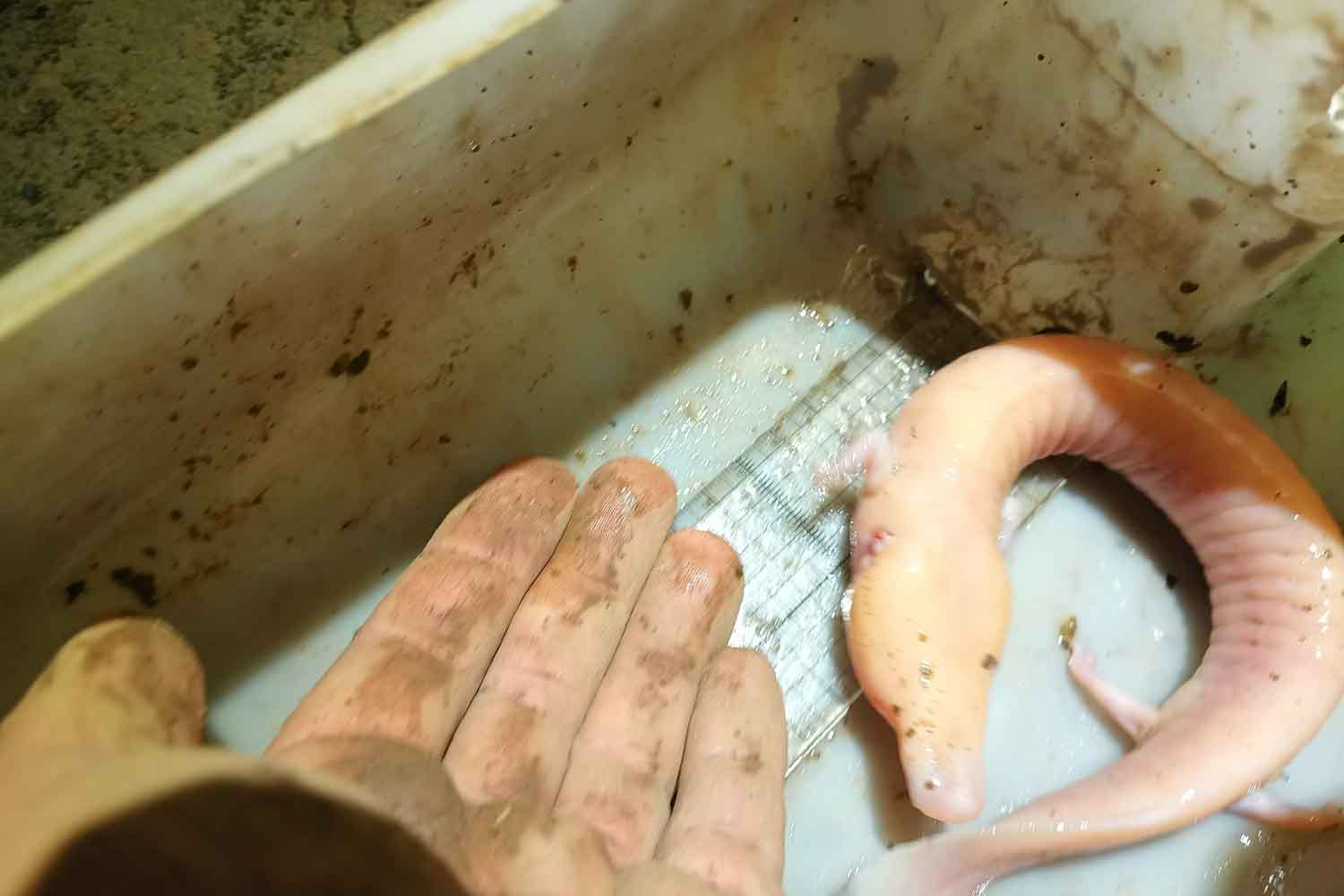
To look at it, it seems fake, a rubber puppet for children, but it is actually the cave amphibian par excellence, the proteus. And in recent months a truly exceptional one has been discovered, already classified as the largest in Italy.
Indeed, the Proteus anguinus is one of the most curious animals on the planet with its skin devoid of pigmentation, its eel-like body and practically no eyes. So much was the surprise of some speleologists from the Adriatic Speleology Society to find themselves face to face with such a large specimen of its species inside the Luftloch Cave, in the Trieste Karst.
A fragile and very ancient animal
The protagonist of this story, a Proteus anguinus, is not just any animal. It is blind, pale as chalk and only lives where the water is really clean. The specimen discovered in the new branch of the Timavo river is 31 centimeters long and weighs around 100 grams, an unusual size, almost surprising for a species which, generally, reaches much smaller dimensions.
The speleologists saw it move slowly in the dark water, and its weight was already felt in the net. For those who have studied these environments for years, such a large proteus is a precious clue: it means that that underground ecosystem, despite being among the most delicate in Europe, is holding up well to the impact of the outside world.
It is an animal that can live up to 100 years, almost a living archive of the environmental history of the subsoil. If he is fine, everything around him is fine too. And that is exactly what scientists at the University of Trieste, who are coordinating a dedicated monitoring project, hope to confirm.
A discovery that tells how much we still don’t know about our subsoil
The Luftloch is not just any cave. It is one of the deepest accesses to the karst labyrinth: tunnels dug by water, vertical wells, walls that tell millennia of geological history. Right here, after over twenty years of exploration and attempts, speleologists managed to reach a stretch of the Timavo that no one had ever documented.
Between the cold currents and the absolute darkness, lives a small community of organisms that have learned to survive without light, without colors, without noise. The proteus is the most powerful symbol of this hidden world, almost a miniature “dragon” that nature has sculpted to adapt to eternal darkness.
That such a large specimen was able to thrive right here is a strong message, almost an invitation not to take these environments for granted which, despite being out of our sight, directly depend on what we do on the surface.
You might also be interested in:
