
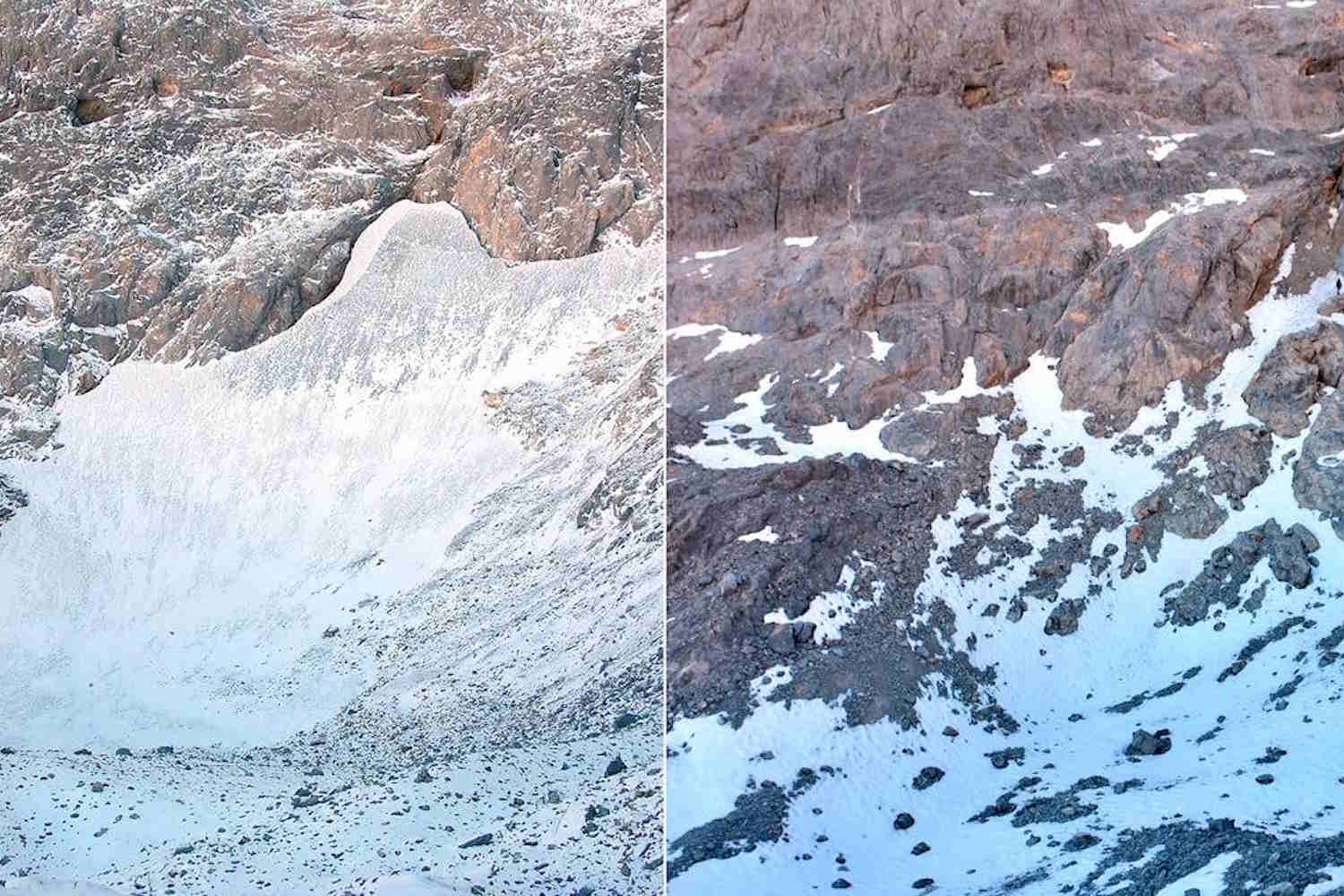
For centuries it was a small glacial pearl nestled among the rocks of the Picos de Europa. Today, all that remains of the Trasllambrión glacier is a patch of dying ice. What has survived harsh winters and difficult summers for generations has been defeated by global warming: the last glacier in the province of León, Spain, has officially disappeared.
Scientists talk about “heat death”: not a metaphor, but a precise diagnosis. The ice no longer moves, it does not regenerate, it does not flow. It melts slowly, summer after summer. It is the same fate that has already struck other glaciers in the Cantabrian Cordillera and which now looms over those of the Pyrenees, from Aneto to Monte Perdido.
The Trasllambrión once occupied about 10 hectares. Today less than half remains, fragmented into small remnants that can no longer be defined as a glacier. Field research, supported by historical photographs and satellite surveys, confirms that it is now just residual ice, a relic of the Little Ice Age.
The geographer has been documenting this decline for years Javier Santos from the University of León, which has been monitoring the area since 2004 together with the Geopat (Geomorfología, Paisaje y Territorio) Research Group, which has been following its evolution for two decades with aerial photographs, satellites and field work. The data tell a clear story: after a slow decline in the twentieth century, fusion accelerated from the 1990s onwards. A brief illusion of stability between 2009 and 2020, due to snowy winters, was swept away by increasingly hotter summers and insufficient snowfall.
In 2023, just two patches of ice remained. In 2025, what survives under the Torre del Llambrión no longer has the minimum characteristics to be considered a glacier. It’s dead ice. But this loss is not an isolated case. Glaciers are natural thermometers of the planet: they react quickly to climate changes. And this is why the situation in the Pyrenees is equally alarming. In just one season, some glaciers lost up to four meters of thickness. Aneto, the largest Spanish glacier, has broken into several parts and some of them have already been reclassified as simple ice fields.
Where once there were 52 glaciers, today just over a dozen remain, many of which are destined to disappear within a few years. Modern technologies – drones, LiDAR, 3D models – leave no room for doubt: many of these glaciers have passed the point of no return.
The disappearance of the ice is not just a symbolic loss: it changes the water cycle, increases the instability of the slopes, transforms high-altitude ecosystems and erases a natural heritage that has shaped the landscape for thousands of years. Where there was ice, there are now screes, landslides and a silence that speaks of the climate changing too quickly.
The Trasllambrión was the last glacial memory of León. Its end reminds us that global warming is not an abstract concept: it has precise names, places and histories. And it is taking place before our eyes.
