
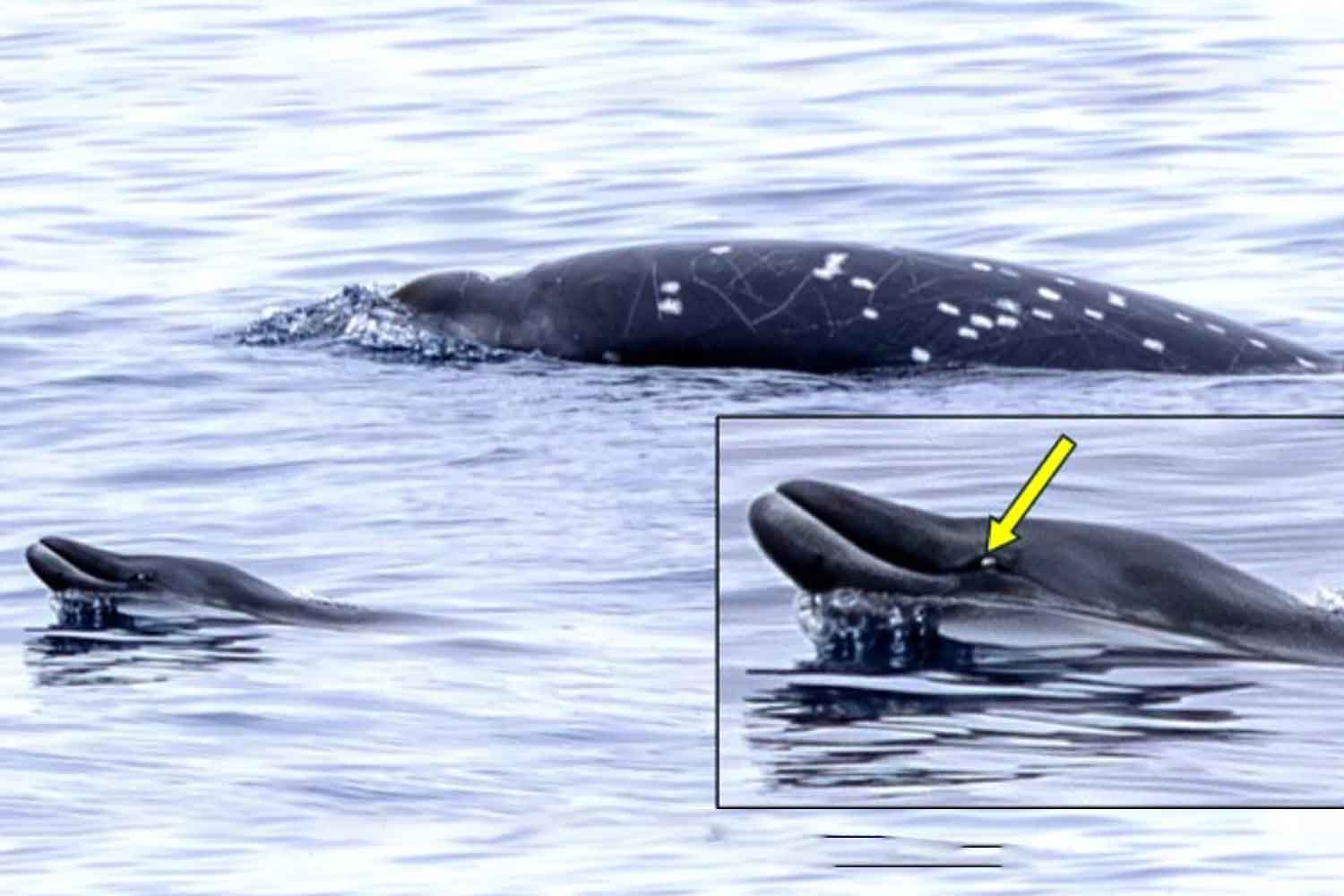
Sometimes nature decides to surprise us just when we consider it already mapped, studied, translated into numbers and graphs. And instead, off the coast of Baja California, in Mexico, an international group of researchers has immortalized something that for decades seemed unattainable: live specimens of the Nishiwaki mesoplodon, a very rare beaked whale, known until now only from a few beached corpses.
These animals, which exceed five meters in length, had never been observed alive in the open sea. They are creatures that emerge on the surface only for an instant, then disappear again into the deepest blue, as if the ocean jealously guards them. They are beaked whales, a family already shrouded in mystery: deep-diving cetaceans, shy, almost allergic to human presence.
Their English name, ginkgo-toothed beaked whalederives from a unique physical detail: a protruding tooth that resembles the leaf of the ginkgo biloba tree, an evolutionary curiosity that has always fascinated the scientific community.
The BW43 signal and the turning point after years of attempts
The team that created this small scientific miracle was made up of biologists from the Naval Information Warfare Center (United States), the Marine Mammal Institute of Oregon State University and Mexican researchers belonging to CONANP, University of Baja California Sur and other local projects.
Their story begins in 2020, when hydrophones recorded an unmistakable sound: an echolocation signal called BW43, attributed for years to a species never seen alive, the Perrin mesoplodon. That sound becomes a lead, a clue to follow. But each expedition ends without results, with the sea continuing to be silent.
Then, in 2024, everything changes. The research vessel Pacific Storm, equipped with advanced acoustic instruments, intercepts BW43 again. The scientists follow the sound like a thin thread leading through the water, and eventually find it: a group of beaked whales on the surface. A fragile, almost unreal presence.
The time to take photos, take tiny fragments of skin using a special crossbow, and the confirmation comes from the analyses: it is not Perrin’s mesoplodon. It is indeed him, the Nishiwaki mesoplodon, the ghost of the Pacific that until now no one had ever seen alive.
Among the individuals identified there are: an adult male with deep scars probably due to shark bites, an adult female accompanied by her calf and some young specimens. The color is dark, with a head that is lighter than the back and particular spots around the eyes that frame them like natural makeup.
Seeing them alive finally allows us to distinguish the fundamental traits of the species, avoiding the identification errors that have confused researchers for decades. Now those shapes, those colors, those scars are no longer simple descriptions on paper: they are real, living testimonies.
The beaked whales, lords of the abyss that no one knows
As naturalist Luca Bittau of Sardinia SeaMe explained, beaked whales don’t leave many clues. They are among the least studied marine mammals in the world, because they live far from the surface, dive deeper than even sperm whales and react to the noise of boats by disappearing without leaving a wake.
In the Mediterranean, for example, very little is known about their seasonal distribution. There are only a few continuous observation points, such as the Caprera Canyon, where Bittau documented two sightings of Sowerby’s mesoplodon, a very rare species here too.
The history of beaked whales is always the same: few observations, enormous technical difficulties, unknown populations, acoustic identities to be deciphered. This is why the discovery in Baja California is not simply a lucky sighting, but a real missing piece of cetacean biology.
Because this discovery is also important for conservation
Observing a species live means finally understanding its behavior, social interactions, real coloration, scars, body structure. And above all it means being able to identify the areas in which it really lives, which are essential for protecting it.
Beaked whales are particularly sensitive to noise, military sonar, and underwater explosions used for geological exploration. Knowing where they are is the only way to reduce risks. Now that researchers have confirmed that BW43 belongs to the Nishiwaki mesoplodon, it will be possible to map the species even without seeing it, using hydrophones distributed in various areas of the ocean.
Scientists have been saying it for years: the ocean hides even more mysteries than we can imagine. The Nishiwaki mesoplodon is living proof of this, literally. And perhaps, after this first historical observation, we will finally begin to really get to know this cetacean which for over half a century has existed only as a shadow on the beaches and as a name in an old scientific article.
You might also be interested in:
