
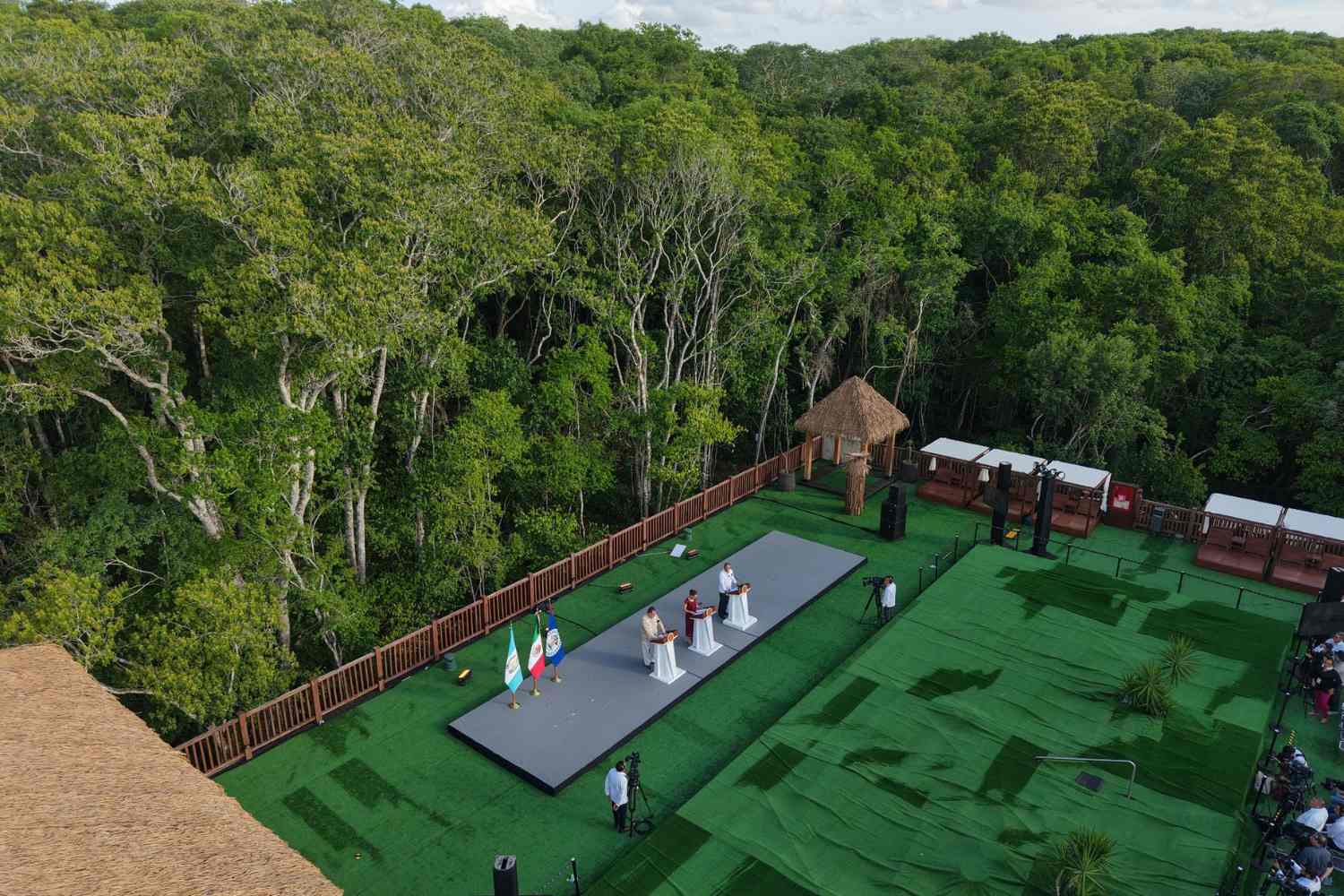
Three leaders – Claudia Sheinbaum for Mexico, Bernardo Arévalo for Guatemala and Johnny Briceño for Belize – announced, on August 15, the birth of the biocultural corridor of the great Mayan forest: 5.7 million hectares that become the second largest protected tropical area of the Americas, immediately after the Amazon.
En un reunión Histórica, nos unimos los jefes de estado de belice, guatemala y méxico para Crear el biocultural gar -wild account, que integrate 5.7 millones de hectáreas de forestical, the Segunda Más Grande of the Después continent of La Amazonia.
Como Mencioné … pic.twitter.com/nye123vfu5
– Claudia Sheinbaum Pardo (@claudiashein) August 16, 2025
The corridor includes 27 areas protected in Guatemala, 11 in Belize and 12 in Mexico. This is a historical political decision that aims to keep not only extraordinary biodiversity – jaguars, tapirs, spider monkeys, quetzal – but also the cultural heritage of millions of Mayan descendants who still live in that area.
“We are not only protecting an ecosystem, but also honoring the legacy of civilization that once prospered in these territories,” said Belize Prime Minister Johnny Briceño.
With mucho enthusiasm anunciamos que méxico, guatemala y belice furman la declaración de calakmul: accompanying biocultural great forest maya. pic.twitter.com/qbhn7svkdw
– Claudia Sheinbaum Pardo (@claudiashein) August 16, 2025
Beyond political borders, a common frontier
The initiative has a value that goes beyond the environment: it puts three states on the net often crossed by political and social tensions. The threats are in fact common: deforestation, fires, pollution, organized crime.
As the Minister Guatemalca of the Environment Patricia Orantes pointed out, it is not just about saving the trees: “We are talking about the need for the Guatemaltec state to resume control of its territory”.
This detail says a lot: protecting the forest also means protecting the communities that populate it, providing economic alternatives to those who are now forced to collaborate with illegal traffickers or tagged. Soldiers are not enough, projects are needed that transform conservation into opportunities.
The risk of megaprogetti and the case of the Maya train
Just while the birth of the corridor was announced, the theme of the Maya train, the tourist railway line inaugurated in Mexico in 2024 and hardly criticized by activists and associations for the environmental impact, was returned to the table.
Arévalo was clear: any extension to Guatemala will not cross protected areas. But the pressure of megaprogetti remains. And it is here that the holding of the signed commitments is measured: solemn declarations are not enough if the development model continues to consume forests and communities.
Invisible custodians and daily responsibilities
A central point of the agreement is the recognition of local communities as “custodians of nature”. Over 2 million people live in the forest, largely descended Mayan, who still practice traditional agriculture and subsistence activities closely linked to the environment.
According to the NGO RAINFOREST Alliance, in the areas where the communities played a direct role in the management, the deforestation rates have reduced up to 75% compared to the unchanged areas. This is the model that Mexico, Guatemala and Belize intend to strengthen: territories lived and managed together with the populations who live there.
The trintational agreement, therefore, is not only an operation of environmental protection: it also marks a political and social recognition of the role of the indigenous and Africaniscendant communities as a guarantee of the survival of the great Mayan forest.
Don’t you want to lose our news?
