
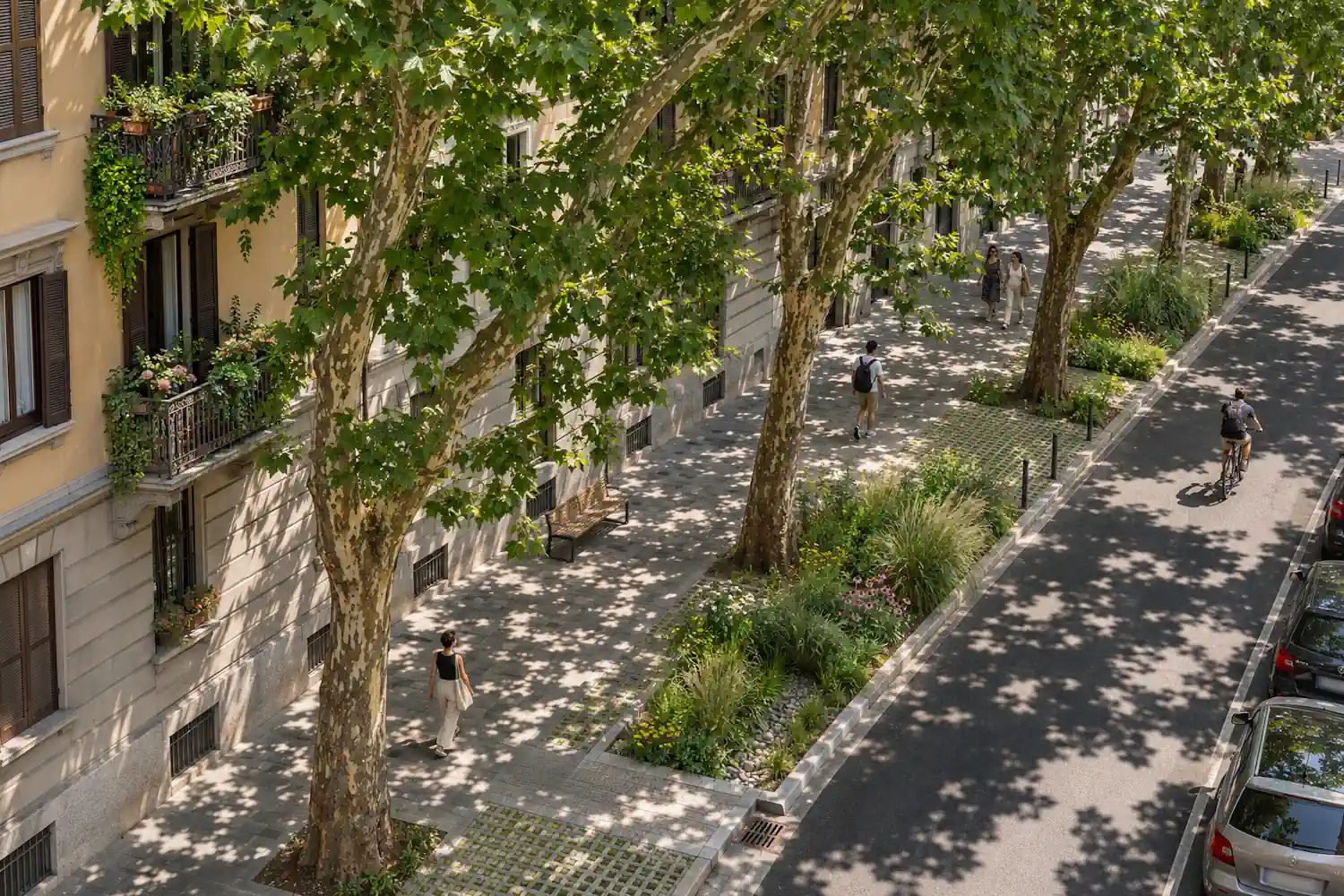
Summer is over, the heat is a memory and heat waves seem far away. It is precisely now, however, that cities should think about how to face the next one. Climate change is felt especially in the warmer months, but solutions must be prepared in advance. Waiting for temperatures to rise again means arriving unprepared.
A record-breaking summer, from Milan to Turin
The numbers for summer 2026 speak clearly. According to the National Research Council, it was the hottest recorded in Italy since 1950, with a national average temperature of 24.3 °C.
The data is confirmed in large cities. In Milan, according to the Milan Duomo Meteorological Observatory, the average summer temperature reached 28.3 °C, with 80 tropical nights. In Bologna the Arpae station in Piazza 8 Agosto counted 81: in 24 of these the minimum did not fall below 25 °C. Turin, with a seasonal average of 27.2 °C measured in the historic Via della Consolata station, even surpassed the 2003 record.
The question, then, is not just how hot it will be next summer. That’s how ready our cities will be to face it.
Depaving is just the first step
One of the strategies that is spreading is depaving: removing asphalt and concrete to return space to the natural ground. This reduces the surfaces that accumulate heat, rain is better absorbed and new green areas are created.
Even in Italy the topic reaches urban planning plans. In the spring of 2026 Genoa included it in its Municipal Urban Plan. The Municipality offers incentives to those who remove impervious surfaces and in exchange asks them to commit to maintaining the redeveloped areas.
Removing the asphalt, however, is not enough. This is underlined by Deerns, an engineering company that deals with urban design and resilience. Planting trees and creating permeable surfaces does not guarantee automatic results. Heat, drought and poor soil can compromise vegetation, especially in the first years after planting.
“The risk is to focus on how many square meters of asphalt are removed or how many trees are planted, without wondering what will happen after five or ten years”explains Mattia Mariani, Unit Director of Deerns Italia. For this reason, according to the expert, it is necessary to consider from the beginning the water needs, the maintenance costs, the life of the materials and the conditions that the plants need to survive.
@Deerns
The lesson of the oasis schools of Paris
A useful example comes from France. With the OASIS program, which started in Paris, school courtyards have been transformed into cooler spaces thanks to vegetation, permeable soils and solutions to improve the microclimate. Deerns Italia has studied some of these interventions, including the courtyard of the Jean Moulin school in Chaville, just outside Paris.
An often overlooked problem has emerged from the French experience. During the summer holidays schools close, and often there is no one left to take care of the trees every day. It is precisely the period in which young trees need water the most. If this is not foreseen already in the design phase, the entire intervention risks being skipped.
“Outdoor space must be designed as a service that lasts over time”comments Mariani.
Water, maintenance and monitoring
What, then, is needed to make cities truly more resilient? According to experts, an integrated design that takes into account the climate of the coming decades and the entire life cycle of the interventions. In practice:
For public administrations, the challenge is to overcome the logic of individual isolated interventions and focus on continuous climate adaptation programs, in which planning, care and verification are part of the same path.
“Making a city resilient does not just mean transforming it today: it means creating the conditions so that interventions continue to work and protect people even in ten or twenty years’ time”concludes Mariani.
Next summer seems far away, but the time to act is now.
