
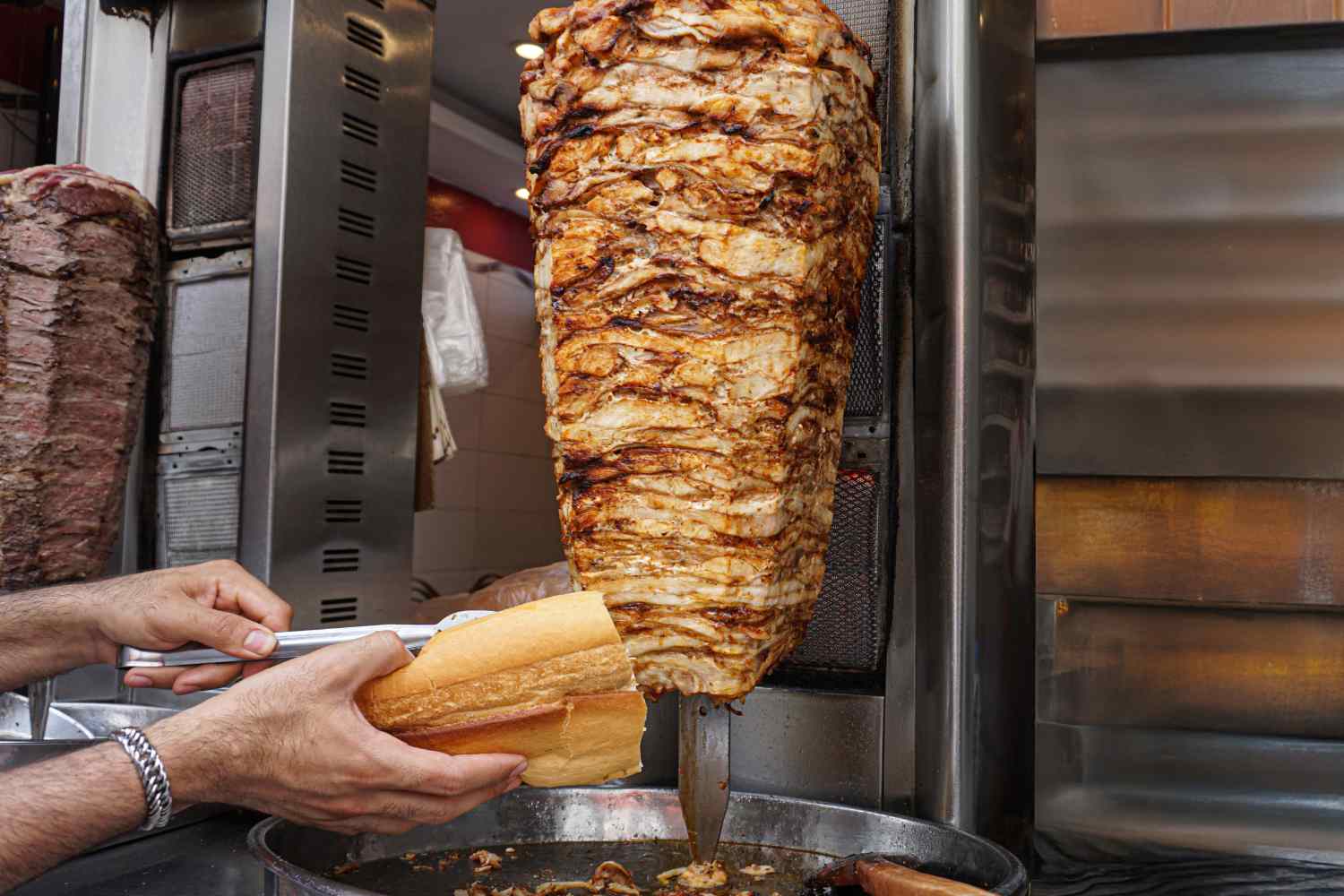
Kebab is a traditional dish that has deep roots in Middle Eastern cuisine, but its popularity has grown enormously around the world, becoming one of the most consumed fast food foods. However, its history and preparation are much more complex than what is often perceived. In its most authentic version, kebab is a dish prepared with meat slowly roasted on a vertical skewer, but today its production has become a real food industry.
The origins of the kebab
The term “kebab” derives from the Arabic word “kabāb”, which means “grilled meat”. The dish originated in the Middle East, with variations found throughout Turkey, Iran, Lebanon and other surrounding regions. Traditional kebab preparation involves the meat, usually lamb or beef, being skewered on a skewer and cooked slowly over an open fire. In Turkey, kebab is an iconic dish, with different variations depending on the region, such as döner kebab, grilled kebab (şiş kebap), and Adana kebab, which is prepared with spicy lamb meat and grilled on skewers.
The industrial production of kebab
Today, however, kebab production has taken a decidedly industrial turn. This dish, which was once a gastronomic pleasure prepared with fresh meat and cooked on the spot, has become a processed product, especially in restaurants and fast food outlets serving low-cost kebabs.
How kebab is made
Kebab production follows an industrial path that is anything but transparent. Contrary to the image of a genuine food, many kebabs begin their life from meat processing waste. Big companies, aiming to maximize profits, use second-rate materials: bones, tongue, fat, and even less noble parts such as eyes and brains are mechanically minced until they obtain a sort of mush.
This base is then “ennobled” through the addition of salt, spices and a series of chemical additives. The aim is twofold: to make the product attractive and to guarantee it a very long shelf life. The final result takes shape around a steel skewer, is frozen and distributed in points of sale.
How to choose kebab if you really have to eat it
But not all kebabs are the same. There is a substantial difference between low quality products and more refined preparations, and the attentive consumer can learn to recognize them.
Consider the price
The first element to consider is the price, a kebab for just 3-4 euros is almost certainly a poor quality industrial product, rich in preservatives and prepared with leftover cuts of meat. On the contrary, a kebab that costs between 8 and 10 euros generally represents a more conscious choice, made with selected meats and more accurate processes.
The composition
Composition is another crucial factor, a traditional kebab should contain mainly meat – usually a mixture of chicken, turkey or veal – with very few other ingredients added. When you are faced with a kilometric list of ingredients, with starches, sugars, preservatives and stabilizers, it is a clear sign of a highly processed product.
The look
The visual appearance can reveal a lot about quality, an artisanal kebab clearly shows the individual pieces of meat skewered along the skewer, following the Turkish tradition. If, however, it appears as an indistinct mass, it is likely that it is a totally industrial product, where the meat has been minced and recompacted.
Consumer awareness is the key to making more informed food choices. Observing, asking and reading labels are not just acts of curiosity, but of responsibility towards oneself and one’s health.
Kebab remains a loved, quick and tasty dish, but as with many modern restaurant foods, the quality can vary enormously. The difference lies in paying attention to details and choosing consciously.
We also recommend:
