
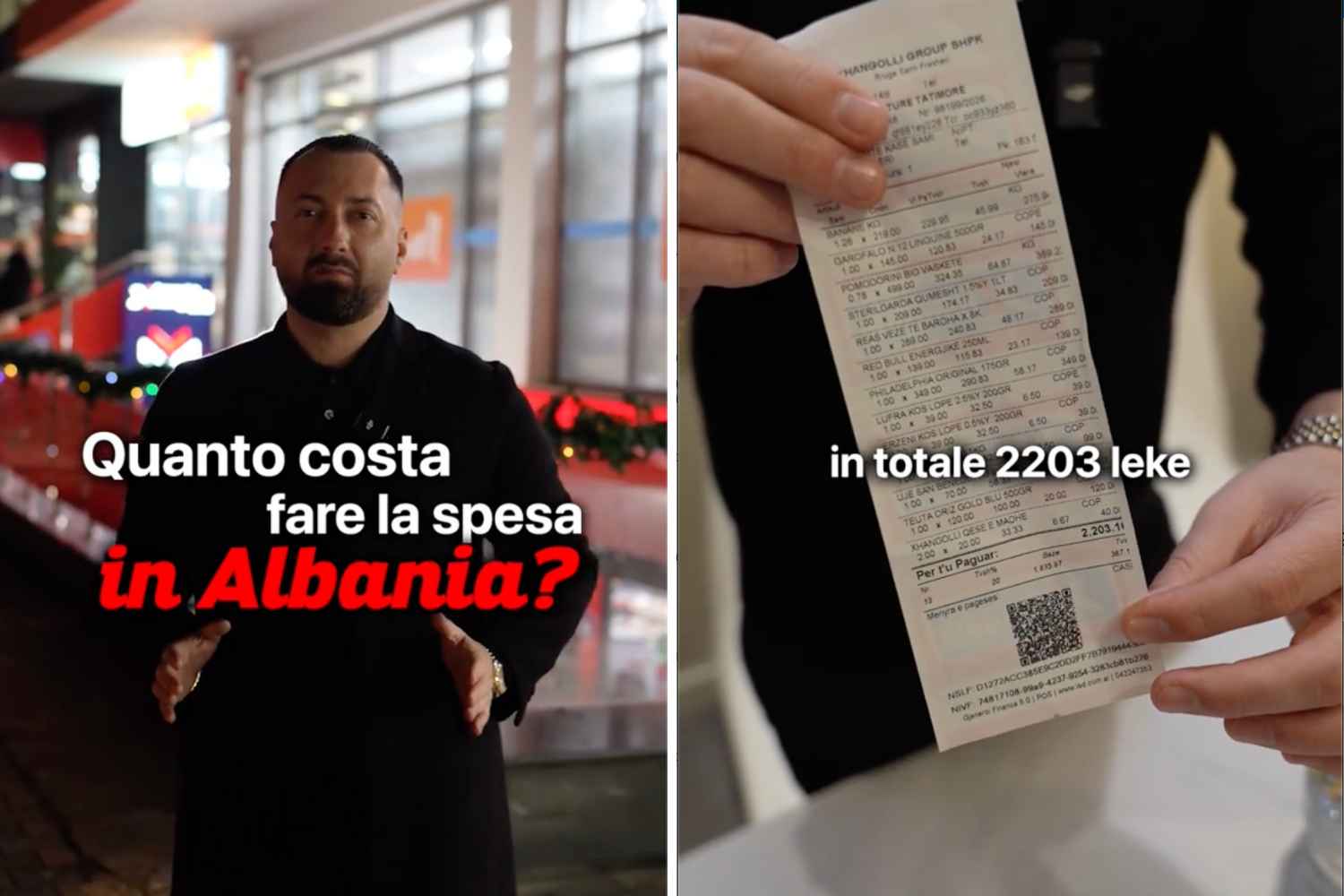
When talking about the cost of living in Albania, we often fall into the trap of directly comparing prices with Italy, forgetting a crucial element: the local economic context. The international tax lawyer Egli Haxhiraj documented an expense of 22 euros in Tirana, but a more careful analysis reveals a more complex reality than it might seem.
Albanian prices
The shopping shown in the Giangoli supermarket, in the Blloku district of Tirana, amounts to 2,203 Lek (about 22 euros). To an Italian this figure may seem advantageous, but for an average Albanian the situation is very different. The problem does not lie in absolute prices, but in the relationship between these and local salaries.
The reality that emerges is surprising: many products in Albanian supermarkets are even more expensive than in Italy. Only some items such as rice and yogurt maintain truly competitive prices. Albanians face this contradiction every day: shopping in a modern supermarket can cost as much, if not more, than in Italy.
The prices of local products
Albanian products have particularly competitive prices: bananas, per 1,260 kg, cost 2.75 euros. Cherry tomatoes, in a one kilo package, can be found at 3.89 euros. The eggs, in packs of six, are priced at 2.40 euros. Rice, per kilo, costs just 1.20 euros. Even energy drinks such as Red Bull are accessible at 1.40 euros. Yogurt from the local brands Lufra and Erzeni can be purchased for 0.90 euros.
Italian products
Those who live in Albania and wish to continue consuming Italian products must take into account a surcharge. Albania is not part of the European Union, so products imported from Italy include transportation costs and customs duties.
500 gram Garofalo linguine costs 1.20 euros, San Benedetto water 0.58 euros, one liter Stilgarda partially skimmed milk 1.74 euros, one kilo Divella flour 0.82 euros, while the original Philadelphia costs 2.90 euros.
Despite the surcharge, many of these products remain accessible and are often cheaper than Italian prices, even considering import costs.
An expense of basic products
A crucial aspect concerns the type of products purchased. The shopping mainly includes basic and low-cost items: bananas, cherry tomatoes, eggs, rice, yogurt. There is a complete lack of medium-high range products such as quality meat, Parmigiano Reggiano, mature cheeses or fine sausages.
When considering these products, the situation changes radically. Italian DOP cheeses, quality cured meats and fine meats in Albania have prohibitive prices, often higher than Italian ones due to customs duties. For an Albanian with an average salary of 400-500 euros per month, these products become luxury goods accessible only occasionally.
Geographical differences
The geographical distinction is also interesting: Tirana is paradoxically less expensive than coastal cities such as Vlore or Durazzo. This phenomenon is explained by the greater offer and competition present in the capital.
In coastal cities, seasonal tourist demand inflates prices, making daily life more expensive for residents. Those living in Vlora or Durres may find themselves paying more for the same products available in Tirana.
The true cost of living
The central point emerges clearly: 22 euros of spending in Albania does not represent a significant advantage when compared with Italy in absolute terms. The difference is barely noticeable for those who come from abroad with a European salary, but it is dramatic for those who earn an Albanian salary.
With an average salary of 400-500 euros per month, spending 22 euros on a basic expense means committing approximately 5% of your monthly income to a single purchase. If you consider that Albanian families shop several times a month, the food budget can easily absorb 30-40% of the salary.
For an Italian moving to Albania while maintaining an Italian salary or working remotely, the prices may seem advantageous. But this perspective ignores the reality of the majority of the local population.
Imported Italian products cost more than in Italy. Local alternatives, when available, may be cheaper but often of lower quality. High-end products remain a luxury. In essence, an average Albanian has significantly lower purchasing power than an average Italian.
@he.haxhiraj
The cost of living in Albania
The cost of shopping in Albania is a complex issue that cannot be reduced to simple numerical comparisons. Prices in Albanian supermarkets are often comparable to Italian ones, sometimes even higher, but salaries are drastically lower. Only specific products such as rice and yogurt offer a real economic advantage.
For those considering a transfer, it is essential to look beyond the absolute numbers: daily spending really tells more than a thousand statistics, but you need to know how to read it in the right perspective. Albania can represent a saving for those with a Western salary, but for the local population shopping means facing European prices with salaries from a non-EU country.
