
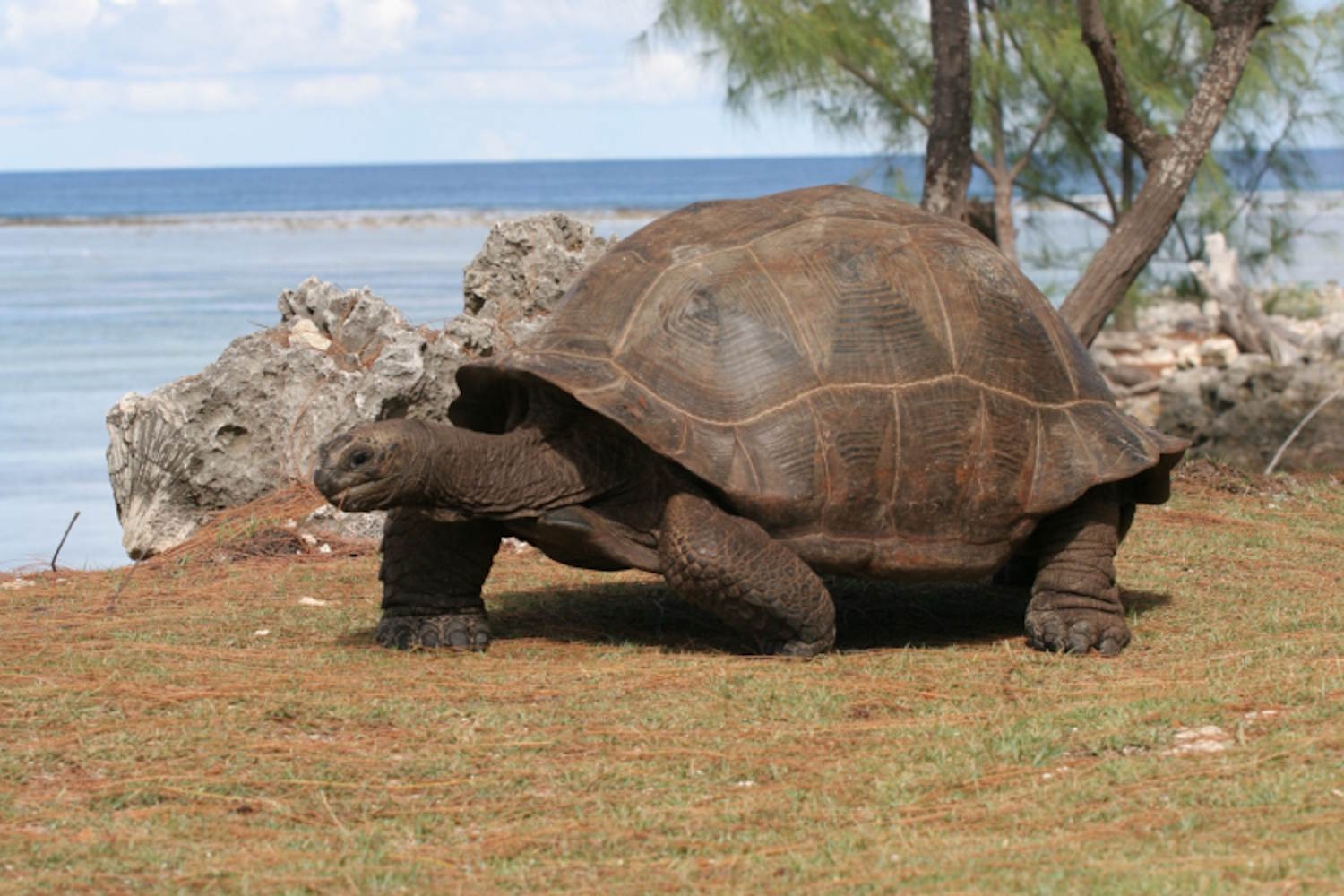
Incredible and wonderful news for biodiversity comes from the Seychelles archipelago: according to a study led byUniversity of Exeter (United Kingdom) in collaboration with Seychelles Islands Foundation (SIF) on the atoll of Aldabra approximately 180 thousand giant tortoises live there. It is the highest figure ever estimated in the area.
The giant tortoises of the Seychelles
These animals are on the Red List of the International Union for Conservation of Nature (IUCN) as vulnerable species according to criterion D2, i.e. that relating to species that occupy very limited areas of the planet or identified as at high risk of worsening the situation.
In fact the archipelago of Seychellesand in particular the atoll of Aldabrais one of only two places in the world where giant tortoises are found in the wild.
The other population, much smaller, lives at Galápagoswhere a project is underway to reintroduce them particularly on the island of Floreana.
Wonderful news for biodiversity (and how the study was conducted)
This news is therefore particularly beautiful and gives hope: the population on the atoll of Aldabraaccording to the latest estimate, in fact, has around 180,000 individuals – the highest figure ever recorded for the species.
The new data was obtained by the team by analyzing turtle counts carried out over five years, between 2018 and 2022, and is the first rigorous estimate of the entire population of the atoll and the first update from the oft-cited figure of 100,000 specimens dating back to the late 1990s.
The monitoring data for this study was collected by SIF staff who live and work on the atoll, year after year – explains Frauke Fleischer-Dogley, co-author of the research – Over 180,000 giant tortoises roaming freely on our atoll demonstrate what can be achieved with a long-term commitment to conservation. This is wonderful news for Seychelles, for the world and for all those who have worked to protect Aldabra
©Ecology and Evolution
What the research has shown and what is important to do now
The study also found that the population remained relatively stable over this period, with a most likely estimate of nearly 183,000 adult and juvenile turtles. This figure exceeds the human population of Seychelles and marks a clear departure from the most critical moment experienced by the species in the 19th century, when intense exploitation reduced the number of tortoises Aldabra to less than 1,000 individuals.
Their recovery, favored by the protection measures introduced when Aldabra It became a full nature reserve in 1981 and a UNESCO site in 1982. It represents one of the greatest conservation success stories in the Indian Ocean, and the new study confirms this important achievement.
The Aldabra giant tortoise monitoring program is one of the longest-running in the region, but the dense vegetation of the atoll sometimes makes it very difficult to count them – says Nancy Bunbury, co-author of the study – By developing models that take into account both sighted and undetected specimens, we have obtained the most reliable reference estimate ever made for this symbolic species of the Seychelles, establishing a fundamental parameter for monitoring the population in the decades to come
The researchers point out, however, that the new overall figure does not imply that the population has almost doubled since 1999: in fact the previous surveys did not count the turtles present but not seen by the operators, because they were hidden in the dense vegetation or in the shade.
The new study instead employed an advanced statistical technique, known as Bayesian hierarchical distance samplingcapable of correcting the data taking into account the undetected animals and the different visibility conditions in the various habitat Of Aldabra.
Since previous methods probably did not identify all specimens, the study therefore suggests that past numbers were underestimated, but it can still confirm real population growth, which appears healthy and stable today.
It also emerged that tortoises reach the highest density in the Aldabra grasslands, followed by exposed open areas and open mixed scrub areas. It was more difficult to spot turtles in habitat characterized by thick scrub, mangroves and Pemphis: it is precisely in cases like these that the new statistical models allow us to compensate for the reduced visibility.
But it’s not over, the giant tortoises are not definitively safe: the climate of Aldabra is changing, with longer and more frequent droughts forecast which will reduce the shade and available food resources, while the rise in sea levels threatens the areas of the atoll located at lower altitudes.
Invasive mammals also represent a fundamental threat: the goats that have returned feral, which had devastated the atoll’s vegetation until 2012, have now disappeared, but cats and black rats continue to prey on the turtles’ eggs and hatchlings.
These results are great news for turtles and are testament to the fantastic work being done in the field,” concludes Dave Hudson, who helped develop the statistical model used to analyze long-term monitoring data and estimate population size. “However, it is important to remember that these numbers are a starting point, not a final goal. We hope to have provided conservation managers with the insights they need to monitor future changes and intervene early as turtles face increasing pressures from climate change, drought and invasive species
The work was published on Ecology and Evolution.
Sources: University of Exeter / Ecology and Evolution
