
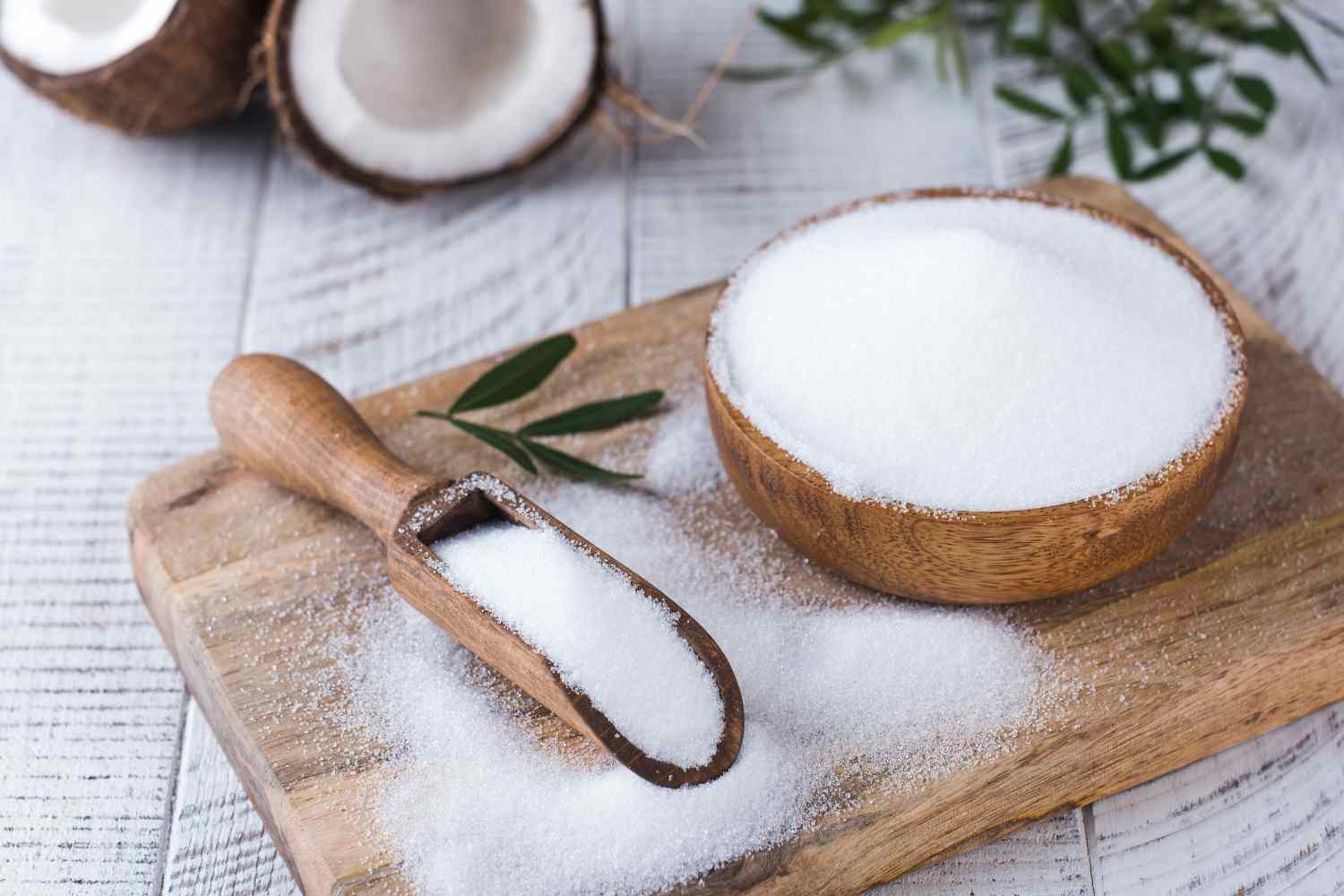
Eritritolo is a natural sweetener considered a valid alternative to sugar but is it really so? We asked for an opinion to “our” nutritionist.
Among the alternative sweeteners to sugar there is increasingly spoken of Eritritolo, a natural variant that is obtained mainly from some vegetables and fruit.
It has a consistency similar to sugar and also the color is equally white but, unlike the latter, in the face of a good sweetening power it has 0 calories and no aftertaste. Among other things, it can be used in cooking and therefore it seems to be perfect even in the preparation of desserts.
We asked the nutritionist Flavio Pettirossi what are the main characteristics of Eritritolo and if we can safely use it instead of sugar as part of a healthy diet. Here’s what he told us:
Eritritolo is a very valid alternative to sugar, it has excellent qualities and benefits and above all it does not affect the intestine. First of all, unlike artificial sweeteners (such as aspartame and acesulfame or natural such as stevia) erythritus is produced starting from the fermentation of sugars naturally present in fruit and other foods of vegetable origin (in some cases, however, it is obtained from the fermentation of sugary composites, such as sucrose, for the action of particular types of yeasts).
And as for the flavor?
It does not have a aftertaste as it happens precisely for artificial sweeteners or for stevia. This allows us to be able to use it also in the preparation of desserts.
What are the advantages of this natural sweetener?
Eritritolo has a sweetening power equal to 70% of the common sugar and difference of sucrose which brings 4kcal/g is without calories. Furthermore, it is not a cariogenic product, this is because it cannot be digested by the bacteria of our mouth, which therefore cannot feed on it to obtain energy and grow indiscriminately, contributing to the erosion of enamel and the formation of caries. This also makes it very useful for children. It is a vegan product, gluten free and has a very low glycemic index, which also makes it useful to those who follow a diet and for diabetics.
Are there possible side effects in its use?
The only side effect of Eritritolo is that if consumed in excessive doses it can have laxative effects, for this we try to limit ourselves to the maximum daily dose: for children it is 15 gr, for adults it is 20-35 g (about 0.5-1g per kg weight).
How to use it in the kitchen
Eritritolo can be used practically like traditional sugar, but with some care. It melts easily, resists high temperatures and does not alter the flavor of the preparations, which is why it is perfect for sweetening hot drinks, yogurt, creams and above all oven desserts. However, it must be remembered that it has a slightly lower sweetening power (about 70% compared to sugar), therefore to obtain the same sweetness it may be necessary to slightly increase the quantity. It can be sprinkled on cakes and biscuits, incorporated into the doughs or used to prepare glazes and meringues, without leaving annoying retrogusts. Furthermore, it does not caramelize as classic sugar: this means that, for example, it is not indicated to create crunchy crusts or caramels, but it works very well in almost all other home preparations.
Practical advice of use
To obtain the best results, it is important to use erythritolo with the right proportions and in the most suitable combinations. In raw preparations, such as smoothies, yogurt, creams and hot drinks, can be replaced with sugar in the same amount without particular problems.
In the oven desserts, however, it is better to slightly increase the dose to compensate for the least sweetening power and mix well to prevent them from remaining unwary crystals. Eritritolo combines very well with natural aromas such as vanilla, cinnamon and citrus peel, which enhance its sweetness without the need to add too many grams. It is better not to overcome the recommended daily doses, because excessive quantities can have laxative effects, especially in children and in those with sensitive intestine.
Recipes
Light biscuits at Eritritolo
Ingredients:
Preparation:
In a bowl you work the butter with the erythritus until a clear and creamy mixture is obtained. Add the egg and mix well, then incorporate the sifted flour with the yeast and lemon zest. The dough is working quickly until a homogeneous consistency is obtained, wrapped in plastic wrap and let it rest in the refrigerator for about 30 minutes. The pasta is spread, the biscuits are obtained with a mold and bake at 180 ° C for about 12-15 minutes, until the edges are starting to brown.
Sugar -free yogurt cake
Ingredients:
Preparation:
The eggs are mounted with erythritol until they become clear and frothy. The yogurt is joined, then the oil flush, continuing to mix. The sifted flour with the yeast and orange zest is added, mixing gently. The dough obtained is poured into a buttered and floured mold, then bakes in a static oven at 170 ° C for about 35-40 minutes, until the surface is golden and the cake is dry to the toothpick test.
Limone light cream
Ingredients:
Preparation:
The milk warms up in a saucepan together with the lemon zest, without bringing it to a boil. In another bowl you can work the yolks with the erythytal and the corn starch until a smooth mixture is obtained. The peel from the hot milk is eliminated and the liquid is slowly pour into the bowl, mixing with a whisk to avoid lumps. Everything is put back on the fire and cooks over a low flame until the cream thickens. It is left to cool covered with contact plastic wrap to avoid the formation of the skin. It is perfect for filling cakes or to be served by the spoon.
