
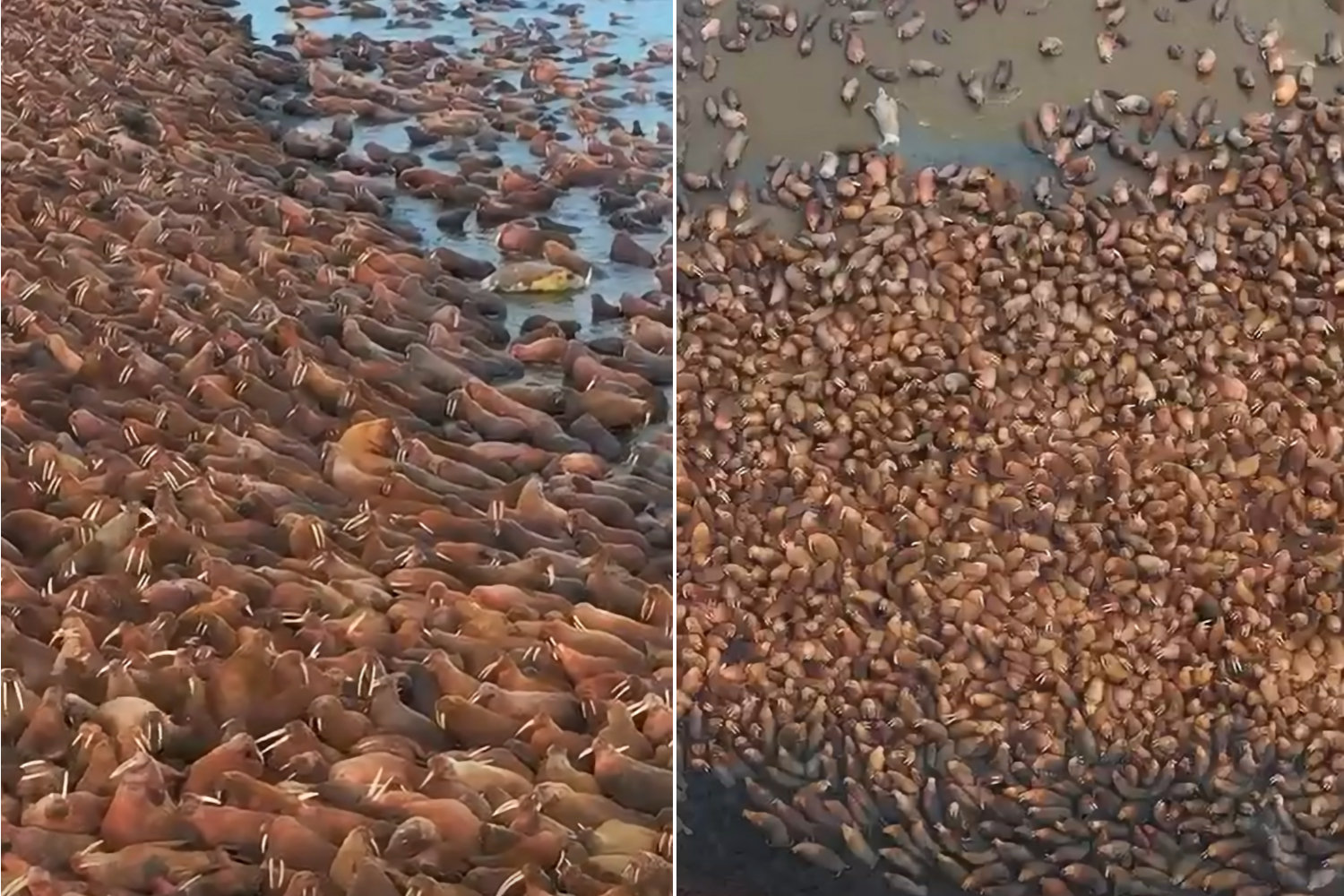
Every autumn on the barrier islands near the village of Point Lay, in northwestern Alaska along the Chukchi Sea, the largest concentration of fauna in North America occurs: over 200,000 Pacific walruses – in particular females migrating between Russia and Alaska, while the males remain in the Bering Sea even in winter – gather on thin strips of land.
As told by John Wros, Alaska director of the non-profit environmental organization The Conservation Fund: “It’s a real cacophony of life… it’s overwhelming to the senses“What has been pushing these animals out of the water in the last 20 years is global warming: after the summer, in fact, sea ice often retreats beyond the continental shelf, into waters too deep for walruses to feed on the seabed, forcing them to use the coast between northern Alaska and the Siberian coast of Russia as a resting base.
The danger of hasty escapes and the deaths of young specimens
However, living crowded together in increasingly restricted coastal spaces exposes walruses to a dramatic risk: a sudden noise or contact with a human presence is enough for a single individual to become frightened and trigger a mass flight towards the sea. In those excited moments, hundreds if not thousands of puppies remain trapped under the weight of the adults. Large animals need large landscapes to thrive, and the Pacific walrus is no exception, as Larry Selzer, president and CEO of The Conservation Fund, explained.
The agreement after 10 years between The Conservation Fund and Cully Corporation on 20,000 hectares
To reduce human disturbance and secure the coastal area, The Conservation Fund signed a ten-year preparedness agreement with Cully Corporation, the Alaska Native corporation that owns the land around Point Lay, ensuring permanent protection for approximately 20,000 hectares. The local community’s commitment to limiting invasive activities is counterbalanced by the organization’s financial support to strengthen economic stability and preserve the residents’ traditional lifestyle.
Questions about local monitoring and real-time adaptation
Some questions remain open about the concrete implementation of protection in the long term, such as the role of residents in the decision-making process, the protection of subsistence and access rights to the territory and the presence of lasting support for local monitoring and management. For John Wros, however, the agreement represents an indispensable response to the climate emergency already underway:
The damage is now done, and this is a form of real-time adaptation. This is what we have chosen to do to ensure the survival of these animals.
