
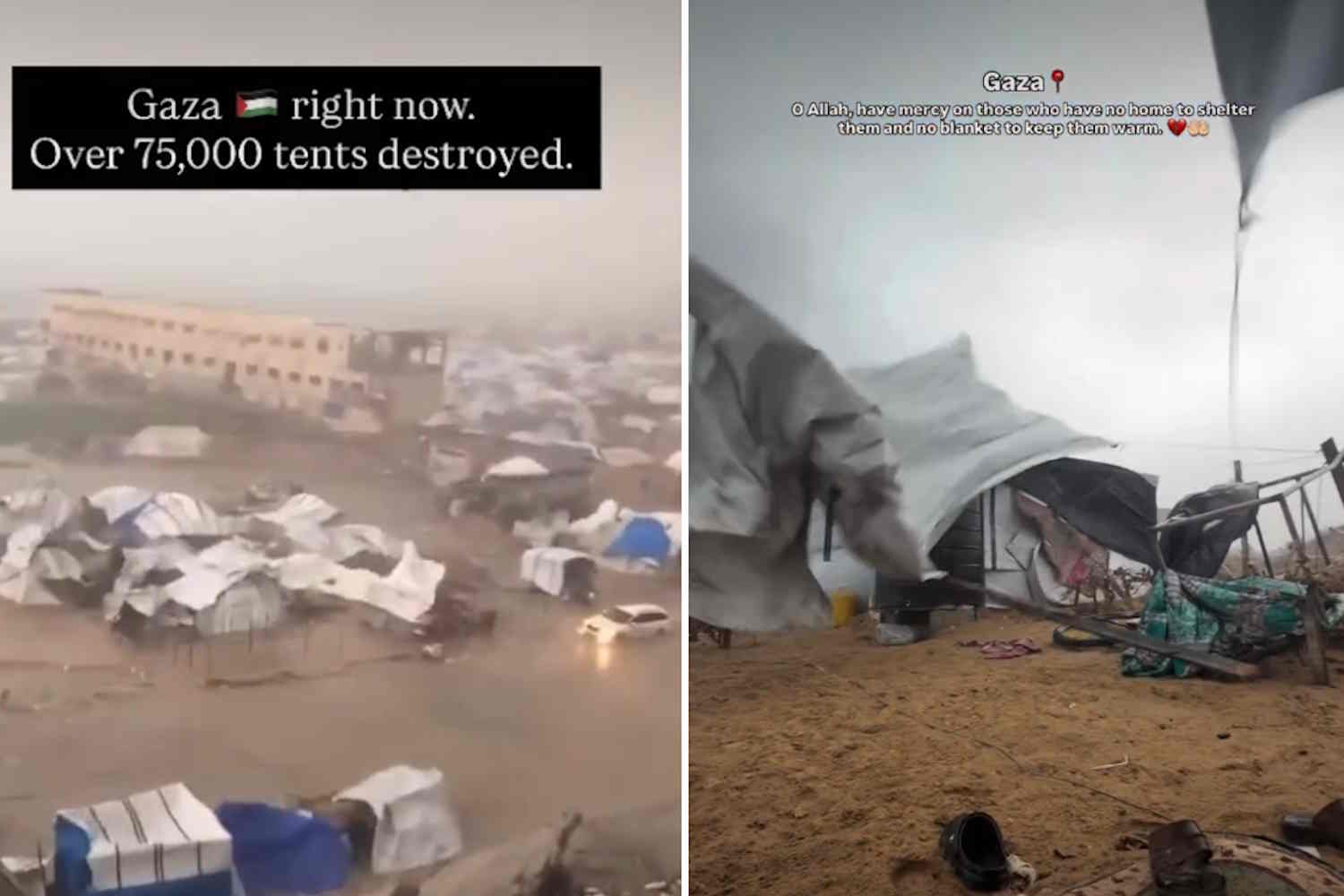
There are 70 thousand, but there could be many more, the tents hosting the displaced people torn down by the wind, torn by the torrential rains of a winter that has yet to begin. In Gaza, where the war has already taken away houses, schools, hospitals and entire neighborhoods, now water is also arriving, the one that enters everywhere, takes away what little is left, wets clothes and mattresses and soaks everything.
Between Friday 6 and Saturday 7 November, a violent disturbance hit the eastern coast of the Mediterranean, transforming the camps of the Strip into expanses of mud and stagnant water. According to the Hamas-controlled government press office in Gaza, at least 70,000 tents were flooded in just twelve hours. A toll that affects tens of thousands of displaced people and which, according to initial information, has caused several injuries.
View this post on Instagram
But in Gaza even the earth underfoot can become a threat: south of Deir al-Balah, a mass of sand collapsed on the tents of two displaced families. Five people died, including a woman and three children (the circumstances of the landslide, the five deaths and the names of the victims are attributed to the Palestinian newspaper Palestinian Information Center).
View this post on Instagram
And the worst is that we are only at the beginning of the rainy season. And every winter history repeats itself.
The water stagnating in the camps, while the lack of adequate sanitation, the cold and the impossibility of drying clothes and blankets increase the health risks for an already severely tested population. Added to all this is the danger of unstable terrain, caving slopes and dunes which, soaked in water, can suddenly collapse onto the tents.
View this post on Instagram
When even the sand becomes a death trap
It happened in the Ard al-Ribat camp, in the al-Baraka area, south of Deir al-Balah. A sandy slope suddenly collapsed, overwhelming the tents of two families who had found refuge there after being forced to abandon their homes.
أربعة شهداء جراء انهيار الرمال على خيام عائلتين من النازحين في مخيم أرض الرباط (حاووز البركة) بمدينة دير البلح، والشهداء هم:
1. الشهيدة/ تحرير نبهان "الأم" وأبنائها الاثنين صلاح ومريم
2. الشهيد الطفل/ صلاح أحمد خالد نبهان
3. الشهيدة/ مريم أحمد خالد نبهان
4. الشهيدة الطفلة/… pic.twitter.com/sZmgrbg8f7— الحـكـيم (@Hakeam) November 8, 2026
According to what was reported by the Palestinian Information Center, one of the tents housed a family who had fled from the north of the Strip. The parents and children were inside when the mass of sand buried them. Help arrived, but without the necessary means. Residents began digging with their hands to try to reach the trapped people, while the rain continued to fall and water invaded the camp.
Here even the sand has become a danger to defend against
Dunes, slopes and sandy escarpments extend along the western coastal strip of the Strip. With the destruction of entire neighborhoods and the lack of available spaces, thousands of people were forced to set up their tents even at the foot of these mountains, without knowing if the ground was stable.
The professor Abdel Fattah Nazmi Abdel Rabboan expert in environmental sciences, explained to the Palestinian Information Center that intense rains can penetrate the sand, increase its weight and, in certain conditions, reduce the stability of the slopes to the point of causing them to collapse. Loss of vegetation, earthworks and land modifications can also increase the risk.
The war has destroyed not only buildings and infrastructure, but has also altered the territory, damaging drainage systems and leaving thousands of families to live in places that have never been assessed from a safety point of view.
Obviously, according to Gaza Civil Protection spokesman Mahmoud Bassal, similar incidents could happen again. There are other tents and structures exposed to the risk of collapse, while there is a lack of both the tools to intervene and alternative accommodations to which to transfer the displaced.
Gaza doesn’t even have the means to free itself from the water
In Gaza there is a lack of safe houses and shelters, but also and above all the necessary means to deal with the flooding. Emergency teams, already put to the test by the war, find themselves having to intervene in submerged camps with insufficient equipment, very little fuel and a largely destroyed infrastructure network.
The municipal authorities and the Civil Protection of the Strip denounce the destruction, during the Israeli military operations, of hundreds of vehicles used for rescue operations, including bulldozers, excavators and water drainage vehicles. All indispensable tools for clearing the streets of rubble, digging drains, removing mud and preventing water from stagnating in the fields where displaced families live.
View this post on Instagram
They are also the same machines that would have been used in Deir al-Balah to try to reach more quickly the people who remained buried under the sand. Without these means, even a storm can turn into an emergency that is very difficult to manage. And without the ability to relocate, displaced people risk remaining exposed to the same dangers even after the rain ends.
Additionally, there are not enough adequate facilities to relocate people who have lost their shelter.
Second Mustafa Qazzaatmember of the Gaza City municipal council and emergency committee, at least 200,000 prefabricated homes are urgently needed to provide safer accommodation for displaced people, along with the bringing in of heavy machinery to remove rubble from bombed buildings, reopen major communication routes and restore essential services such as electricity and heating.
Yet, according to what Qazzaat himself reported to the AFP agency, since the announcement of the truce, Israel has not authorized the entry of prefabricated homes, only allowing the arrival of limited quantities of tents. The Israeli government has instead subordinated the start of reconstruction to the disarmament of Hamas and the movement’s renunciation of control of the Strip.
However, difficulties in the entry of aid are not only reported by the Palestinian authorities. The United Nations and the Norwegian Refugee Council (NRC), an international humanitarian organization, have also documented the restrictions and delays that hinder the arrival of the supplies necessary to face the winter.
In particular, the United Nations Office for the Coordination of Humanitarian Affairs (OCHA), in its report of 5 November 2026, reported that Israeli authorities continued to reject the entry of wood necessary for the construction of emergency shelters. As of the same date, according to the UN, only about 2,800 tents were available for distribution within the Strip.
The Norwegian Refugee Council had already raised the alarm on October 5, reporting that Israeli restrictions on materials intended for shelters, including some waterproof covers, were significantly slowing down the arrival of aid. According to the organization’s estimates, maintaining those procedures would have taken over seven months to bring in at least 500 trucks of shelter materials.
It is therefore not an absolute ban on the entry of tents, but a system of limitations, authorizations and delays which, according to humanitarian organisations, prevents them from responding promptly to the needs of an already homeless population.
A winter that risks being even more difficult
The same disturbance also caused flooding and power outages in several Israeli locations. In Binyamina, around 50 millimeters of rain fell in an hour, while in Tel Aviv 40 millimeters fell. The authorities ordered temporary road closures and issued flood warnings.
But in Gaza, where most of the more than two million inhabitants have been forced to leave their homes and live among rubble and makeshift accommodation, a rainy day can mean losing even the last shelter. And the tragedy of Deir al-Balah adds another terrible awareness that it is not enough for a tent to resist wind and rain if the ground on which it was set up gives way.
Experts ask us to identify the dunes and slopes at risk, evacuate the most exposed camps and find safe accommodation for families. But how can you save someone if there is nowhere to take them?
For those who live in the camps of the Strip, winter is a tragedy. Yet another emergency to try to survive.
Sources: Reuters / Al Jazeera / Palinfo / The Guardian / United Nations / Norwegian Refugee Council (NRC)
