
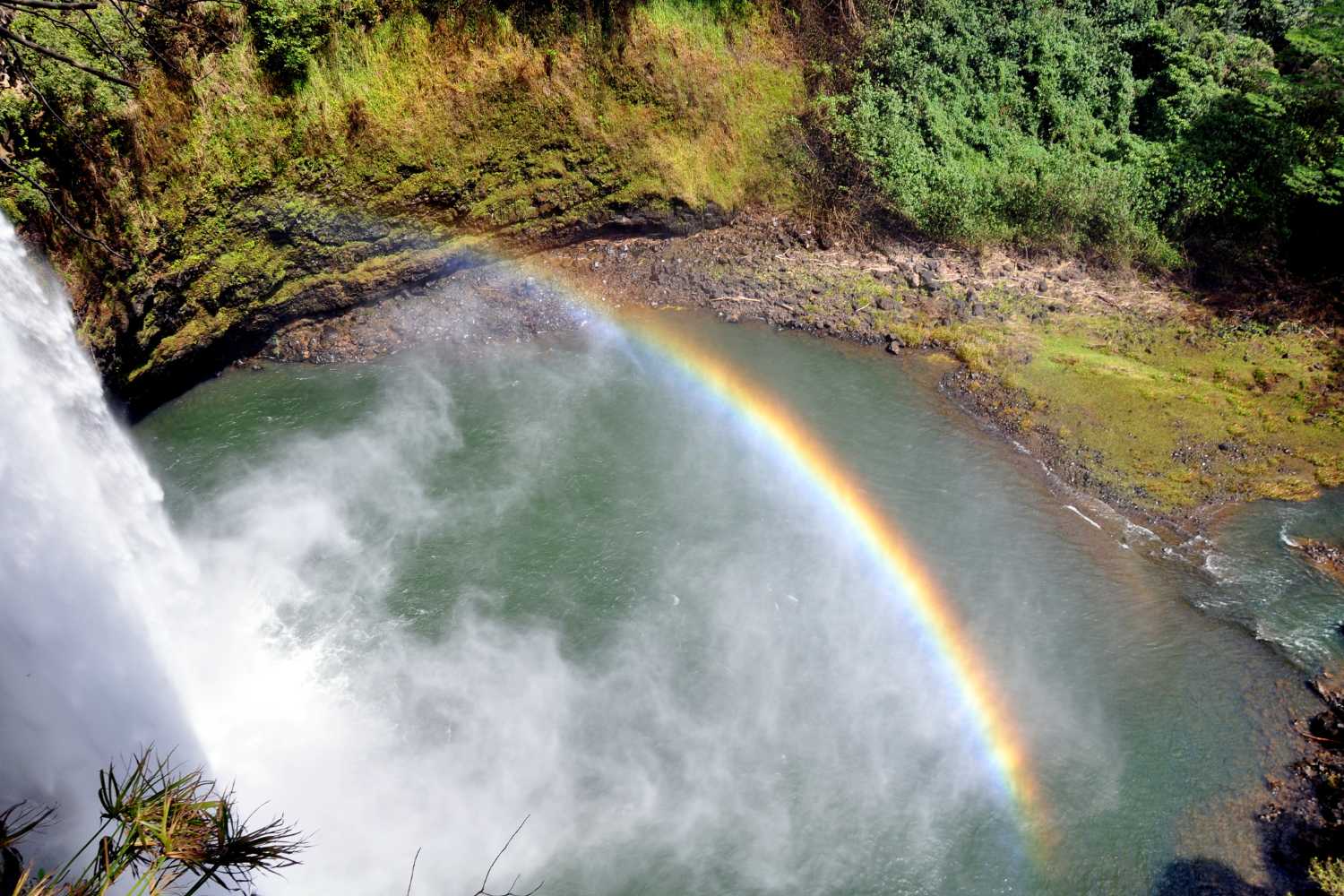
Imagine finding yourself along a scenic road in Hawaii and seeing a sight in the distance that will make you doubt your eyes: a waterfall whose water, instead of falling downwards, rises upwards as if by magic. This is not a mirage or a cinematic trick, but a real natural phenomenon that occurs at Waipuhia Falls on the island of Oahu.
A wonder of nature
Waipuhia Falls, known locally as the “Upside Down Waterfall,” is located in the Nu’uanu Valley, along the scenic Pali Highway that passes through the central mountains of the island of Oahu. This waterfall is located in an area where the wind blows at high speed, reaching up to 75 km/h, creating one of the most spectacular and rare phenomena in the entire Hawaiian archipelago.
View this post on Instagram
The very name of the waterfall, Waipuhia, means “blown water” in Hawaiian, a clear reference to the phenomenon that characterizes it. Located on Mount Konahuanui, this natural wonder is visible from Highway 61, better known as the Pali Highway, giving motorists an unexpected and memorable sight.
But how is it possible for water to flow backwards?
View this post on Instagram
Powerful northeast trade winds, channeled by the site’s topography, capture the falling water and push it up the canyon before it even reaches the bottom, creating the illusion that the waterfall is flowing in reverse.
These winds, known in Hawaiian as “hau”, are the same trade winds that characterize the climate of the Hawaiian Islands, constantly blowing from east to west. When they encounter the rock walls of Nu’uanu Canyon, they are channeled and accelerated, gaining enough strength to counteract gravity itself.
The result is an extraordinary sight: the water that should fall down the cliff is literally repelled upwards, turning into a nebulous reverse waterfall that appears to evaporate into the air before hitting the ground.
When to witness the phenomenon
The surprising effect is visible only during the wet season, between November and March, when heavy rains feed the waterfall and winds are particularly strong. Waipuhia Falls is rain-fed, meaning the phenomenon is most noticeable immediately after or during heavy rainfall.
During monsoons and tropical storms, when the gusts of wind are more intense, the spectacle reaches its peak. Under these conditions, virtually all the water is pushed upwards, creating an even more dramatic and surreal effect. The water mist that forms in the air, illuminated by the sun’s rays, can also give rise to spectacular rainbows, adding further magic to the landscape.
How to observe the waterfall in reverse
The peculiarity of Waipuhia Falls is that they can be admired from the comfort of your car. Driving east along the Pali Highway, attentive observers can spot the waterfall on the right, on the slopes of Mount Konahuanui. The phenomenon is best seen from a distance, as up close it may be difficult to perceive the full effect.
Although there is theoretically a path that leads to the falls, local experts strongly advise against attempting to reach them on foot. The route crosses private properties and is extremely challenging: there is no real defined track, the ground is often muddy and slippery, and the vegetation is so thick that in some places you literally have to hack your way with a machete. Furthermore, reaching the base of the waterfall carries the risk of sudden flooding of the stream during storms.
A rare but not unique phenomenon
Reverse waterfalls are rare but not entirely unique phenomena in the world. The most famous example is found at Naneghat, a waterfall in Maharashtra, India, about three hours from Mumbai. There are similar cases in other parts of the world, such as the Kinder Downfall in the Peak District National Park in England, where the wind can push the water upwards with the same spectacularity.
The Waipuhia Falls remain one of the most accessible and frequent examples of this phenomenon, thanks to the particular geographical conformation of the Nu’uanu valley and the constancy of the Hawaiian trade winds.
Beyond the Waipuhia
The Hawaiian archipelago is considered one of the American states with the greatest density of waterfalls, thanks to the abundant rainfall that characterizes the islands and their volcanic origin. From Kauai’s spectacular Wailua Falls, made famous by the television series “Fantasy Island,” to the Big Island’s majestic Akaka Falls, over 400 feet tall, each island offers waterfalls of extraordinary beauty.
Yet, among all these natural wonders, Waipuhia Falls holds a special place in the collective imagination. They are not the tallest, nor the most powerful, but they are certainly among the most fascinating and mysterious. Their ability to seemingly defy gravity makes them a perfect symbol of Hawaii’s natural magic.
In an age where we think we’ve seen it all, nature continues to surprise us with phenomena that defy our expectations. The Waipuhia Falls remind us that the world is still full of wonders to discover, that sometimes the right atmospheric conditions are enough to transform a normal element of the landscape into something extraordinary.
For those visiting Oahu, this phenomenon represents a unique opportunity: there is no need to organize demanding excursions or rely on expensive helicopter tours. Just drive along one of the most beautiful scenic roads on the island, keep your eyes open and, if luck is on your side and the wind blows strong enough, you can witness one of the most incredible sights that mother nature can offer: a waterfall flowing backwards.
