
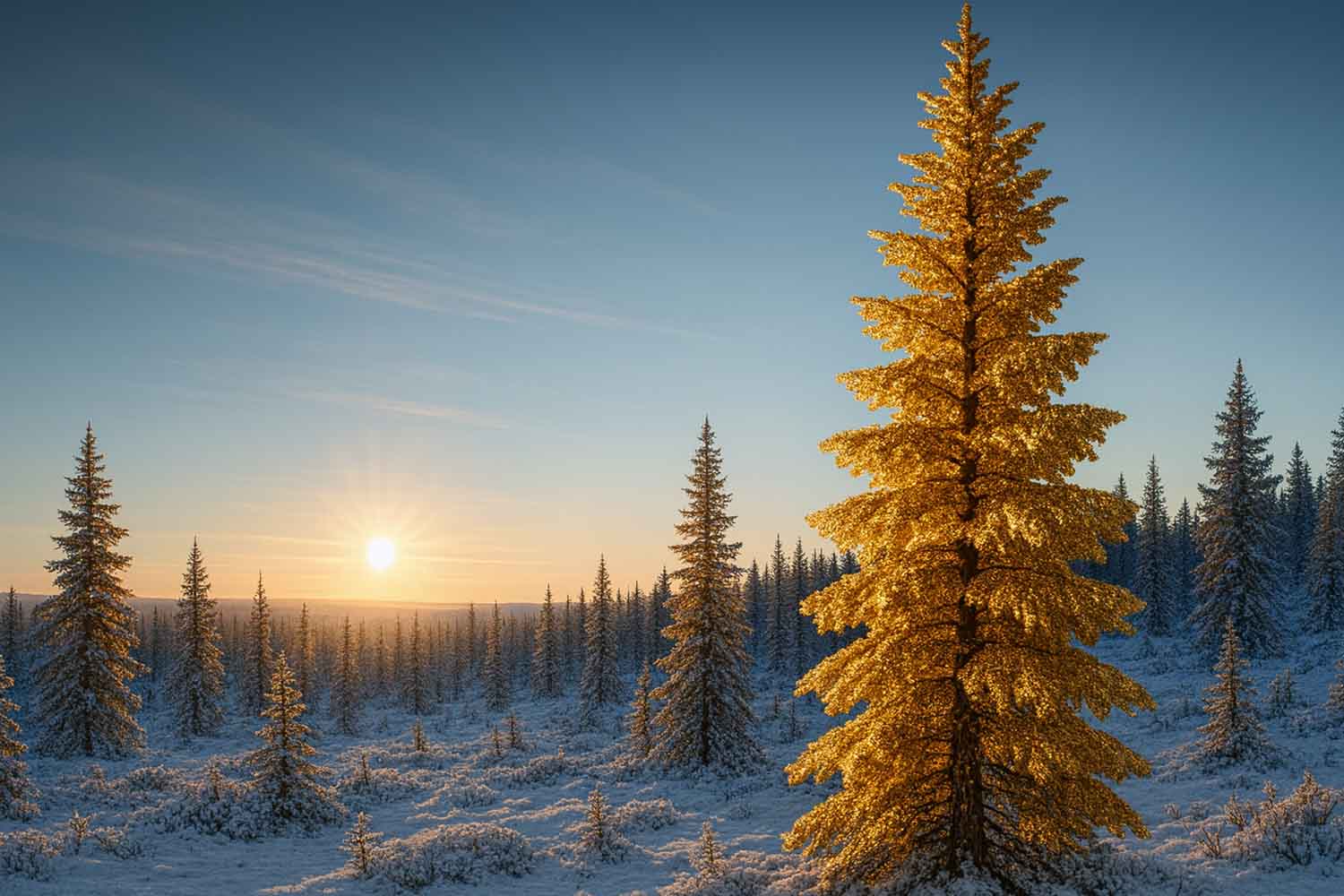
It seems like a Nordic fairy tale, but instead it is pure science. In Lapland, among expanses of snow and infinite silence, some spruce trees (Picea abies) hide a precious secret: gold nanoparticles are found in their needles. Not enough to make anyone rich, of course, but enough to make one think that the trees can “reveal” the presence of gold in the ground.
This was discovered by a team from the University of Oulu, Finland, who published the results in the journal Environmental Microbiome. Scientists analyzed 138 needle samples from 23 fir trees near the Kittilä mine, Europe’s largest goldfield. In four of these trees they found tiny particles of gold surrounded by bacterial biofilms, a kind of “fingerprint” of the metal that shines even without the sun.
The bacteria that help fir trees “grow” gold
The secret is in the bacteria that live inside the tree.
According to Dr. Kaisa Lehosmaa, lead author of the study, microorganisms such as Cutibacterium, Corynebacterium and P3OB-42 play a decisive role:
We observed that the internal microbiota of fir can influence gold accumulation.
The process works like this: the gold present in the soil, dissolved in the water, is absorbed by the roots, goes up into the tree vessels and reaches the needles. There, bacteria turn it into solid gold, at the nanoscale, in a natural phenomenon called biomineralization. Ergo, trees do not “produce” gold, but capture and store it.
A discovery that changes the way we search for gold
The point is not the quantity – too small to think of as a business – but the idea: if trees accumulate gold, they can become natural sentinels of underground deposits. Already in Australia, similar research had found traces of gold in eucalyptus leaves. Now Lapland confirms that the phenomenon is real, and perhaps more widespread than we imagine.
For geologists this is a silent revolution: instead of drilling into the ground, it would be enough to analyze the needles or leaves of some plants to understand what lies underneath. An approach that respects nature and reduces the environmental impact of mineral exploration, transforming trees into green bioguides towards underground resources.
In a world that is depleting its resources, this discovery reminds us how much ecosystems are smarter than us. The fir trees of Lapland do not only offer oxygen and postcard landscapes: they filter metals, communicate with bacteria and tell invisible stories of what happens beneath the surface.
Perhaps, rather than looking for gold, we should learn to listen to those who guard it.
You might also be interested in:
