
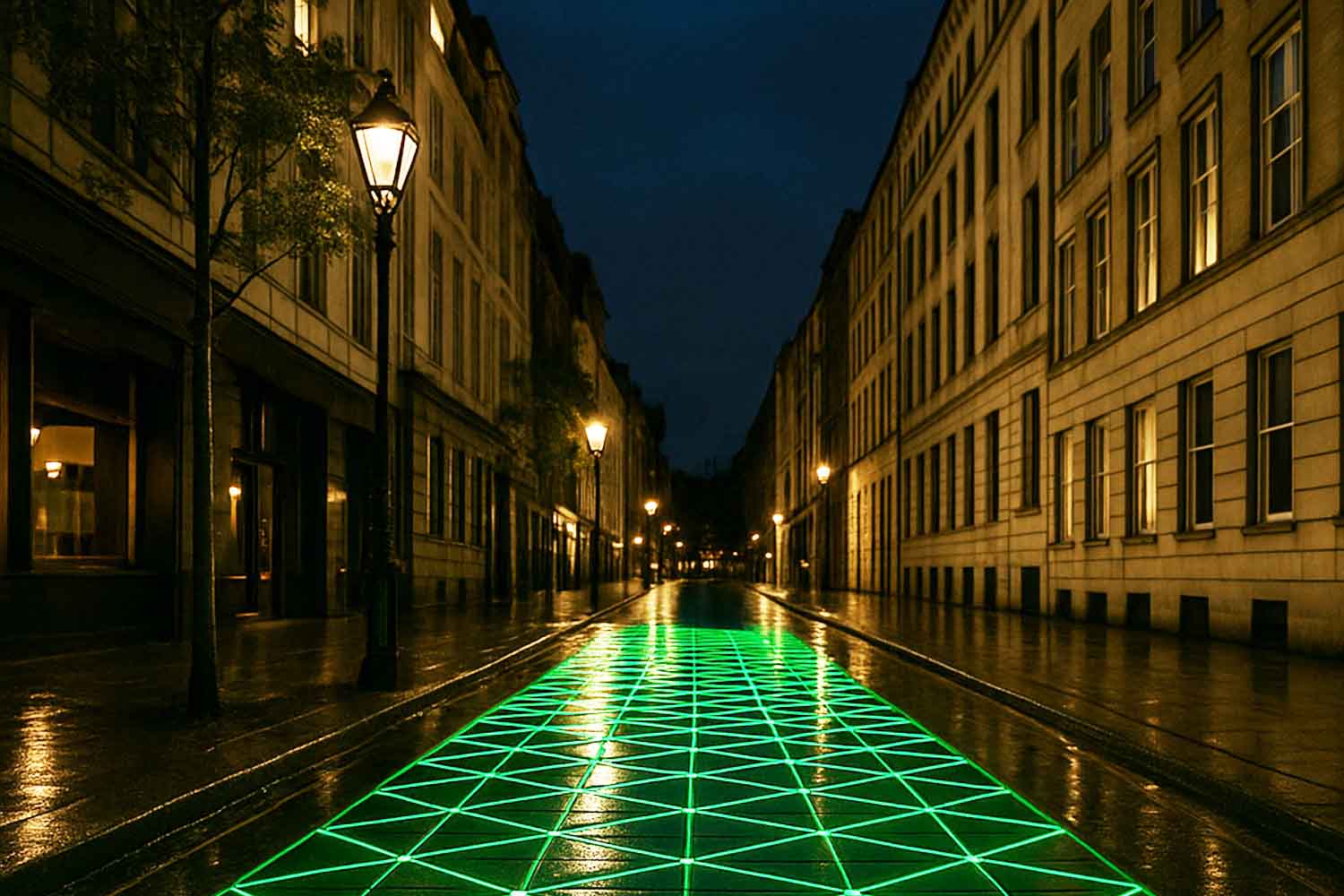
Stroll along a quiet street in the center and discover that your every step generates energy. It sounds like science fiction, but that’s exactly what happens in Bird Street, a small side street off Oxford Street in London, chosen as an urban laboratory to test an idea that overturns our perception of public space.
Right there, between shops and historic buildings, a strip of “kinetic” paving captures the force of passers-by’s feet and transforms it into electricity. This is not an amusement park trick, but concrete technology, designed to power LED lights, small audio systems and environmental sensors installed along the street. At every step, a microshock of energy helps make the road more sustainable and smarter.
It is not a utopian project: it has already happened, and it was the first example of an “energy sidewalk” in the world.
How it works
Behind this futuristic sidewalk there is a simple yet ingenious technology: special piezoelectric tiles which, compressing under the weight of people, activate a small mechanism capable of generating energy. It is a modest amount, of course, but enough to make the street lighting shine and to demonstrate that even the most everyday gestures can become a circular resource.
The route installed in London covered approximately ten square metres. On a busy day, the tiles recorded thousands of steps, a constant flow capable of powering LEDs and low-power devices. Passers-by were even given the opportunity, via apps, to monitor in real time how much energy they were producing. A surprising and immediate way to make visible what we normally don’t perceive: that every movement has an energetic impact.
And Bird Street didn’t just produce electricity: it also integrated air quality sensors and sound installations. A small “smart street” on a human scale, designed to demonstrate that technology can improve urban life without distorting it.
If it is true that a sidewalk like the one on Bird Street will never be able to supply an entire neighborhood, its value is not in the bill numbers. It’s in the message. It shows how every urban space, such as a square, a station, a shopping centre, can become a small node of clean and participatory energy.
The strength of the “energy sidewalk” lies precisely in making us imagine a new model of city: no longer a passive consumer, but a widespread producer, where energy also comes from daily gestures, from people, from their simple coming and going.
And above all, it reminds us that the ecological transition is not just made up of large plants and political decisions: it is made up of minute, intelligent innovations that change mentalities even before the urban landscape.
You might also be interested in:
