
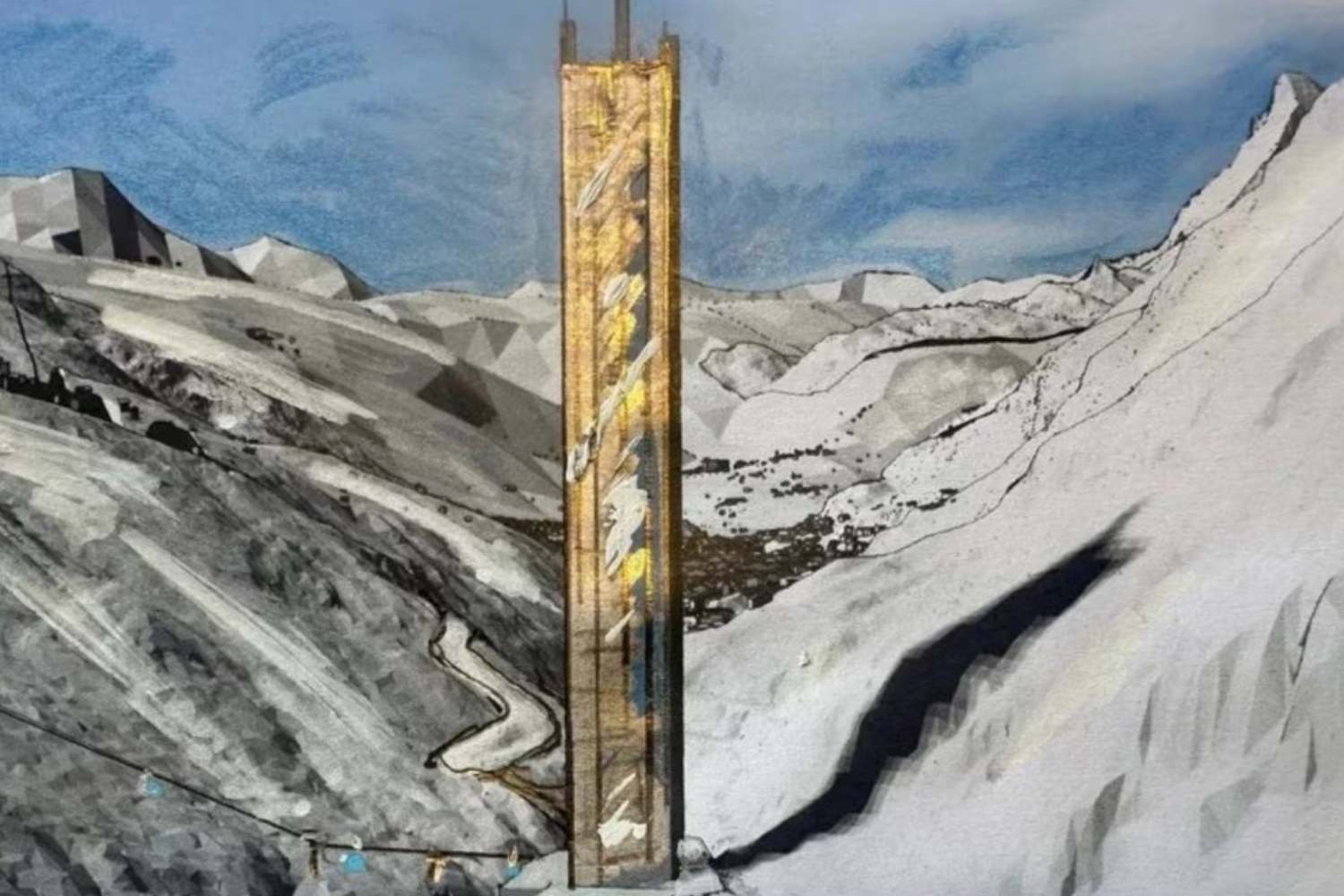
In Zermatt, where the Matterhorn dominates one of the most famous panoramas in the world, a proposal is causing discussion: building Lina Peak, a 260-metre, 65-storey tower that would become the tallest skyscraper in Switzerland. The idea was born as a response to a problem that has become unsustainable over the years: the housing crisis affecting residents and seasonal workers, crushed by out-of-reach prices and the pressure of tourism.
Lina Peak as a vertical village
The project imagines a building capable of vertically concentrating over 550 residential units, public services, sports spaces, cultural areas and even direct connections to the ski resorts. The declared objective is to reduce land consumption, creating a multifunctional structure that combines residence, tourism and services in a single compact place. A model that aims to preserve the landscape, limiting horizontal expansion and the construction of new structures close to the village.
The project bears the signature of Heinz Julen, a local architect and entrepreneur known for his bold solutions, suspended between contemporary design and territorial roots. According to Julen, the tower would act as a “relief valve” for Zermatt: a way to generate new living spaces at controlled prices, financed by the sale of the luxury lofts planned on the upper floors. His proposal thus seeks to combine economic and social sustainability, without resorting to public funding.
The problem of overtourism
Zermatt welcomes millions of visitors every year and during the high season exceeds 40,000 visitors, compared to only 6,000 residents. The shortage of available housing has brought the vacancy rate close to zero, while short-term rental platforms have further aggravated the situation. Lina Peak was created to rebalance this pressure, offering a new distribution of spaces that makes daily life compatible with increasingly invasive tourism.
An impact that cannot be ignored
On paper, therefore, we are talking about reducing land consumption. In reality, however, a skyscraper of this size would represent an invasive intervention in an environment that thrives precisely thanks to its visual and naturalistic integrity. A very high tower that would permanently redesign the profile of an area considered a symbol of Alpine nature, irreparably altering what makes Zermatt a unique place.
Of course, the problem of the lack of accommodation due to growing overtourism is real, but responding with a megastructure attractive to tourists and investors risks fueling the very dynamic that generated the problem: more flows, more pressure, more infrastructure. All this penalizing the environment.
Lina Peak will have to overcome technical and regulatory obstacles, but the main issue remains environmental. The Alps are not a backdrop that can be modified at will and a building of this size can only represent a wound in the landscape. The question, therefore, is not whether the tower is possible, but whether it is compatible with an already fragile ecosystem. And the answer is a clear no.
You might also be interested in:
