
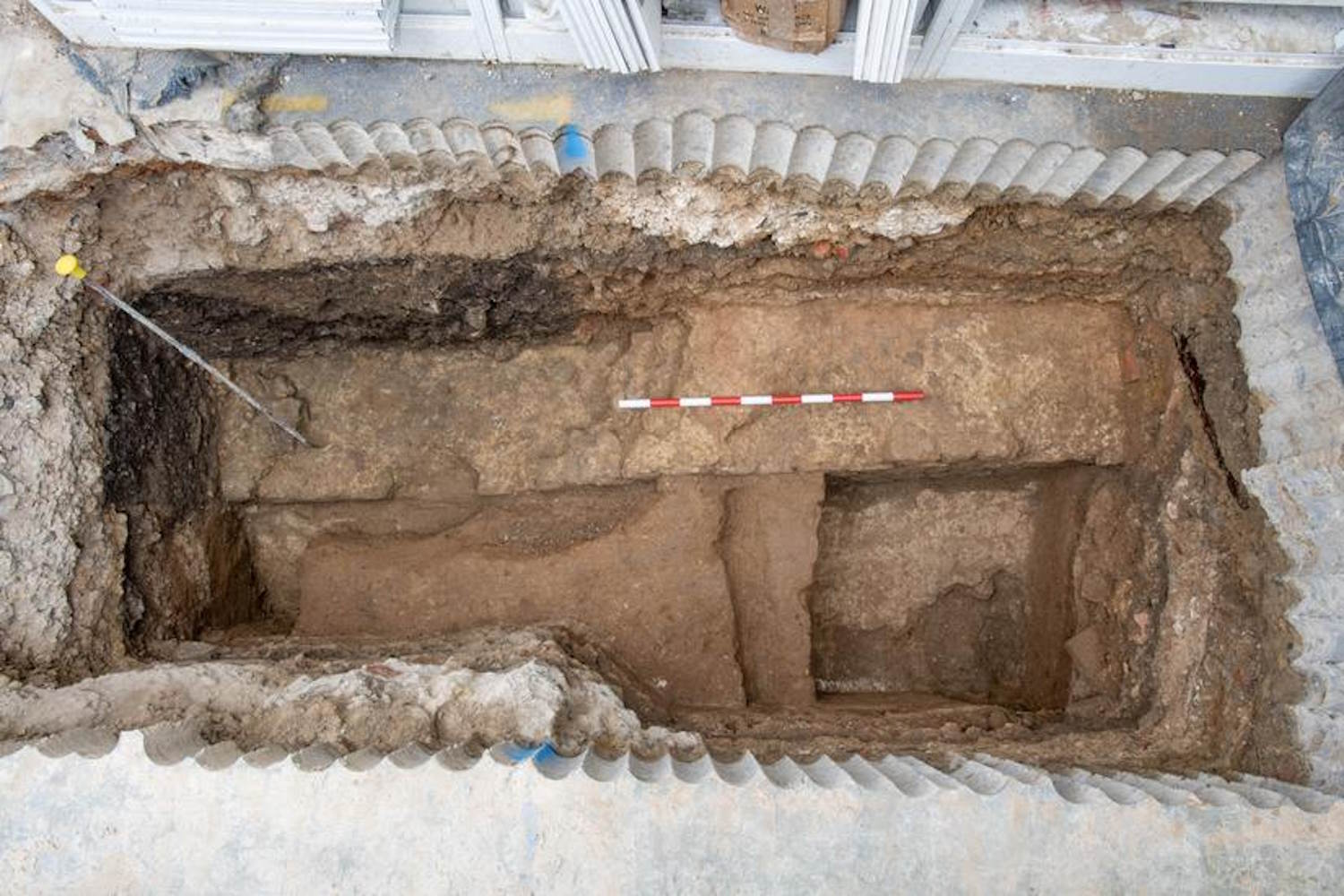
In the heart of Londonunder a commercial building, “hid” one ‘Ancient Roman basilicafrom the time between the late 70s and 80s DC has now been found by an archaeological research group led by Museum of London Archaeology (Mola), and is considered by experts as One of the most important finds in Roman history found in the capital of the United Kingdom.
How the discovery took place
The works were conducted in the basement of 85 Gracechurch Streeta commercial building next to the Leadenhall Market in the City of London. In reality, after decades of previous research and excavations, it was already known that this site was found Above the northern end of a Roman basilica.
However archaeologists were not expected anything that was really discovered when the owners of the site, Hertshten Propertiesasked to start new investigations before a planned redevelopment.
Although we knew that the basilica could be under this site – scientists write – it was difficult to predict how much of the structure, if present, if it were survivor. It was likely that any remains would be disturbed by both subsequent Roman buildings and the most recent ones
To see what levels of conservation could be present, archaeologists have therefore dug a series of proof pits (small archaeological trenches), strategically positioned where walls and foundations could be present.
What we discovered is extraordinary. Inside the trial pits there were foundations and massive walls made of flint, waste stone and Roman tiles: in some areas we believe that they are more than 10 m long, 1 me 1 me deep 4 m deep. It was clear that significant parts of the basilica They were still below 85 of Gracechurch Street!
More than one “simple” Roman basilica
The Basilica was part of the largest Roman hole and served as a political, judicial, commercial and social center for residents and visitors of today’s London. Archaeologists and historians believe that it was built in the late 70s or 80s DC during the power of agricultural (78-84 AD). Located on a high point of the city and built on a raised platform, it extended on an area of the size of a football field.
This was a clear symbol of Roman power and authorityalso because the basilica probably rises on two floors. In the face of the construction there was an open courtyard, where local people engaged in public and community activities, such as markets, festivals and important public announcements.
But what makes this discovery even more special is the concrete possibility that these foundations are within oneBasilica area known as court. Here, on a raised stage, magistrates, political leaders and important officials took important decisions on the London government and perhaps even beyond, shaping the past and present of the City. It is therefore possible that 2,000 years ago this place was just The heart of Roman London.
This is one of the most significant discoveries made in the City in recent years. It is like discovering the chair of the President and the Chamber of the Chamber of Municipalities, 2,000 years in the future. The levels of conservation of the basilica have far exceeded our expectations and perhaps we have the most important part of the building. It is exciting that we have only scratched the surface of the potential of this site with our initial investigations. We can’t wait to find out more about these remains, working with the owners of the site, the London Museum and the City of London Corporation to develop a truly unique and captivating archaeological experience and public space
A updated planning request that incorporates the new space in 85 Gracechurch Street should be presented in the Spring of 2025. If approved, complete excavations will take place on the site, which could reveal further details on the construction and interiors of the Basilica. The new experience will be expected Open to visitors since 2029/2030.
Sources: Museum of London Archaeology / Museum of London Archaeology / Facebook
