
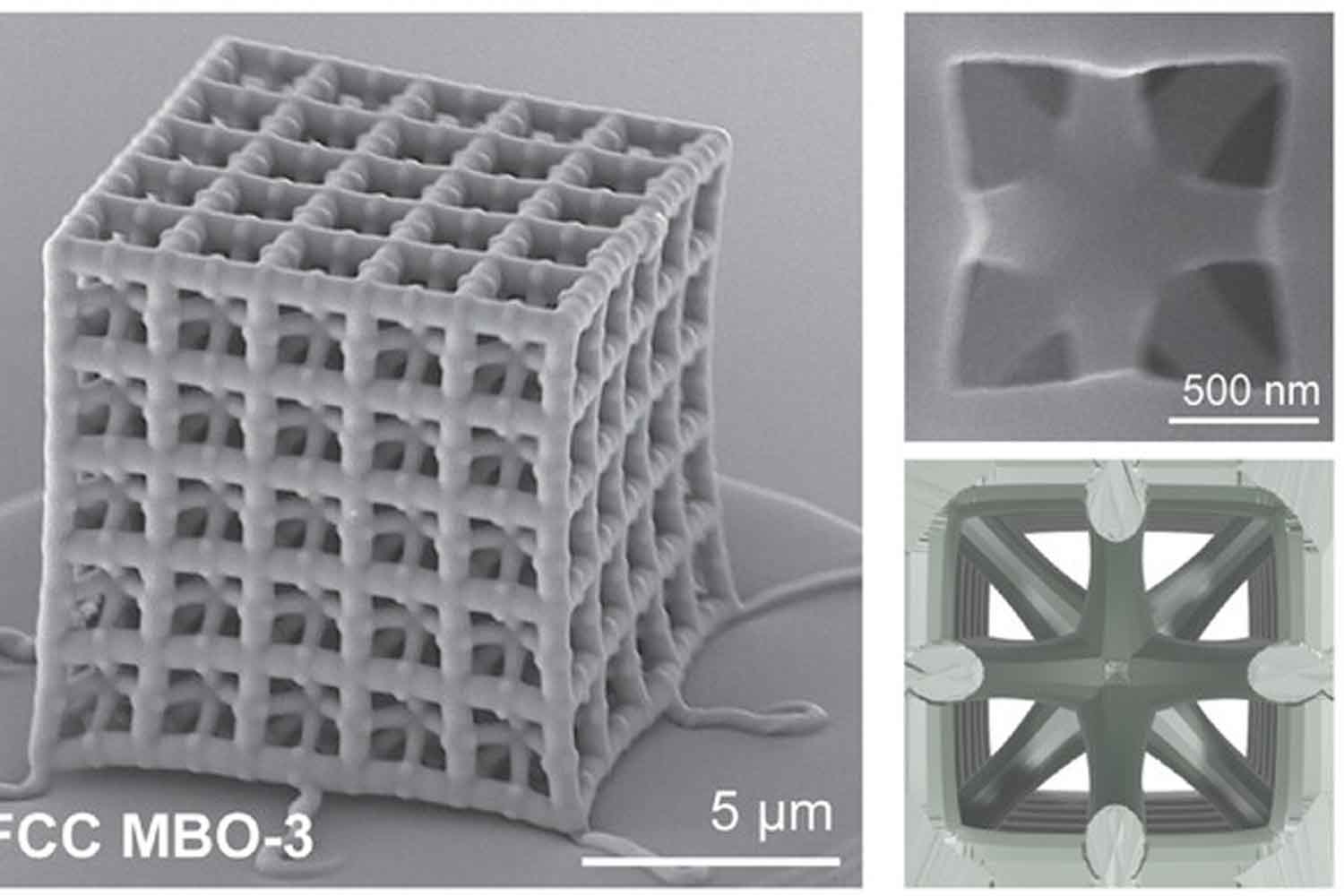
A team of researchers from the Faculty of Applied Sciences and Engineering of the University of Toronto has developed Materials with nanometric architecture innovative, characterized by an exceptional combination of resistance and lightness. These materials may apply in key sectors such as Automotive, aeronautics and aerospace.
The research is the result of a collaboration with the Korea Advanced Institute of Science & Technology (Kaist) of Daejeon, South Korea, and is based on a cutting -edge approach that combines Artificial intelligence and 3D printing with two photons polymerization. Let’s discover this revolutionary discovery in detail.
Ultra-resistant and light materials: the challenge of the distribution of tensions
The new ones Materials with nanometric architecture developed by researchers combine resistance comparable to that of carbon steel with a lightness similar to that of foam. However, the main challenge faced by scientists was to solve the problem of concentration of stresseswhich in traditional materials often causes premature sagging.
The Professor Tobin Filleter He explained that standard reticular structures have corners and intersections that favor the accumulation of mechanical tensions, increasing the risk of breakage. “By facing this problem, I understood that it was a perfect case for theautomatic learning“, The researcher said.
At the basis of these materials there are microstructures composed of repetitive units of just a few hundred nanometers. To make a comparison, it would be necessary to alignne Over 100 to reach the thickness of a human hair.
Artificial intelligence to optimize materials: the use of the Mobo algorithm
To improve the distribution of stresses, the team has adopted an approach based on Automatic learning with Bayesian optimization multi-objection (MOBO). This method made it possible to identify ideal geometries To improve the distribution of tensions and the relationship Resistance/weight structures with nanometric architecture.
Second Peter Serlesthis is the first time that the machine learning is applied to the optimization of materials of this type. “The results surprised us. Also, thanks to the mobo, we were able to work with a Reduced but higher quality dataset“, The researcher explained.
In addition to artificial intelligence, the team used one 3D printer with two photons polymerizationlocated at the Research and application Center in Fluidic Technologies (Craft). This advanced system of additive manufacture allows the creation of carbon nanostructure capable of enduring a tension of 2.03 MPa/m³/kgabout 5 times higher than that of the titanium.
Applications in the aerospace sector and future prospects
The possible applications of these Materials with nanometric architecture I am widely promisingespecially in the sector Aeronautical and aerospace. Scientists predict that they could be used to make ultralight components for planes, helicopters and space vehicles, helping to significantly reduce fuel consumption, as stated by Peter Serles:
If the titanium is replaced with this material, we could save 80 liters of fuel per year for each kilogram of material used.
This milestone would represent a fundamental step forward to reduce the carbon imprint of the aviation.
In the future, the team will focus on scalability of the production of these materials, to allow the manufacture of components macroscopics at low costs. In addition, researchers are exploring New structural configurations To get materials even lighter, resistant and rigid.
