
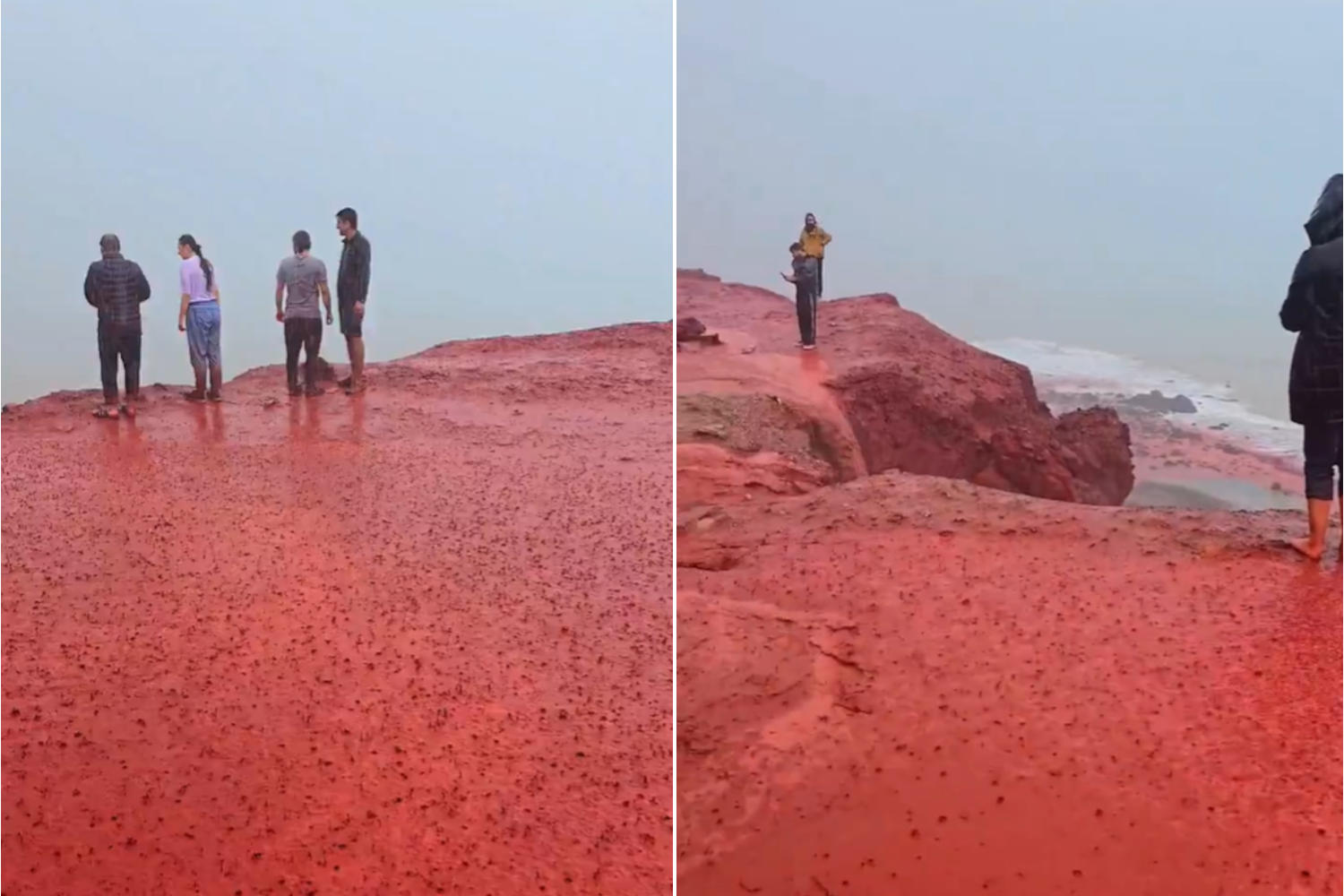
Red everywhere, as if the sea had been suddenly painted. On the Iranian island of Hormuz, the Sahel Sorkh beach has once again amazed the web after a strong storm that transformed sand and waves into a crimson-colored expanse. The videos, which quickly went viral, show rainwater coming down from the hills and pouring into the sea, creating a powerful and almost unreal visual effect.
A natural phenomenon that repeats itself over time
This is not a new or mysterious event. The island of Hormuz has been famous for centuries for its soil rich in iron oxide, in particular hematite, a mineral that gives the rocks an intense red colour. When the rains are abundant, the sediments are dragged downstream and end up directly in the sea, coloring the water and the shoreline. It is a completely natural process, already observed several times in the past, especially after intense rainfall.
Heavy rain at “Sahel Sorkh” (Red Beach) in Hormoz Island has created an astonishing scene.
The beach’s vivid red color is due to a high concentration of iron oxide, particularly the mineral hematite, found in the island’s soil and rock.#Iran #nature pic.twitter.com/wxE4eSSzyW
— Living in Tehran (LiT) (@LivinginTehran) December 16, 2025
Because the red is so intense
The visual strength of the phenomenon depends on the high concentration of iron: in contact with water, the very fine particles of hematite remain in suspension, reflecting the light and creating that “blood-colored sea” effect that is so striking. Once the rain stops, the color gradually tends to dissolve, returning the beach to its usual appearance.
Science versus suggestion
The images, however, have sparked the imagination of many online users. There are those who spoke of biblical prophecies, evoking apocalyptic scenarios and symbolism linked to water that turns into blood. Others recalled how, in ancient times, a similar phenomenon could have been interpreted as a divine sign. Today, however, the explanation is clear and documented: no supernatural event, no biological involvement such as algae or bacteria, but only geology and rain.
The island of Hormuz, an open-air laboratory
Hormuz is often called a true natural geological museum. In addition to the famous red beach, the island is home to multicolored soils, purple-hued cliffs and landscapes that seem to come from another planet. It is no coincidence that local hematite is also called “red earth” and has even been used in the past in traditional cuisine and cosmetics.
You might also be interested in:
