
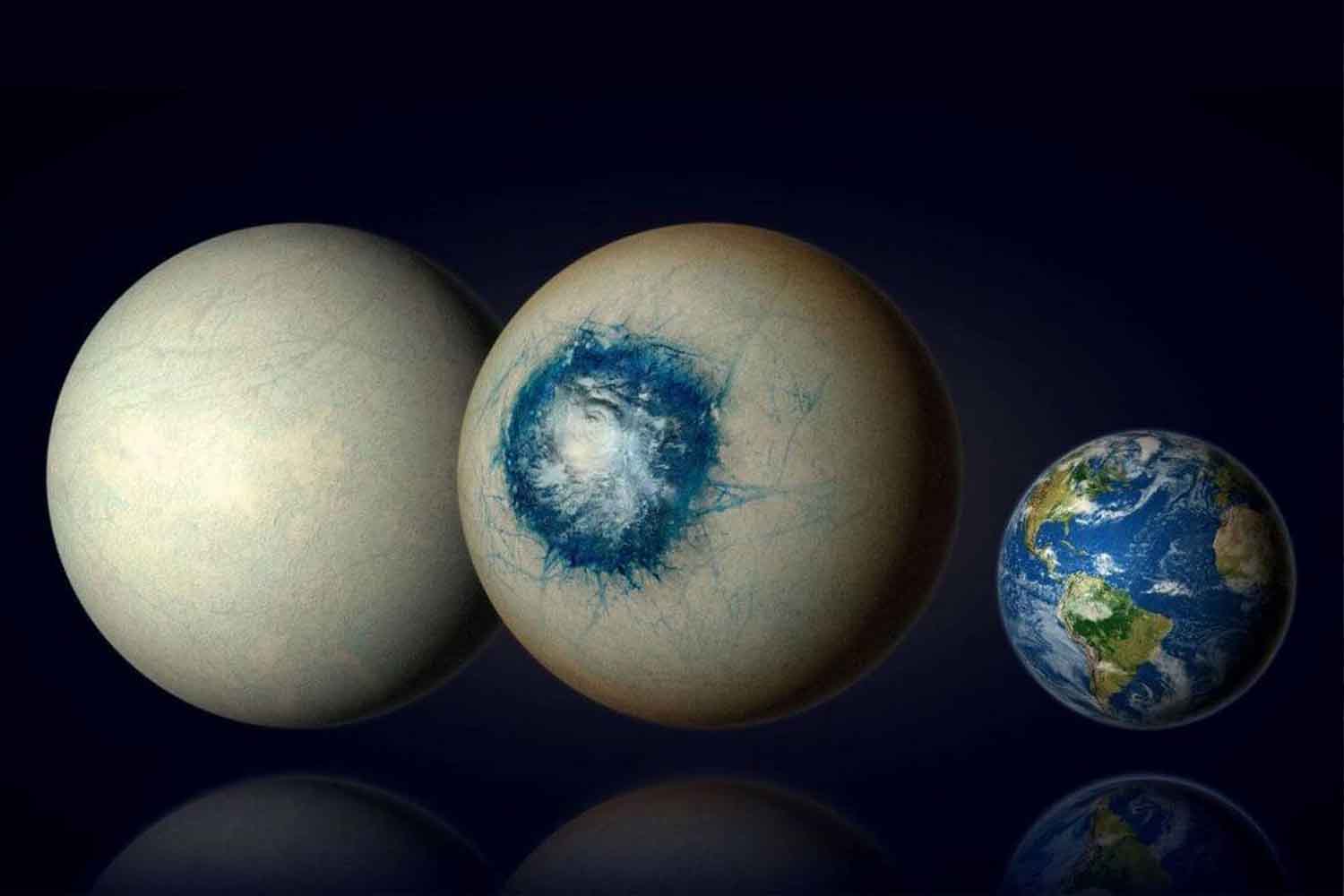
At first glance it looks like an enormous pupil suspended in the darkness of space. Actually LHS 1140 b it is one of the most studied exoplanets of recent years because it brings together elements that, for those involved in science and the environment, are difficult to ignore: water, ice, atmosphere and extreme conditions. This is also why the NASA has included it among the most interesting worlds to observe carefully.
We are not faced with a graphic fantasy or a media gimmick. The image that made him famous comes from concrete scientific models, built starting from real data. And it is precisely this combination of rigor and controlled imagination that makes LHS 1140 b so fascinating.
Why LHS 1140 b looks like an eye in space
LHS 1140 b is located about 48 light-years from Earth and orbits very close to a red dwarf. This short distance makes the planet probably gravitationally blockedalways showing the same face to his star. It’s a common condition in the universe, but one with profound consequences.
On one side of the planet the Sun never sets, on the other it never rises. The shadowed side remains frozen, covered by permanent ice. The illuminated one, however, could reach temperatures sufficient to maintain liquid waterespecially if the atmosphere is thick enough to retain heat. In the most accredited climate models, this temperate zone is concentrated in the center of the illuminated side, forming a large dark area surrounded by white ice. Hence the visual effect that resembles an eye.
It is important to say it clearly: , but a scientific reconstruction. No one has ever directly observed the surface of LHS 1140 b. However, the shape does not arise from nothing, but from simulations that take into account mass, orbit, type of star and possible atmospheric composition.
Water, atmosphere and life possibilities
LHS 1140 b is a Rocky super-Earthlarger and more massive than our planet. Studies suggest that water could make up as much as 20% of its massa huge amount by Earth standards. This data has led researchers to hypothesize the presence of vast oceans, at least in some areas.
Another key point is the atmosphere. The simulations indicate a possible nitrogen-rich atmosphere, similar in some respects to Earth’s, capable of redistributing heat and making the differences between day and night less extreme. In such a scenario, the border zone between light and dark could offer relatively stable conditions, at least from a physical point of view.
For those concerned with sustainability and the future of the planet, LHS 1140 b also represents an opportunity to look at the Earth with different eyes. Studying such distant worlds helps to understand how fragile is the balance that allows liquid water to exist and how rare a favorable combination of environmental factors is in the universe.
