
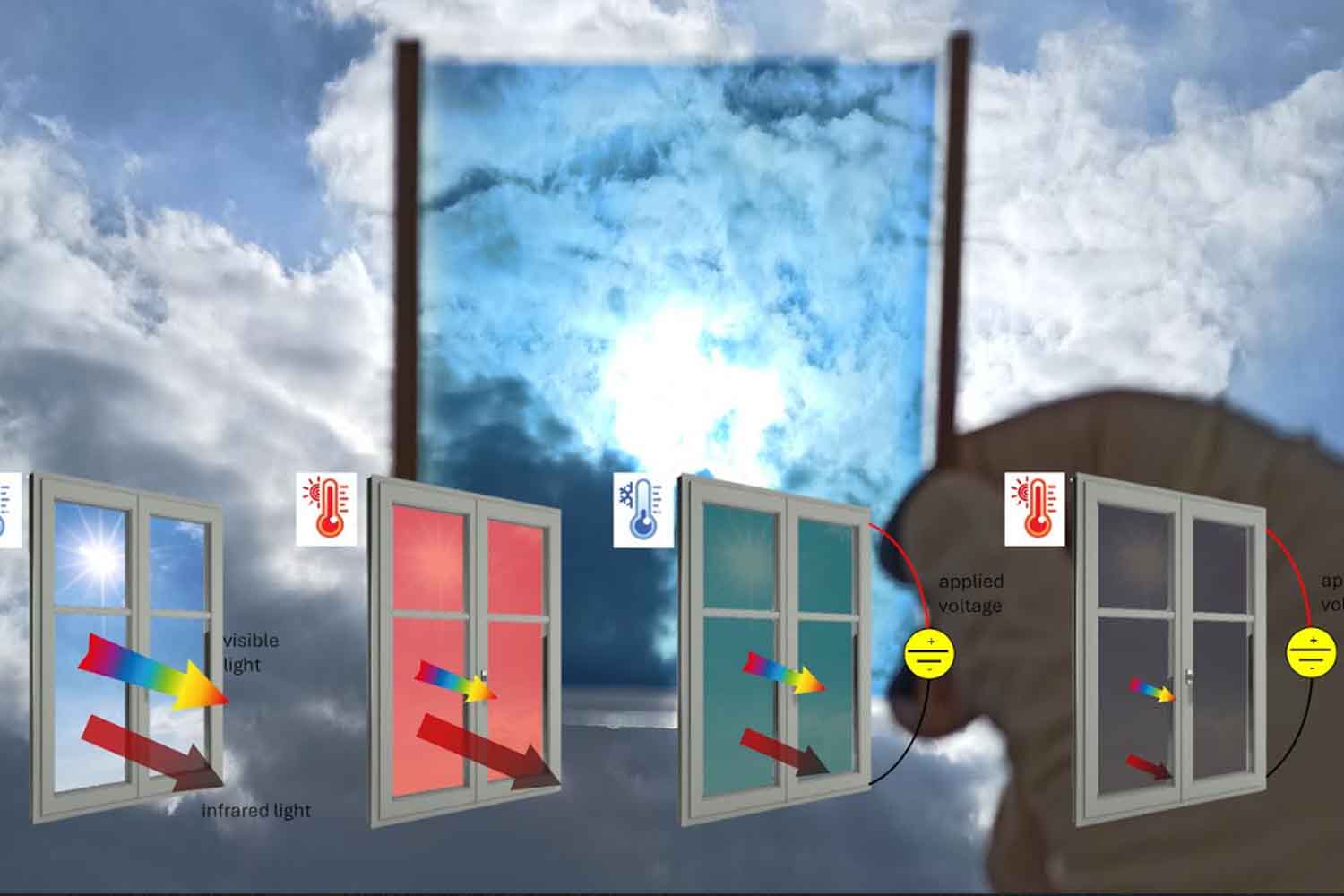
It often happens that we think about how to make homes and offices cooler in the summer, brighter in the winter and less energy intensive all year round. Now comes an interesting idea from Italian research: a material that changes color on its own based on temperature or electric current.
Is called chameleon device and it is a perovskite-based gel that reacts immediately to external stimuli, making a surface lighter or darker when needed. Developed by Cnr-Nanotec together with researchers from ENS Paris-Saclay, it is a simple (but very promising) way to better manage light and heat without consuming almost nothing
How the “chameleon” gel works
At the center of the research is a polymer gel that contains two-dimensional perovskites. Materials that have already been studied extensively in photonics, but which are used here in a completely new way. The interesting thing is that researchers can “dose” the ingredients, perovskites and copolymer, as if they were preparing a scientific recipe. The proportions change and, consequently, they are modified color, transparency, activation temperature And conductivity.
The result is a multitasking material: it functions both as an electrolyte and as a chromogenic part. In short, it does two jobs in one. This allows you to create the so-called thermo-electrochromic devices (TECD)small systems that react to heat and electricity by offering four different optical states.
In practice: it can be transparent, coloured, more or less dark, more or less filtering. And all this on command.
The performance: very fast, resistant and capable of modulating the light up to 75%
Here comes the part that really appeals to those who deal with sustainable technology:
All this means windows that automatically adapt to the light, screens that regulate the brightness themselves and optical devices that consume ridiculous energy compared to current solutions. A possible manna for those who want it reduce waste and consumption without sacrificing comfort.
The next steps of the research
The team doesn’t stop. Marco PuglieseCnr-Nanotec technologist, explains that the objective now is lower the temperature at which the color changes and use even more sustainable 2D materials. And in closing, Fabrizio Illuminatidirector of Cnr-Nanotec, summarizes the vision:
This technology is concrete proof that a modular approach to materials science can give rise to flexible, customizable solutions with a real impact on our daily lives.
