
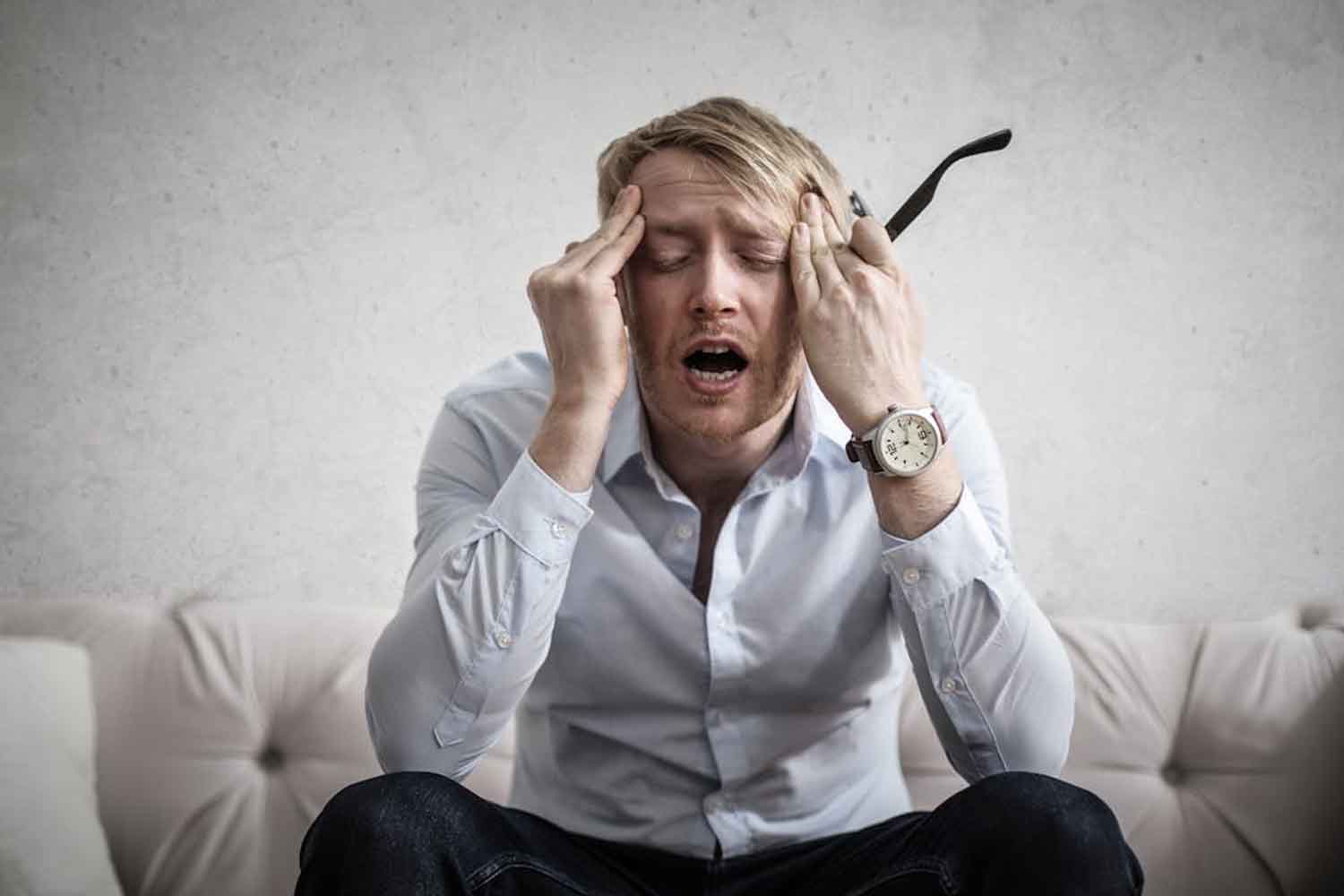
There is one thing that almost everyone takes for granted when it comes to psychological stress: that it is a single sensation, more or less intense, more or less manageable. A vague burden, difficult to define, which brings with it a bit of anxiety, a bit of insomnia, a few moments of irritability. Well, this idea could be wrong or, at least, highly incomplete.
A study published in the journal eClinicalMedicine has called this starting point into question, with results that concern anyone who has ever wondered why certain difficult periods leave different signs than others, or why two people with the same diagnosis can feel so bad in completely opposite ways.
Not all mental tension is the same
Tom Bresser, researcher at the Netherlands Institute for Neuroscience (NIN), analyzed the responses of hundreds of adults looking for recurring structures in their states of psychological distress. What he found is that so-called hyperarousal, the technical term to indicate that condition of prolonged alertness, of mental and physical tension that does not go away, is not at all a unique phenomenon. It is divided into seven distinct forms, each with its own characteristics.
The seven profiles that emerged from the research are: anxious, bodily, sensitive, sleep-related, irritable, alert and one defined as “sudomotor”, which concerns sweating and redness due to nervous activation. These are not separate categories that appear in different people: these patterns overlap in the same individual, but in different proportions depending on the disorder he suffers from.
In depression, for example, it is the irritable profile that is more marked. In generalized anxiety, anxiety prevails, while those who suffer from panic attacks tend to manifest above all the bodily component: the heart beating fast, shortness of breath, the physical sensation of danger. Post-traumatic stress disorder is characterized by vigilance and the sudomotor component, that activation of the nervous system that produces sweating and hot flashes. Social anxiety is more related to sensitivity, while ADHD does not show a clear dominant profile, but more diffusely distributed activation.
A new tool to measure what the old questionnaires confused
For years, clinical research has relied on questionnaires built around individual disorders, tools that tended to capture mixed signals instead of isolating the different components of tension. The result was that studies conducted on similar populations seemed to contradict each other, simply because they measured different things without knowing it.
Bresser’s team developed a 27-item questionnaire capable of detecting all seven profiles simultaneously. An instrument then validated on a second sample of 592 people, which confirmed its solidity, as Bresser explained.
Instead of having to search for the right combination of questionnaires, researchers can now use this tool to map hyperarousal much more easily and comprehensively.
Some sleep laboratories already use it. The practical impact is not secondary. If a patient came in with insomnia, he or she might also have a latent predisposition for anxiety or a traumatic disorder, without anyone having yet identified it. Recognizing which form of tension is most active at that moment can help the clinician understand what is really fueling the symptoms, even before a defined diagnostic picture is structured.
The research then opens up an interesting scenario on a neurobiological level. Different brain systems — those that regulate response to threat, attention, sleep, bodily signals — function independently. It is possible, according to Bresser, that each of the seven profiles corresponds to the activation of distinct circuits. The consequence would be relevant: instead of treating tension as a single target, therapies could focus on the specific pattern driving that person’s symptoms at that moment.
A final indication concerns the large epidemiological databases. The analysis showed that data from the UK Biobank (over 500,000 subjects) allow us to estimate three of the seven profiles: anxious, irritable and sleep-related. This paves the way for large-scale studies relating tension patterns to genetic data, neuroimaging and long-term health outcomes.
The authors acknowledge some limitations: the main sample was predominantly female and older, recruitment occurred through a sleep registry, which may have attracted people with existing sleep difficulties, and the measurements are based on self-reports, not objective physiological data. Future research will need to include younger, more balanced samples, with measures such as heart rate or brain activity.
Despite this, the study shifts something fundamental: it is no longer a question of understanding how bad a person is, but in what way they are bad. A distinction that, in the long run, could change both the diagnosis and the treatment.
You might also be interested in:
