
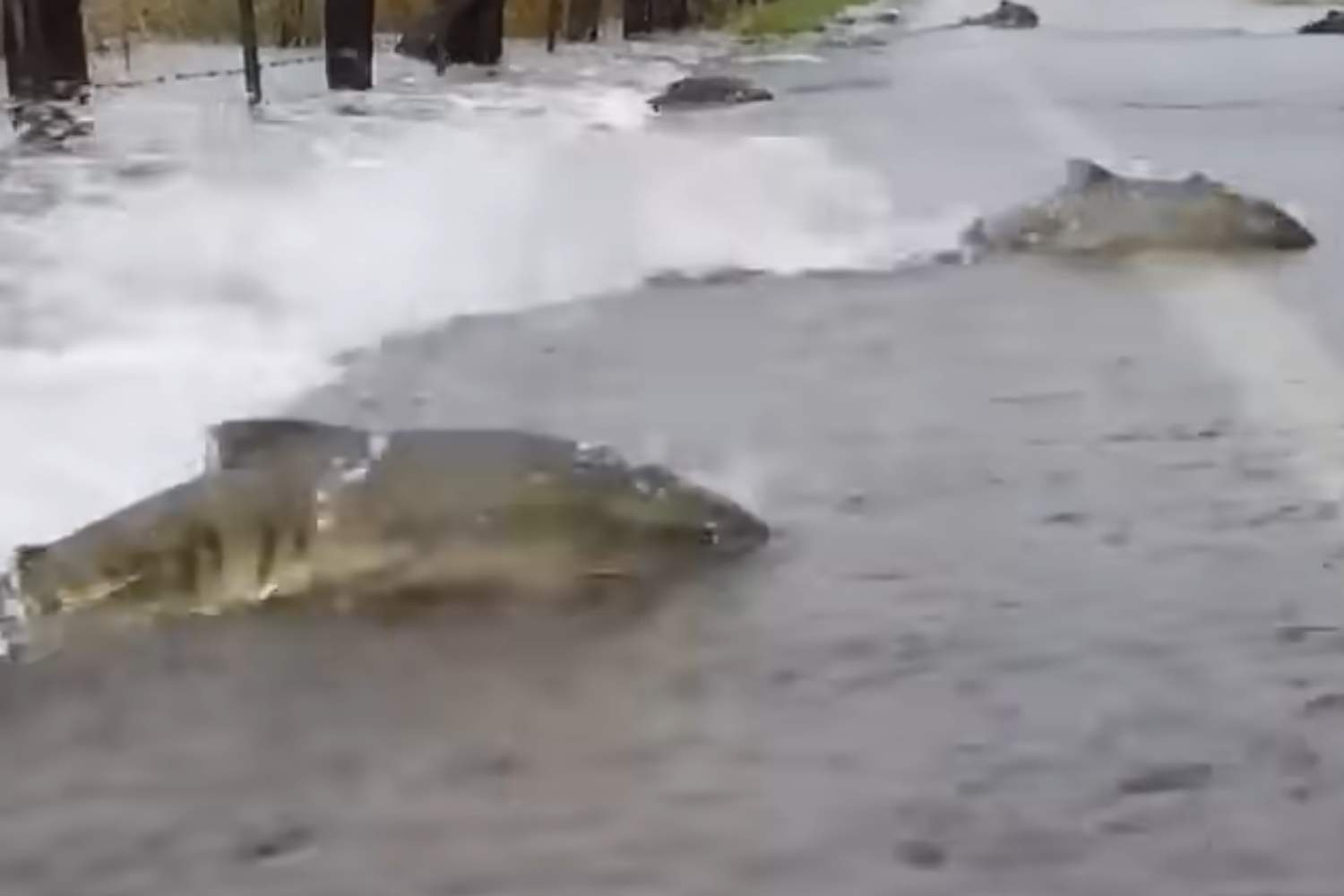
Every year salmon make one of the most extraordinary journeys in the natural world: they swim up rivers against the current to return to the place where they were born and reproduce. It is an ancient call, engraved in their instinct. But in Washington State, this thousand-year path increasingly collides with a foreign element: the road. In some areas, human infrastructure has been built directly along or over their natural routes, turning migration into an even more extreme ordeal.
Rain, flooded roads and broken paths
During heavy autumn rains, streams like the Skokomish River overflow, encroaching on roadways. The water drags the salmon with it, who suddenly find themselves crawling on the asphalt, driven only by the urgency of reaching the spawning areas. It is not a choice, but a direct consequence of the fragmentation of ecosystems caused by our works. Scenes that seem surreal reveal, in reality, a profound imbalance between nature and infrastructure.
The invisible price of migration
The ascent of the rivers is already the most critical moment in the life of a salmon. For weeks they stop feeding, use up all their energy reserves and face currents, predators and natural obstacles. Added to these today are artificial barriers. Many salmon are unable to overcome them: some die from exhaustion, others are run over, still others remain stranded far from the water. Every failure affects not just an individual, but the loss of an entire generation.
A global problem, not an exception
What happens in Washington is not an isolated case. From Christmas Island in Australia, where millions of crabs cross the roads, to many other migratory routes around the world, the conflict between animals and infrastructure is increasingly evident. Climate change worsens the situation, making rainfall more sudden and intense and increasing the frequency of these forced crossings.
Rethinking our space
These images ask us an uncomfortable question: how much space do we really leave for wild life? Salmon crossing a road is not a viral curiosity, but a warning sign. Rethinking bridges, canals and ecological corridors is not just a technical choice, but an act of responsibility towards balances that have existed for thousands of years and which today depend on our decisions.
You might also be interested in:
