
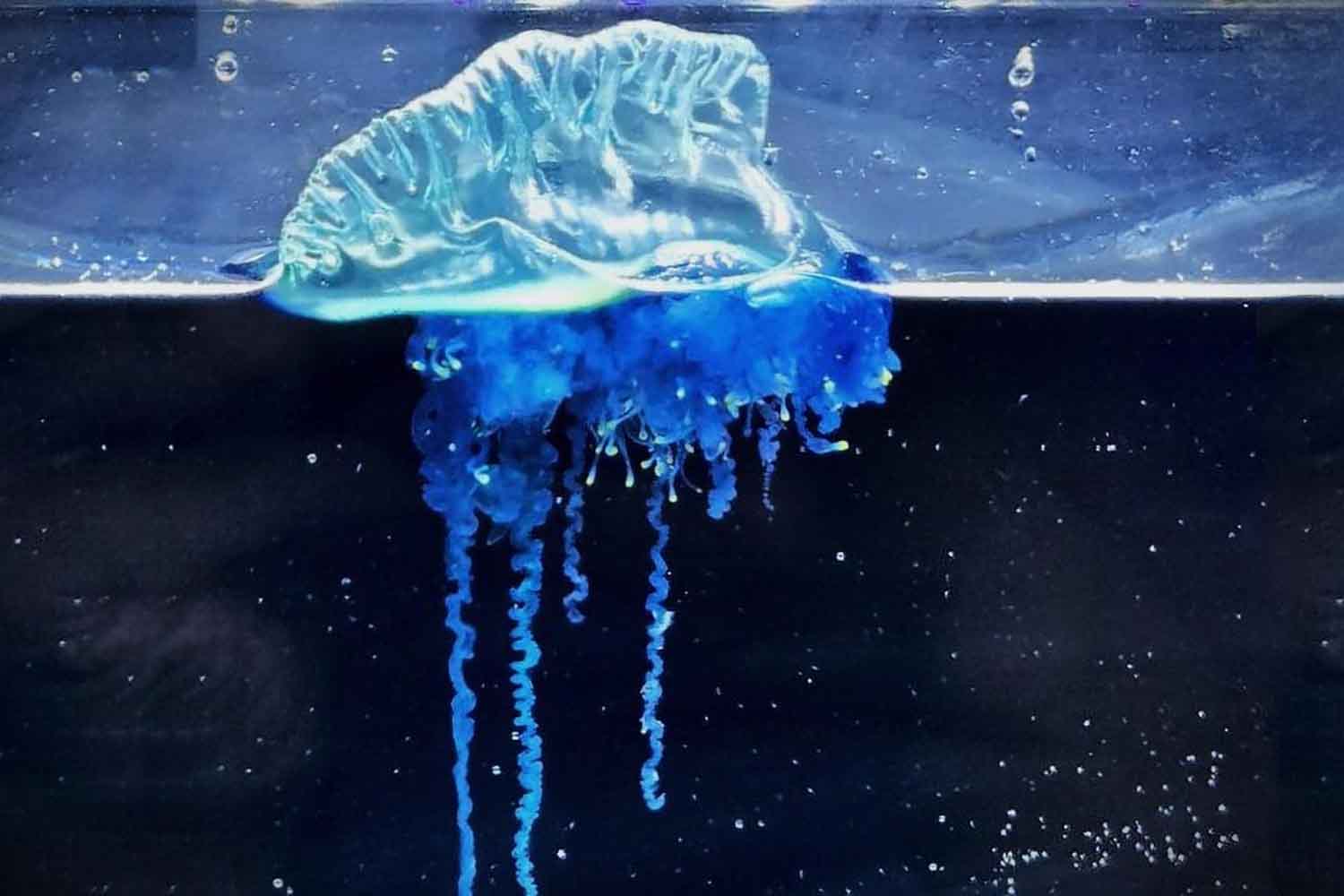
It should never have been there. And instead, in the summer of 2024, a poisonous sea creature, with hypnotic colors and a surprising history, appeared on the beaches of northern Japan. This is how researchers discovered Physalia mikazuki, a new species similar to the Portuguese caravel, probably transported there by unusually warm sea currents. A fascinating discovery, but also a wake-up call on the health of our oceans.
Gamo Beach, in Sendai Bay, is not a place used to tropical “guests”. Its waters, historically temperate, have always represented a natural barrier for species typical of warmer seas. For this reason, when in July 2024 some residents noticed strange, intensely blue floating structures along the shore, attention was immediately drawn.
They looked like balloons deflated by the sea, but the resemblance to the Portuguese caravel was uncanny. And not surprisingly: we are talking about one of the most poisonous marine organisms in the world. For years science has believed that gender Physalia included only one species, or at most two. However, the analysis of the specimens that arrived on the coasts of the Tohoku region of Japan told another story: it was something new, never described before.
The differences that made it a new species for science
The discovery happened almost by chance. Yoshiki Ochiai, engaged in a completely different research project in Sendai Bay, came across this organism never before seen in those waters. He collected it, took it to the laboratory and from there began a long and meticulous job, made up of observations, comparisons and anatomical details to decipher.
The name chosen, Physalia mikazuki, has a precise meaning. “Mikazuki” means in Japanese crescent and recalls the shape of the helmet worn by the legendary samurai Date Masamune, founder of the city of Sendai. A strong symbolic link with the territory in which this species was found.
From a physical point of view, the differences are not marginal. This new Portuguese caravel is much smaller than the known ones: the float measures from approximately 9 to 72 millimeters, while the best-known species can reach 30 centimeters. The colors are intense, with shades ranging from deep blue to purple, crossed by a translucent blue-greenish membrane.
The stinging tentacles and digestive polyps also change, with a curved shape and yellow ends similar to small balloons. Every single detail was compared to historical scientific texts, when the anatomy of these organisms was drawn by hand. In the end, the researchers no longer had any doubts: it was a new species.
A worrying arrival
Like all Portuguese caravels, Physalia mikazuki is also not a true jellyfish. It is a siphonophore, that is, a colony of organisms that collaborate as a single living being. There are those who deal with floating thanks to a bladder full of gas, those who capture prey, those who defend the colony and those who manage digestion and reproduction. A perfect biological machine, but extremely dangerous.
Its presence in Japan is not just a scientific curiosity. The researchers reconstructed the journey of these organisms using digital simulations of sea currents. It all leads to anomalous heat waves and warmer-than-normal currents, capable of carrying tropical species northward.
The consequences are not negligible. From an ecological point of view, Physalia mikazuki feeds on fish larvae and small planktonic organisms, with the risk of altering local balances and also affecting fishing activities. For people, the danger is real: its bites are painful and potentially dangerous, a new problem for a region that has never had to deal with this type of risk until now.
The discovery, published in the scientific journal Frontiers in Marine Scienceis therefore much more than a new entry in zoology textbooks. It is tangible proof of a changing ocean, dragging with it species, balances and problems that until recently seemed distant.
You might also be interested in:
