
At some point it happens. You look at your hands, your face, maybe a scar that takes longer than usual to heal, and you understand that the skin tells everything. He talks about the sleepless nights, the accumulated stress, the sunbathing without thinking too much. For years the answer has always been the same: creams, serums, high-sounding promises and, in the most advanced laboratories, human stem cells. Today, research opens up a different and surprisingly simple path: a microalgae that lives in fresh water.
A common microalgae as a natural ally for skin regeneration
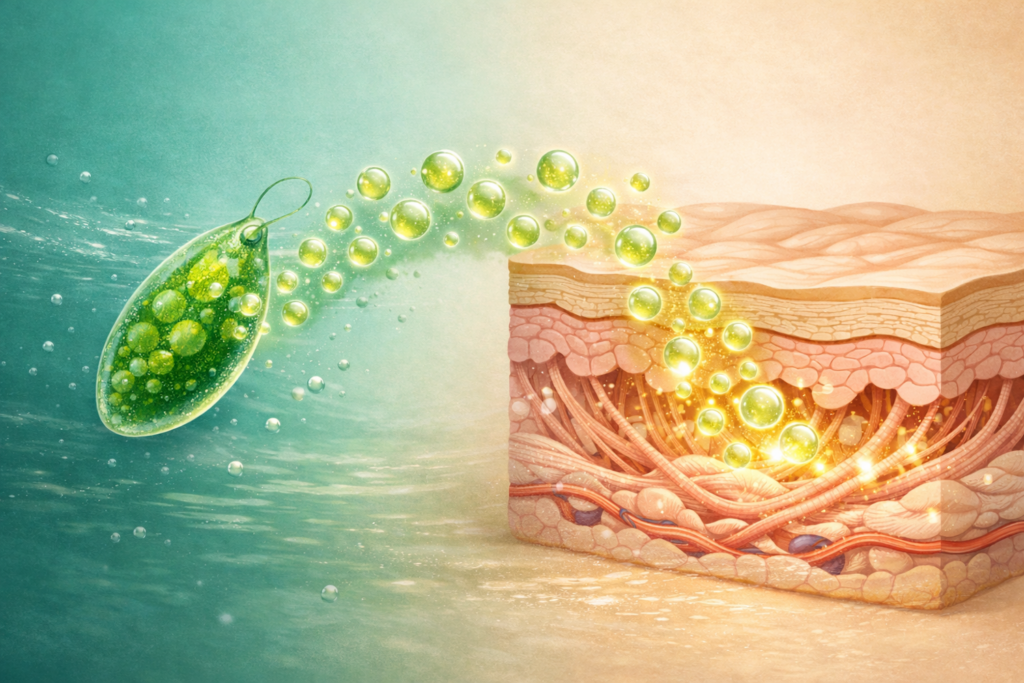
In South Korean research laboratories, some researchers have decided to observe Euglena gracilis from a new perspective. It is a green unicellular organism, present in lakes and ponds, often ignored. By subjecting these cells to controlled pressure through microscopic filters, a precise process occurs. Cells fragment and spontaneously reorganize into tiny vesicles.
These extracellular vesicles function as biological containers. They carry paramylon, a natural substance produced by algae, studied for its regenerative properties. The structure of the organism makes the process possible. Euglena has a flexible membrane, similar to that of human cells. This feature allows for cell extrusion, a controlled squeezing that transforms a single cell into multiple functional capsules.
The result is abundant, controlled and repeatable production of bioactive vesicles. The data shows a concrete ability to accelerate wound healing and stimulate the production of collagen, the protein that keeps the skin compact and elastic.
Because these microvesicles reach beyond the skin surface
The skin protects, filters, repels. Many cosmetic products remain on the surface precisely for this function. The extracellular vesicles obtained from microalgae have a structure compatible with human cell membranes. They come into contact with the skin, fuse with the cells and release their contents inside.
This delivery method makes the treatment more effective. The vesicles cross the skin barrier and interact directly with cells. The data collected indicates concrete benefits. Production costs are more accessible. Ethical issues become simpler. Health risks decrease. Large-scale production becomes technically feasible.
An already structured line of research develops around this study. Some groups work on vesicles derived from beneficial bacteria, such as lactobacilli, with results in photo-aging. Others develop hybrid systems that combine plant vesicles and anti-inflammatory molecules to protect skin cells from UV damage. The picture that emerges is coherent: science is learning to work with what biology already makes available.
You might also be interested in:
