
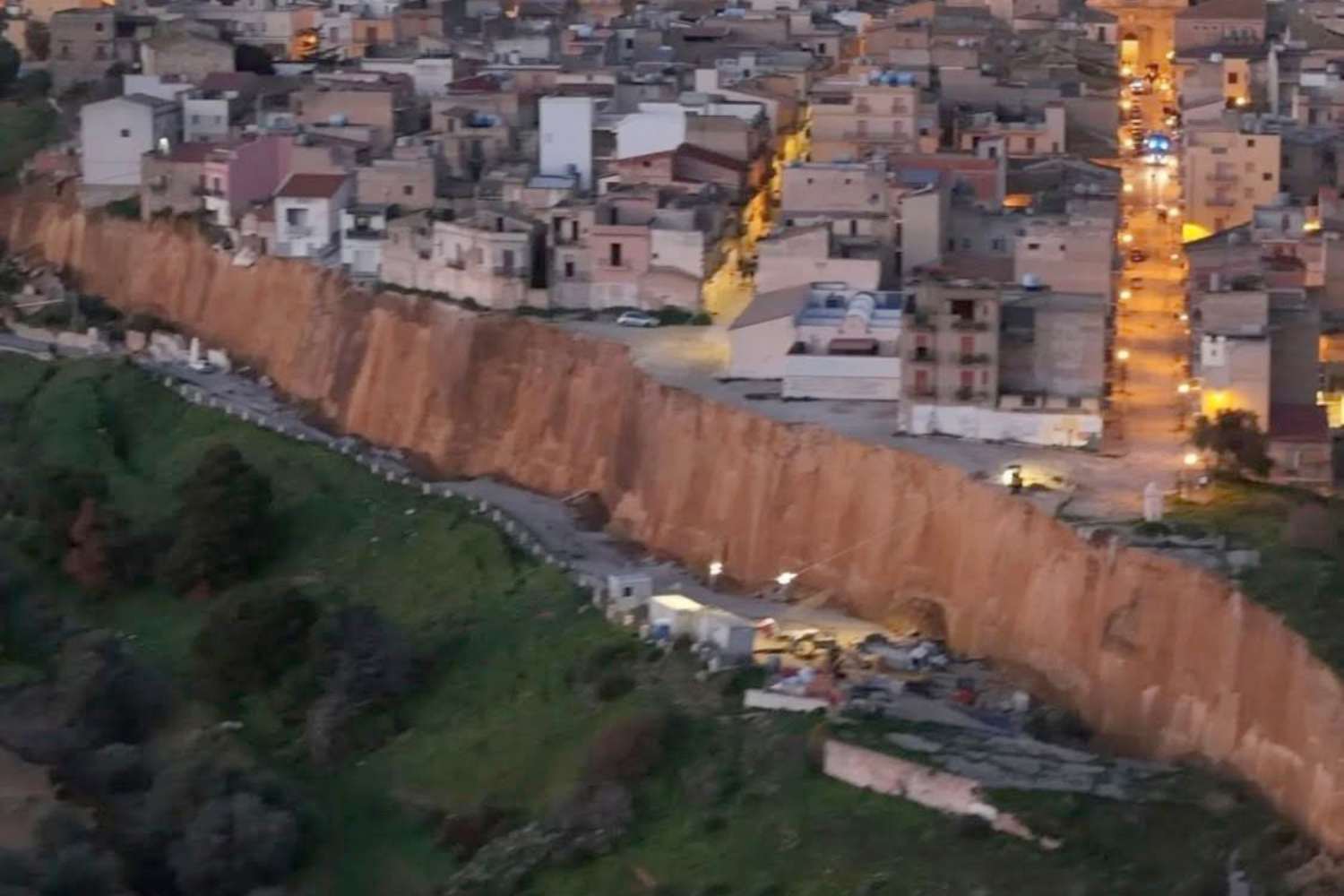
The Niscemi landslide continues to sow destruction: a short while ago a three-storey building collapsed. It was in the balance and evacuated some time ago, but disasters are added to an already devastated area. And it has been raining incessantly for 48 hours.
The landslides
Last week the municipality of Niscemi, in the province of Caltanissetta, experienced moments of terror: two landslides close together compromised road connections and forced hundreds of people to leave their homes. The latest landslide, that of Sunday 25 January, in the neighbourhood Holy Crossesaggravated an already critical situation after a previous landslide that occurred ten days earlier.
As a precaution, the authorities had ordered the evacuation of around 1000 residents from areas considered at risk, and the displaced people had been directed to temporary reception facilities. Schools had been closed, although children and young people have now returned to classrooms.
The collapse of a three-storey building
Landslide of #Niscemia 3-storey building collapses into a precipice #January 31st #news #actualityhttps://t.co/AnGFQMnGIh
— ilSud24.it (@iISud24) January 31, 2026
As local portals report, a three-storey building right in the Sante Croci district, one of those poised on the Niscemi ridge, collapsed. He was a few meters from the symbolic image of the car on the precipice. Yet another destruction in a devastated municipality.
NEW COLLAPSE A #NISCEMI.
The latest aerial shots filmed this morning by the “Local Team” (which has been carrying out exceptional information and dissemination work since the beginning of the emergency) are impressive. In the last few hours an entire three-storey building collapsed into the ravine. pic.twitter.com/3md8UllCqO— MC (@Virus1979C) January 31, 2026
But unfortunately it doesn’t end here: in Niscemi it has been raining for 48 consecutive hours and other buildings are at risk of collapse, slowly crumbling. The sign of a country that is literally dying.
#niscemi A three-storey building has just collapsed into a precipice.
— Cleofe (@100Cleofe) January 31, 2026
Climate change and land consumption
And unfortunately this latest collapse (which may not be the last) is not a surprise: on January 28, head of Civil Protection Fabio Ciciliano reported that the landslide was (and is) still active.
(…) not only what we see is collapsing, but the entire hill that is descending towards the Gela plain
And no, it is not a misfortune due to bad luck: it is one of the increasingly frequent consequences of climate change and the wicked consumption of land, with the associated irresponsible building illegal activity.
It is not bad weather, the whole of Italy has now become a sad theater of extreme events, from record hailstorms in the Po Valley to floods in the Marche region, to the latest devastating cyclone Harry in the south.
And the consequences are no coincidence.
The sandy soil – explained Riccardo Ferraro of the Italian Society of Environmental Geology – has a shear resistance angle of around 35 degrees, while the slope reaches inclinations of up to 85 degrees. An unnatural condition, destined to rebalance sooner or later. The intense rains and the Cyclone Harry they accelerated a process already underway, saturating the surface layers with water and triggering sliding
What happened in Niscemi is the “natural” consequence of poor management of the territory: hydrogeological risk ignored and, in several cases, illegal building practices which continue unabated in the South.
A deadly mix: the climate crisis hits hard but, where everything is more fragile, even more so.
