
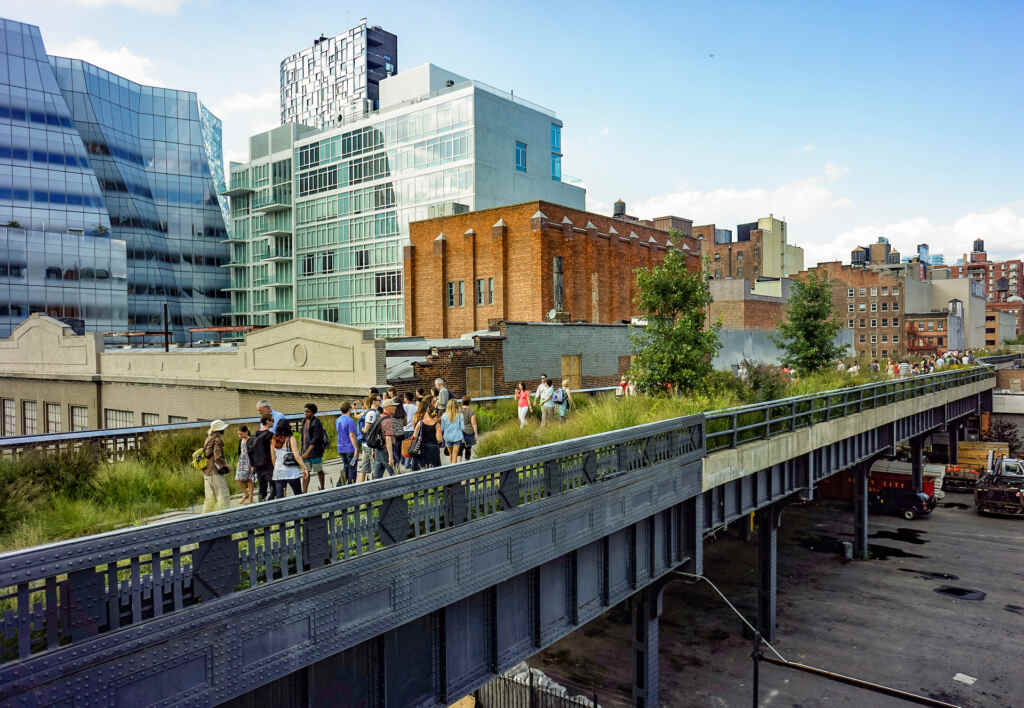
In New York there is the High Line, in Rome the green ring road could arrive. The idea is to intervene on a currently unused section of the Eastern Ring Road, between the Tiburtina station and Batteria Nomentana, to transform it into a linear green space designed for the city. This is not a ready-made executive project, but a process officially launched by the Capitol to evaluate its feasibility, impacts and costs.
In recent days the council led by Roberto Gualtieri approved a document that starts the planning process. The passage comes after a motion voted unanimously in the Capitoline Assembly and places the proposal within the urban regeneration and sustainable mobility policies on which Roma Capitale has been working in recent years.
A project included in Rome’s climate commitments
The green ring road is connected to the environmental objectives set by the UN Agenda 2030 and by the Climate City Contract of Roma Capitale, approved in October 2025. Rome is one of the hundred European cities called to aim for climate neutrality by 2030, a goal that requires structural interventions, especially in the urban areas most affected by traffic and infrastructure.
In this context, the project has already obtained formal recognition as the first UNESCO urban oasis, indicated as a reference model for the creation of green spaces in metropolitan contexts with high infrastructural density. A recognition which, in intention, should accompany the transformation process and not replace its concrete evaluation.
From the viaduct to the park: what could change
The proposed intervention concerns approximately two kilometers of disused infrastructure, to be converted into a linear park of 3.4 hectares. The project aims to restore urban continuity to an area that is currently fragmented, introducing greenery, cycle and pedestrian paths and accessible spaces. The setting is that of a park designed to also function from an environmental point of view, with the use of renewable energy, composting practices and soil remediation interventions.
Alongside ecological aspects, the area should host leisure spaces, sporting activities and initiatives related to urban agronomy, including educational activities and workshops. The project involves the planting of over 500 trees and the inclusion of new urban services, including a greenhouse, a market and an auditorium, as well as cycle paths and connections with the Nomentano and Tiburtino districts.
Expected impacts on air, heat and water management
Among the declared objectives is the reduction of air pollution, with a containment of PM10 and CO₂ and a decrease in local traffic. The increase in greenery should also help reduce heat islands, one of the most evident problems in Roman summers, by lowering temperatures in the surrounding areas.
The installation of a rainwater collection and purification system is also planned, which would be reused for irrigation of the park. A solution designed to improve the management of water resources and reduce urban vulnerability to extreme weather events.
An open project, between research and shared management
The green ring road was also designed as a space for experimentation. Collaboration with universities and research centers present in the area could transform the park into an open-air urban laboratory, dedicated to environmental education and applied research.
The hypothesized management model is based on collaboration between institutions, citizens and associations, through forms of public-private partnership involving the Municipality of Rome, Cassa Depositi e Prestiti, Italian Railways, universities and international bodies such as UNESCO and FAO. The project was conceived by Nathalie Grenon of Studio Sartogo Architetti Associati together with the Agenda 21 working group, with the support of national and international partners.
In a quadrant of the city where residents and committees have been asking for environmental redevelopment interventions and usable green spaces for years, the launch of the feasibility study represents a first step. The decisive step will be to understand times, resources and methods of implementation, to evaluate if and how this portion of the Eastern Ring Road can really change its function and role in the city.
You might also be interested in:
