
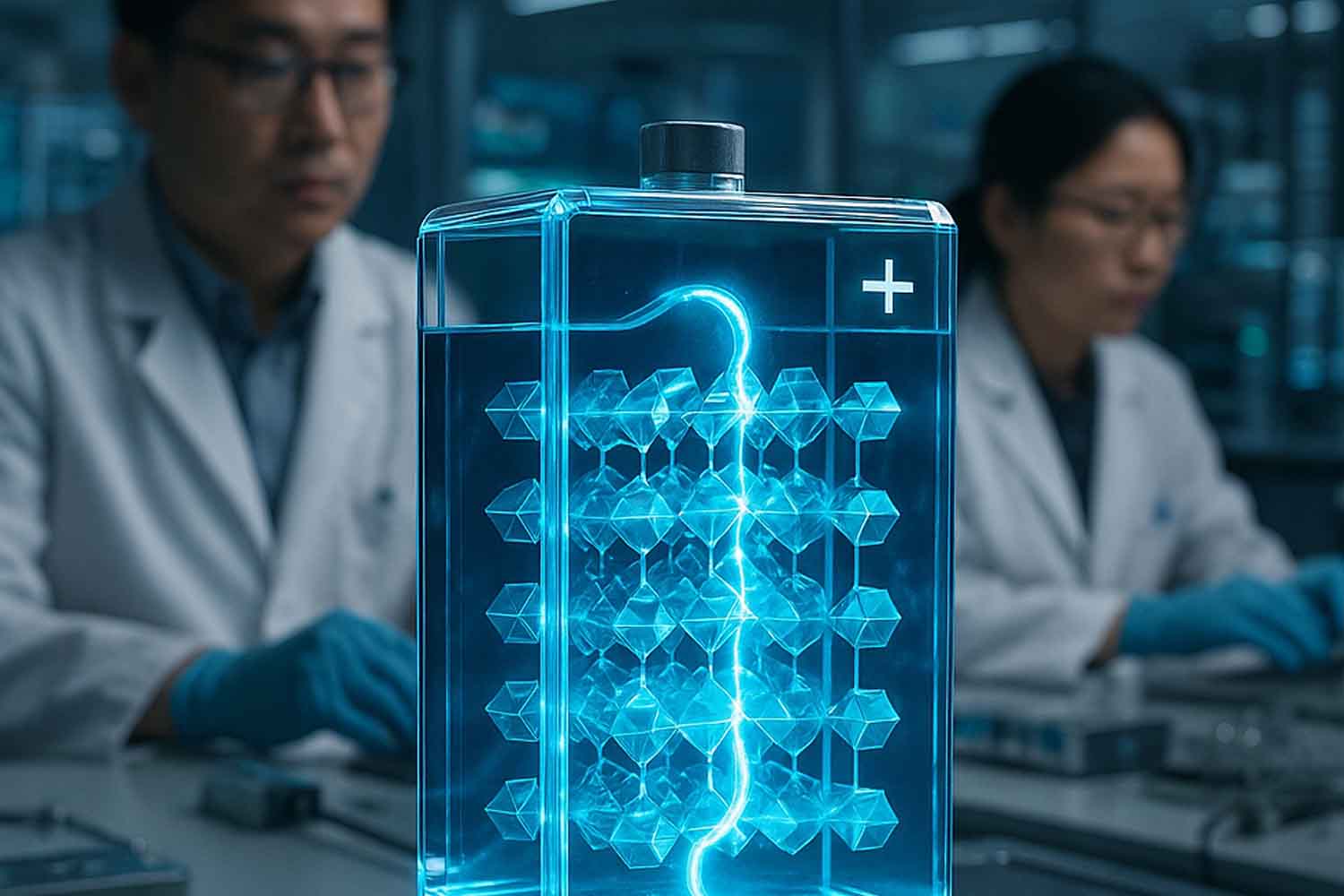
A team of South Korean scientists has developed one Battery in Perovskite capable of achieving electronic efficiency well 56,000 times higher compared to the currently existing models. This discovery could revolutionize the energy accumulation sector, laying the foundations for a new generation of more powerful, compact and sustainable devices.
The project was led by a group of researchers from theUlsan National Science and Technology Institute (UNIST)in collaboration with theKorean Institute of Materials Science (Kims). The goal was to overcome the structural limits of the current cells in Perovskite, and the results obtained were surprising.
Here’s how the new battery in Perovskite works and because it is so efficient
At the basis of this extraordinary progress there is the use of a supermonical material in perovskite with crystalline structure. Scientists managed to drastically improve the Mobility of ionsallowing electrons to flow with a speed never recorded before. All without compromising the stability of the material.
One of the keys to success was the optimization of the interface between the electrolytic material he is Solid cathodstwo fundamental components in solid state batteries. This new approach has allowed one almost total reduction in resistance to the passage of ionswith an exponential increase in performance.
The team has developed a Solid electrolyte based on a structure in perovskite of the Li₃xla₂/₃ – Mitio₃a compound that has shown an extremely high Ionian conductivity, while maintaining thermal and mechanical stability. The result is one solid state battery capable not only of reaching record performance, but also to maintain the safety and reliability necessary for large -scale applications.
Potential applications
This innovation opens extraordinary scenarios for the future of energy. New generation perovskite batteries will be able to find employment in different sectors, come on electric vehicles to smartphoneup to Accumulation systems for renewable energies.
Thanks to theirs high energy density and the ability to operate at safer temperatures than traditional lithium batteries, these cells represent a fundamental step towards more devices reliable, lasting and sustainable.
The researchers also stressed that the materials used are more cheap and easily availablewhich could reduce production costs and make this technology accessible on a large scale.
