
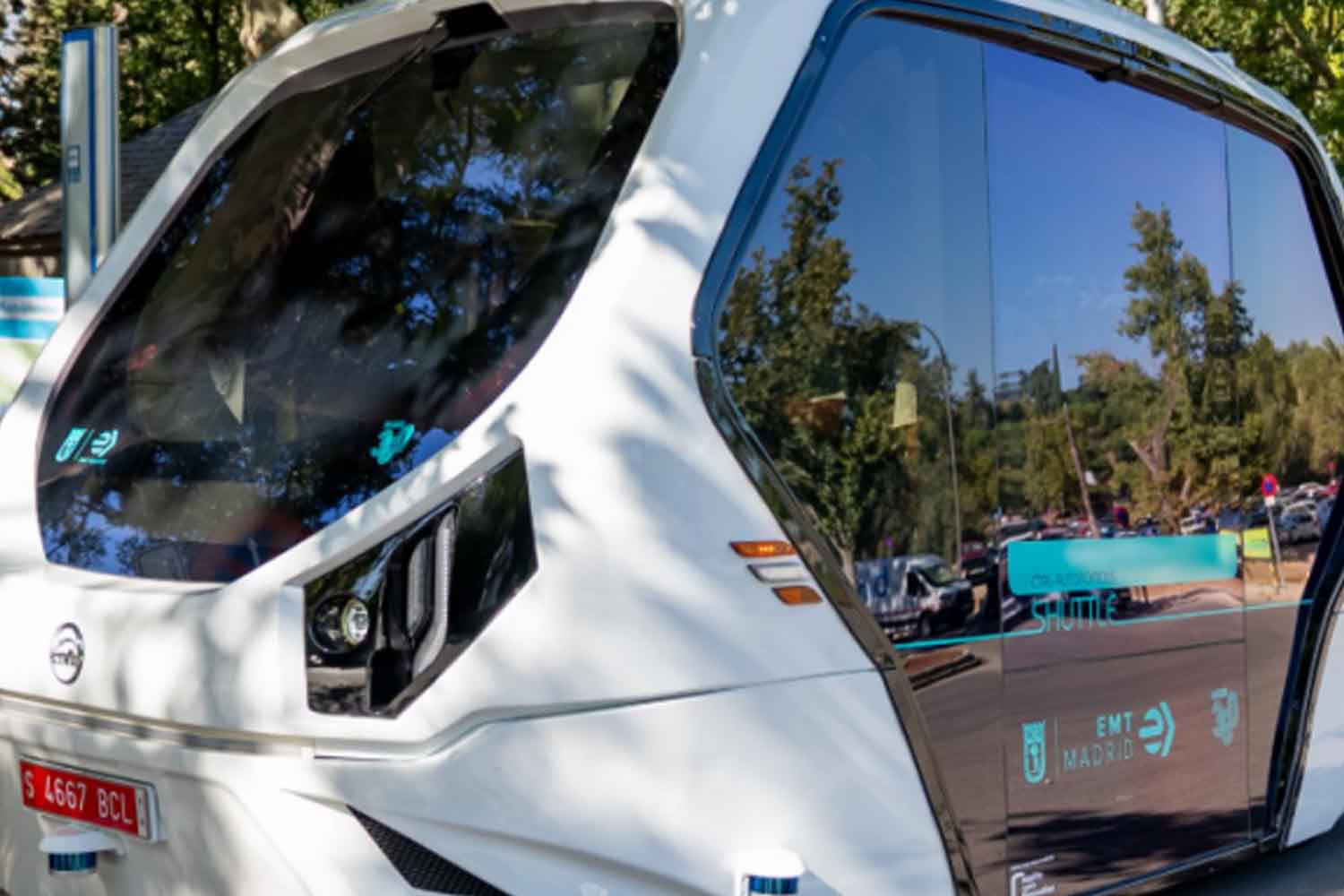
Madrid has taken a historic step towards the mobility of the future with the introduction of its first electric autonomous bus in the Casa de Campo. It is a minibus capable of carrying passengers without a driver, the result of a collaboration between the Empresa Municipal de Transportes (EMT) and the Centro Tecnológico de Automoción de Galicia. The initiative, included in the European Mobility Week, offers a free service on a 1.8 kilometer circuit and allows autonomous driving performance in an urban environment to be evaluated in real conditions.
The main objective of the trial is to test the safety and efficiency of this technology in contact with city traffic and pedestrians, paving the way for a cleaner and more intelligent transport system.
Technology, accessibility and sustainability
The fully electric vehicle can accommodate up to 12 passengers and operates from Monday to Friday during the day, with six stops along the route. Thanks to LIDAR sensors, cameras, GPS and advanced processing software, the bus is able to detect pedestrians, cyclists, traffic lights and obstacles, reacting autonomously to traffic changes. However, an operator remains on board to ensure safety in case of emergency.
This minibus represents a fusion of clean energy and autonomous technology, elements that reduce emissions, lower noise levels and improve road safety. Its monitoring systems record parameters such as speed, trajectory and accessibility, providing valuable data to optimize urban mobility.
Environmental and social benefits
In addition to promoting a cleaner environment, the experimentation promotes inclusive and accessible transport, also designed for people with reduced mobility. In fact, automation allows for a more fluid and controlled experience, while the electric motor helps to drastically reduce CO₂ emissions.
EMT emphasizes that this technology is not intended to replace drivers, but to support public service in areas of high demand or staff shortages. With the success of this project, Madrid joins the group of European cities at the forefront of experimenting with autonomous public transport, together with Paris and Stockholm.
The Spanish capital thus demonstrates its desire to lead the transition towards more efficient, safe and sustainable urban mobility, paving the way for a future in which innovation is placed at the service of people and the environment.
You might also be interested in:
