
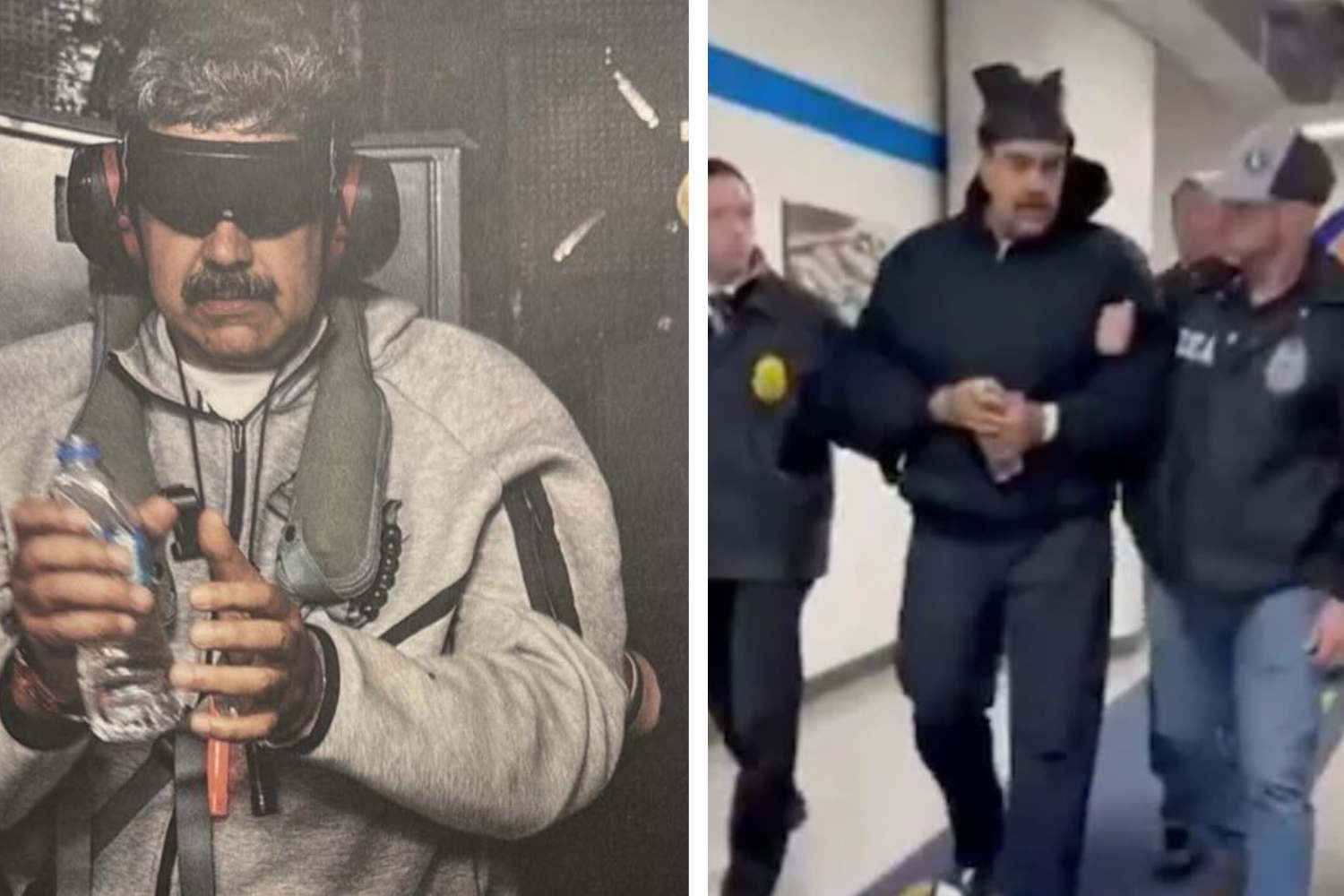
After yesterday’s capture, Nicolás Maduro arrived in New York. The images, released on social media by the Trump administration’s Rapid Response 47 account, show the Venezuelan leader handcuffed and accompanied by federal agents as he walks down the corridor in the headquarters of the Drug Enforcement Administration.
Last night Maduro and his wife Cilia Flores were surprised in their sleep and taken away by US forces during a sensational military action that openly violates international law. In the meantime, the bombing of Caracas and various military sites caused around 40 victims, including civilians, and people died, both civilians and soldiers, as quoted by the New York Times.
The accusations against Maduro
Nicolás Maduro is currently with his wife at the Metropolitan Detention Center in New York, awaiting trial. The charge of conspiracy to commit narco-terrorism, and possession of weapons of war and destructive devices to be used against the United States.
Donald Trump confirmed this during a press conference, referring to the capture of the Venezuelan president as “one of the greatest displays of force ever seen by the US”, comparable to the attacks against Soleimani, Al-Baghdadi or Iranian nuclear sites” and underlining that the objective would be “freedom for the Venezuelan people”.
The real reasons for Trump’s military aggression
The tycoon wants to convince the world that his serious attack was driven by the fight against drug trafficking and by pity towards the Venezuelan people. That the inhabitants of Venezuela, brought to their knees by rampant corruption and poverty due to a highly authoritarian and repressive regime, are not doing well is undeniable, as is the fact that the country is an important transit territory for cocaine. However, according to the UN Office on Drugs and Crime (UNODC), the South American nation is not a real “narcostate”, as claimed by Trump.
The tycoon’s interference has a much deeper geopolitical significance. In fact, Venezuela has the largest oil reserves on the planet (i.e. 18% of world reserves) and a significant part of its crude oil has also ended up under Chinese orbit in recent years. Beijing has used Venezuelan oil as an energy and financial lever, consolidating a presence that Washington considers unacceptable in its “backyard”.
In other words, it is not a question of “defending democracy”, but of deciding who commands the raw materials and maritime routes of Latin America.
On an ideological level, this line of action fits unambiguously into the Monroe Doctrine, which was enunciated in 1823 by US President James Monroe (in a period in which Latin American colonies were gaining independence) and today revived by Trump. The principle remains the same as two centuries ago: the entire Western Hemisphere is considered an area of exclusive interest to the United States, and any penetration by rival powers is considered a threat to be eliminated, at any cost, even with military force. The US president’s interest is in establishing a pro-Trump government in Venezuela, in order to extend his influence.
What future for the Venezuelan people?
Now the future of Venezuela is uncertain and seems to be in the hands of Trump, who announced: “We will guide the country to a safe, proper and judicious transition. We do not want to be involved, nor for someone else to take our place and find ourselves in the same situation we have experienced in the last long years”.
The reaction of Nobel Peace Prize winner María Corina Machado – a great supporter of Trump and Nethanyau – was not long in coming: “Today we are ready to assert our mandate and take power. Venezuelans, the time for freedom has come!” he wrote on his X account. But at the moment the tycoon seems to exclude his direct involvement, given that he does not have the support to govern the country.
Trump’s attacks in the past few hours could be just the beginning of a much more violent escalation. In this regard, Amnesty International has launched an appeal, raising fears for civilians and activists in the Latin American country.
The military action conducted yesterday in Venezuela by the Trump administration, which led to the capture of Nicolás Maduro and Cilia Flores, raises serious concerns for the human rights of the Venezuelan population. It most likely constitutes a violation of international law, including the United Nations Charter, as is the United States’ declared intention to manage the country and control its oil resources. – we read in a statement – Amnesty International is particularly concerned about the risk of a further escalation of human rights violations in the country, which could arise both from new US operations and from the Venezuelan government’s response to US attacks.
Trump’s violent intervention has been hailed as a lifeline by many Venezuelans celebrating Maduro’s capture, but the problem isn’t whether the Venezuelan leader is liked or not, it’s how he was taken out. History repeats itself. The USA “exports democracy” with bombs and military raids. Over the last half century it has happened with countries like Iraq, Iran, Libya and now Venezuela. What do they have in common? Have significant oil reserves.
“There is no people who are more just than the Americans. Even if they are forced to wage a war, due to reasons of force majeure, of course, they do not do it because it is convenient for them. – Giorgio Gaber recited in 1996 in one of his powerful monologues – No! It is because there are still places where there is neither justice nor freedom. And they, there it is, pum! They bring it to you. They are carriers, the Americans. They are healthy carriers of democracy. In the sense that It doesn’t hurt them, but they stick it to you.
