

Unmissable double show in the May sky: for two consecutive nights, 4 and 5 of the month, Mars it will be “immersed” in the splendid Crib cluster. The event, among other things, will take place just before the peak of the splendid falling stars Eta Aquaridi. Not to be missed!
As the UAI explains, on the nights of 4 and 5 May the red planet will cross the open star cluster of the crib, after leaving the conjunction with the moon the previous evening. A show that, with a little luck, could be also seen to the naked eye (in the maps the Heaven of 4 and 5 May at about 11.00 pm).
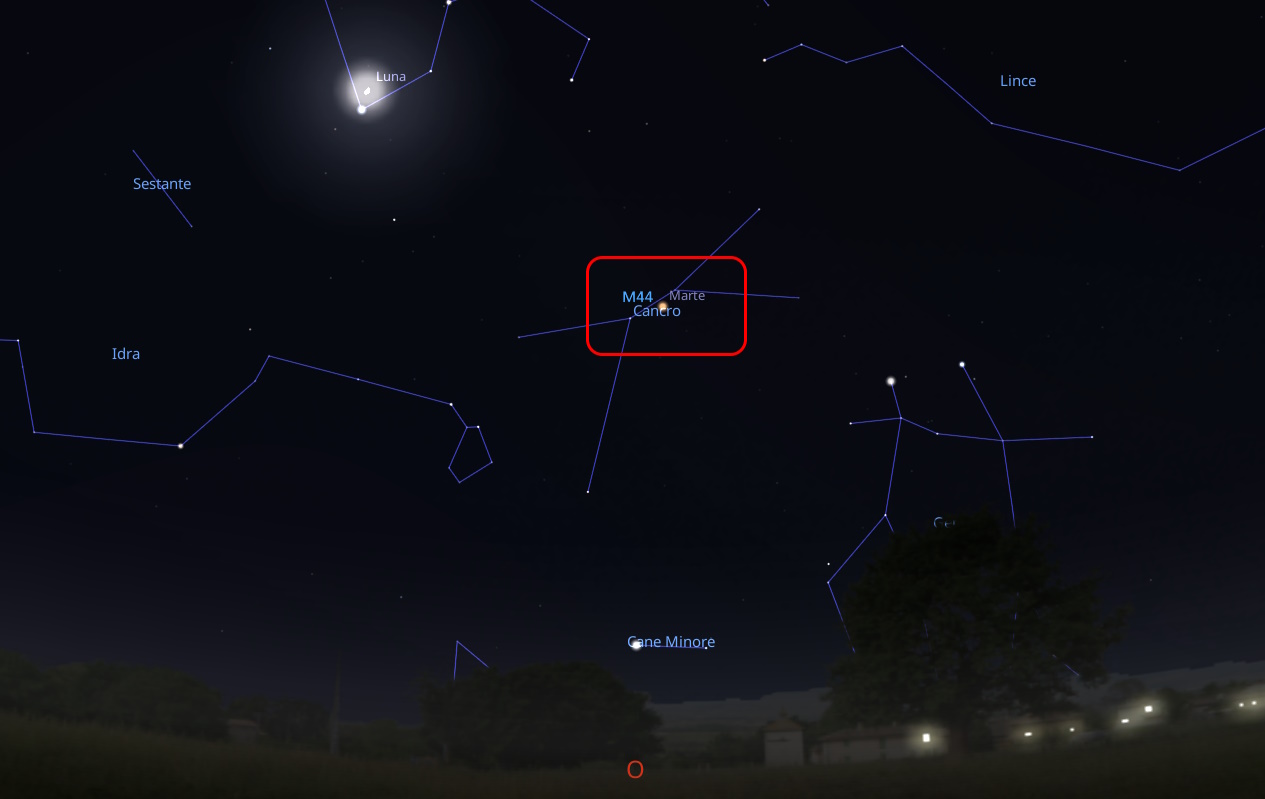
As Starwalk reportsin fact, theCrib cluster listed in Messier catalog like Messier 44 or M44 and can be identified in the Cancer constellation also with the naked eye, as it is the third object of Messier brighter after the Pleiades and the Andromeda galaxy and the second object Deep-Sky closer in the catalog after the Pleiades.
To be more precise, with the naked M44 eye it may appear as a bright spot blurred with the naked eye in dark places without light pollutionand, reading the maps well, in reality you can see even in less ideal conditions. To better observe the stars, especially clearly distinct, it is preferable to have at least a good binoculars.
We also know that M44 is a open clusteras his stars, born approximately in the same period from the same gigantic molecular cloud, are linked together in a lasso way, and that it is rather “young” in astronomical termswith an age between 600 and 700 million years (for comparison, our own sun system is formed about 4.6 billion years ago).
The event, which is unmissable in itself, will also take place in full activity of the splendid Eta Aquaridithe shooting stars More numerous and shining of spring: in fact the peak is expected on May 5 and 6, but the swarm is actually for several days, so we can hope for a large number of meteors even a few days before and a few days after the peak, perhaps even during the life of Mars surrounded by stars.
Not to be missed!
Source: Uai
