
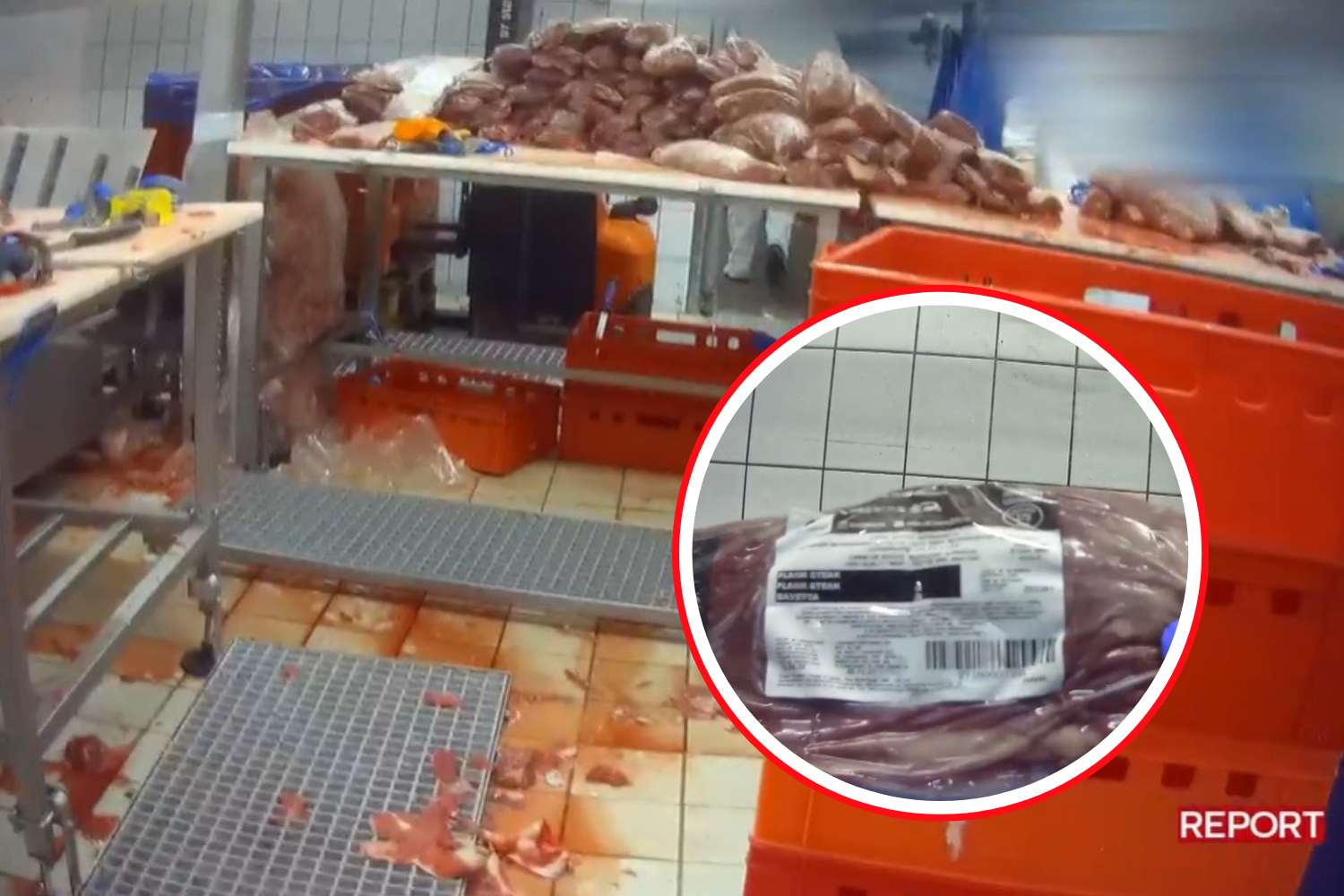
A system of “recycling” of expired meat that may have continued for years, amidst alarming hygienic conditions and ineffective controls. This is what emerges from the shocking investigation by Report, broadcast on Sunday 23 November on Rai3.
Giulia Innocenzi’s investigation, with the eloquent title “Nothing is thrown away“, shows the inside of the Bervini factory in Pietole, in the province of Mantua, on an ordinary day of meat processing. We are talking about a historic company in the area that manages around 200 million euros of imported meat every year.
What you see in the videos shot undercover is expired meat, coming from Uruguay, New Zealand, other countries and even from Egyptian military reserves, which is thawed, manipulated and refrozen to be put back on the market.
A worker at the plant, with his face obscured to protect his identity, told Report chilling details about the meat: “It was black, it smelled, it was ugly. To the sight and smell it was inedible“, he declared, referring to cuts that had expired for two, three, up to four or five years. In one day’s work, the worker also managed to film some labels, showing that it was meat expiring in 2023 or even earlier.
The procedure, the employee explained, was always the same: on Friday evening a truck arrived with pallets of meat which was immersed in boxes of cold water throughout the night. The following morning, the water was replaced with hot water to soften the still frozen pieces.
Meat “cleaning” operations
Once thawed, the meat was subjected to what the workers called a “cleaning operation”. The packages were thrown onto the tables, opened with a knife and stripped of the brown surface layer, the most compromised one.
We try to restore the meat as if it were clean, that is, the first layer is removed, the one that is most stained, the blackest, the parts that may perhaps be smelliest. – explained the worker, who then continues – When the piece of meat takes on an almost healthy appearance, it is repackaged and refrozen or is finished defrosting and immediately sent to the market.
But this practice is far from safe. As clarified by the expert Nicola Decaro, Director of the Veterinary Medicine Department – University of Bari, when interviewed by the broadcast:
Why does the top layer turn brown? Because there was the uncontrolled proliferation of bacteria which caused the putrefactive process to begin.
And simply removing the visibly deteriorated part is not enough:
Expired meat implies an uncontrolled proliferation of bacteria, including some pathogens that can harm human health.
After all this “processing”, the meat was repackaged with new labels that reported false data – erasing any trace of the real expiry date – and put back on the market as if nothing had happened.
Freezing does not kill bacteria
One of the most worrying aspects concerns the false belief that freezing can eliminate risks:
Freezing stops microbial growth, but it does not mean that it kills the bacteria, because the bacteria present in this meat still remain alive and viable – explained Decaro.
And defrosting in hot water, a practice documented in the investigation, makes the situation even worse:
Most bacteria, especially pathogenic ones, have an excellent replication temperature that fluctuates between 36 and 39 degrees, so contact with hot water facilitates bacterial proliferation.
The risks for consumers are therefore concrete and serious:
Pathogenic bacteria such as salmonella, listeria and others have devastating effects, from diarrheal forms to neurological manifestations, therefore very serious diseases – underlined the expert.
Critical hygienic conditions
The images collected by Report show a truly disturbing scenario: pieces of meat falling to the floor and being simply repositioned in containers, work surfaces soaked in blood, cabinets invaded by cockroaches. In some cases, the bags were even removed, leaving the meat floating directly in the water of the tanks, without any protection.
It remains to be clarified how practices of this type can occur.
The Valpadana ATS, after having viewed the images collected from the broadcast, declared that it will intervene promptly to investigate the case. It will now be the task of the competent authorities to shed light on what happened, verify the actual extent of the affair, ascertain any responsibilities and reconstruct who that potentially dangerous meat was sold to. Only at the end of the investigations will it be possible to establish with certainty whether and for how long these contested practices were implemented.
The company’s response
When asked by Report, the Bervini company firmly rejected all accusations, claiming that “the meat we market has never, under any circumstances, reached its expiry date“. In the official reply, the company specified that community and national regulations allow freezing fresh refrigerated meat before it reaches its expiry date, transforming it from “fresh chilled meat” a “fresh frozen meat“, and that all operations are carried out “according to strictly controlled procedures“.
The company also underlined that in its years of activity “no food safety problems and no food alerts have ever been generated by the work of the Bervini company” and that the factories are “constantly subjected to checks by the State Authorities”.
This is the full reply:
Bervini Primo Srl, in reference to the request received from the “Report” broadcast, firmly rejects any accusation of reselling expired meat.
The meat we market has never, under any circumstances, reached its date deadline, let alone exceeded it, as the Bervini company has always applied punctually comply with community and national laws and ministerial provisions.
The regulations and ministerial provisions allow the freezing to proceed of fresh refrigerated meat, vacuum-packed, before it is reached the expiry date assigned by the manufacturer.
This operation does not change the status of the fresh meat which changes from “fresh meat”. refrigerated” to “fresh frozen meat”.
Operations are carried out according to strictly controlled procedures, which guarantee the full healthiness of the product.
Proof of this is that in all these years of activity there have been no safety problems food and no food alert has ever been generated by the processing of Bervini company.
Our factories are constantly subjected to checks by the State authority.The Community and National regulations that support these operations are:– EC Regulation 853/2004
– Law 25/2022
– Ministry of Health note dated 4 April 2022.It is mandatory on original packages that are subjected to freezing indicate, in accordance with the law, only the freezing date. Such frozen meats may be intended for processing by others food sector operators.
