
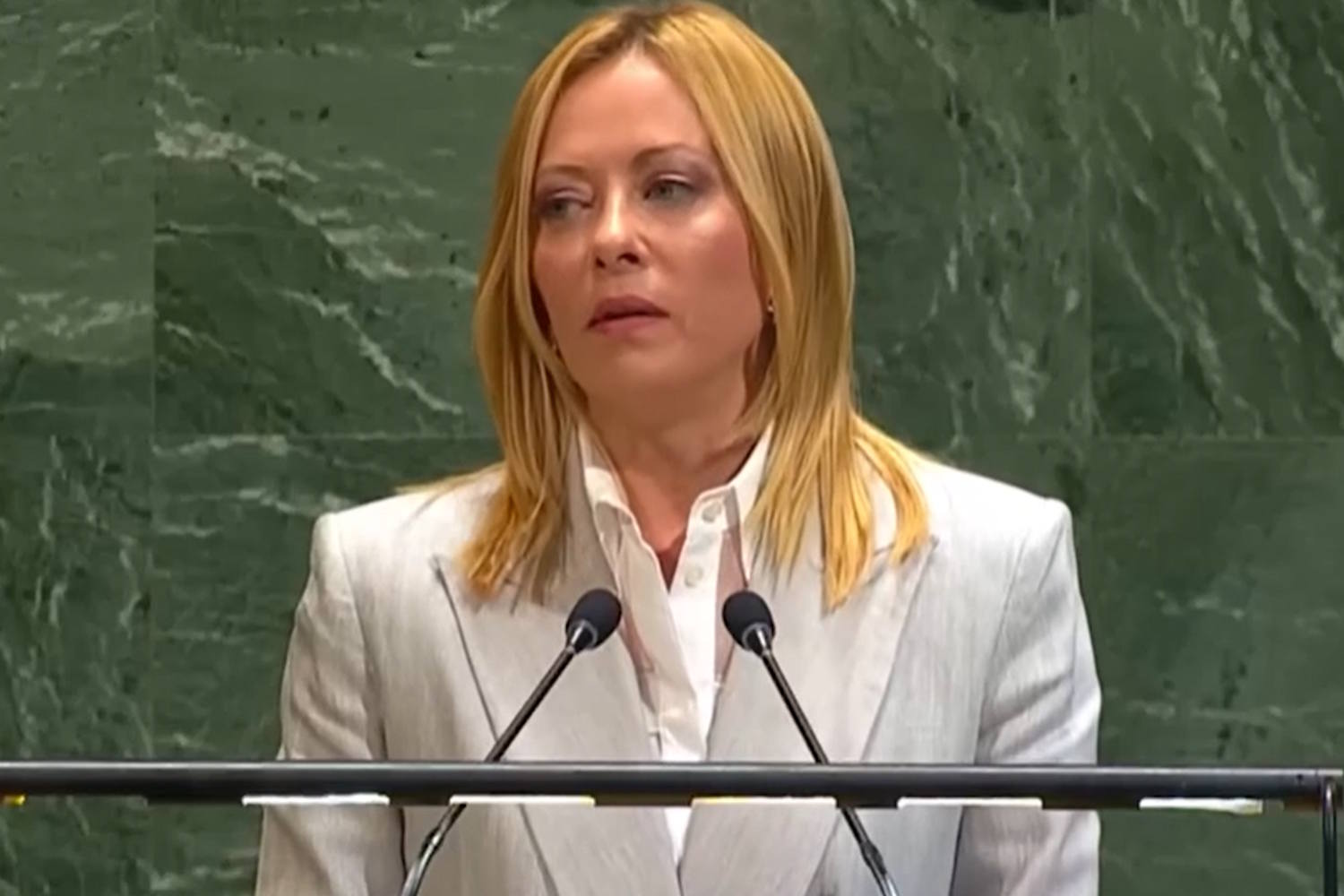
Untitantoesima General Assembly of the United Nations, new day: the one in which, in the New York headquarters, our Prime Minister Giorgia Meloni, made a speech that – from certain points of view – pairs with that of Donald Trump of the other day.
Things will be able to go much worse if we do not stop the creation of unsustainable production models at the table – thunders -, like the “green plans” that in Europe – and in the entire West – are leading to deindustrialization long before decarbonisation.
And so also Giorgia Meloni, after the tycoon, describes environmental policies and ecological transition as factors of social and economic destabilization, coming to contest its environmental benefits and to accuse them of “deplete knowledge“.
Once again, therefore, we have to disassemble point by point by removing that not, it is not the transition that affects families and businesses but the climatic crisis.
The phrases of President Giorgia Meloni and the facts
- “Unsustainable ecology has almost destroyed the car sector in Europe … and has not improved the overall health of the planet“.
– fact checking (car): the European car sector is in difficulty (energy costs, Chinese competition, poorly governed transition), but “almost destroyed“It is a caricature. We are still talking about 13–14 million jobs in the EU car ecosystem and over 3 million in the core manufacture.
-Fact checking (climate): to say that “green” policies have not improved the state of the planet ignores a trivial fact: EU emissions dropped by 37% compared to 1990, with -9% in only 2023 (historical record), driven by energy. The ETS system also saw -5% in 2024. They are measured reductions, not chatting. (European Environment Agency) - “The ‘green plans’ are leading to deindustrialisation long before decarbonisation“
– Fact checking: confuses cause and effect. In 2025, the physical impacts of extreme events are mainly affecting families and businesses, not the transition itself: the estimate for the summer 2025 in Italy is 11.9 billion euros losses, which will rise to 34.2 billion euros by 2029. It is part of EU damage from € 43 billion in 2025 (up to € 126 billion per 2029). These numbers come from an analysis university of Mannheim: if ignored, the costs rise; This is true deindustrialization, because of the change that changes. - “Ecologism … made it lose jobs“
– fact checking: rather transition move jobs; It can destroy some and create others. Macro evidence: the health and employment co-benefits of policies consistent with the net-zero are documented (less dead from pollution, less days of illness, better productivity). A review on The Lancet Planetary Health finds systematic health co-benefits; Ipbes quantifies opportunities up to 395 million jobs by 2030 if you act on nature and biodiversity. - “Has not improved the state of health … of the planet” (again)
– Fact checking: heat and pollution kill today. In the summer of 2024 Europe recorded 62,775 deaths related to heat, over 19,000 in Italy: doctors have no doubts about what it is used for (reducing emissions and strengthening fragile protection). Primary prevention is decarbonize: it means less dust/no₂/ozone, less hospitalizations and deaths. - “Technological neutrality and gradualism vs ideological extremism“
– Fact checking: technological neutrality makes sense if they measure the results (emissions on the whole life cycle) and do not use it to postpone. Meanwhile, banal extreme weather events are already pushing prices and inflation: ECB and connected studies bind waves of heat and drought to shock on productivity and food prices. Delaying climatic action increases macro costs, other than “saving gradualism”.
The benefits of the transition (to name a few eh: less dead, better air, minor health costs, new employment) are in short widely documented. To say that the “green” is not needed, that “deindustria” and “does not improve health” is not true: SUVVIA, the numbers say the opposite.
Sources: Eurofound / European Environment Agency / University of Mannheim / The Lancet / Isglobal / European Central Bank
