
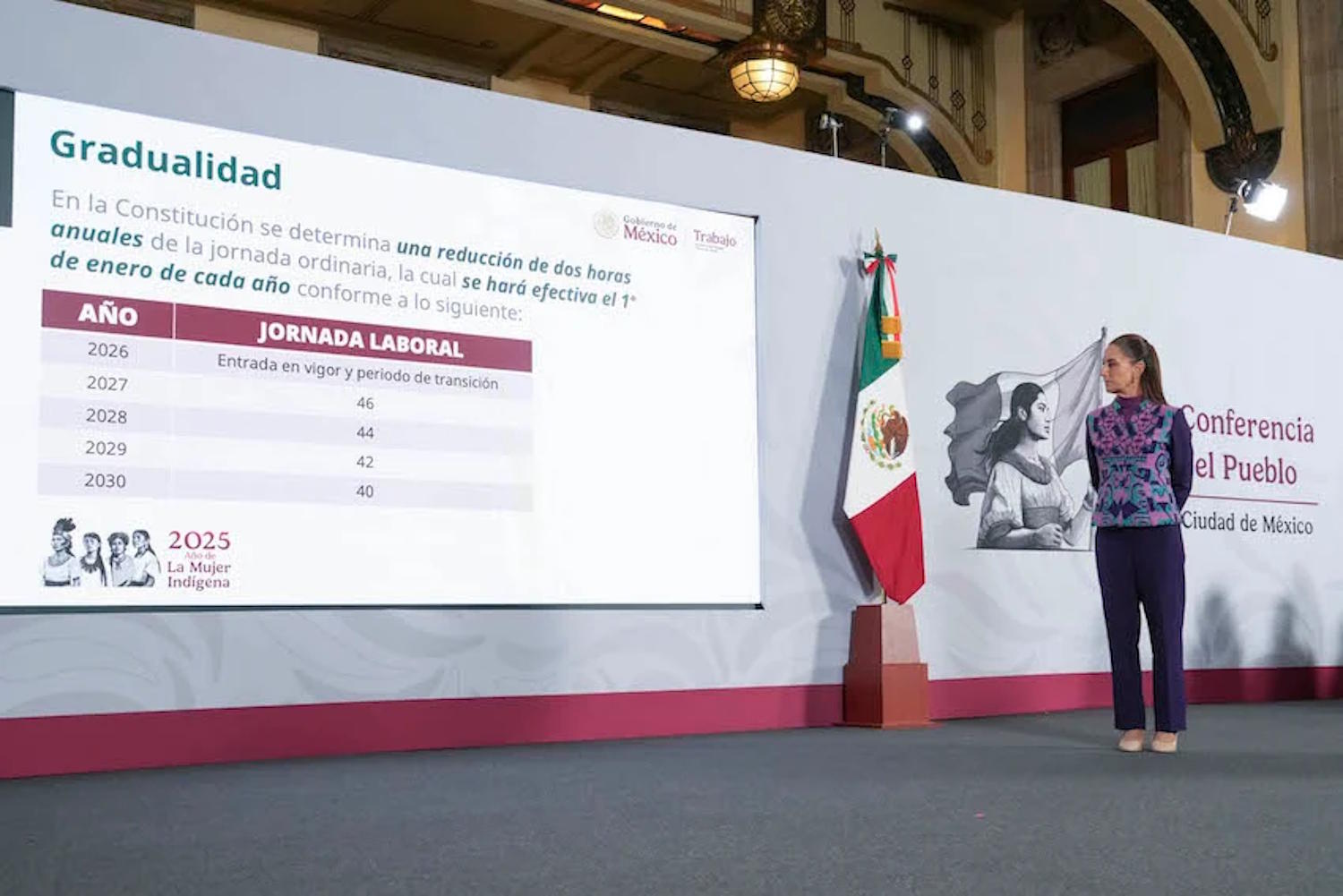
Mexico has announced an important labor reform which provides for the gradual reduction of weekly working hours from 48 to 40 hours by 2030. A historic turning point for the country and a measure that is part of a broader plan that aims to improve the quality of life of Mexican workers, promoting a better balance between work and private life and stimulating productivity.
Starting from 2027, weekly working hours will be reduced by two hours every year: starting from 46 hours, then decreasing to 44, 42 and finally reaching 40 hours in 2030. The authorities have ensured that during this process there will be no reduction in wages or benefits for workers. The initiative will affect approximately 13.4 million workers across the country.
Read also: Spain, historic turning point: the working week is shortened to 37.5 hours (with the same salary)
In parallel, the Government approved a 13% increase in the minimum wage, which will come into force from January 2026. The minimum daily wage will rise from 280.24 to 315.04 pesos, offering economic support to millions of low-paid workers.
These reforms reflect Mexico’s commitment to improving working conditions and promoting greater social justice, seeking to respond to workers’ needs without compromising the country’s productivity.
Where are we at?
In Europe, many countries have already adopted working hours that are on average shorter than the traditional 40-hour week. In countries like the Netherlands, Germany or Austria, weekly working hours are shorter, with an average of 36 hours worked per week. While some countries have made progress in terms of reducing working hours, others such as Greece or Poland have longer weekly hours, even exceeding 40 hours, reflecting a different labor market reality.
In Italy, the situation is a little more complex. Here the law provides for a 40-hour working week, but in practice the situation varies greatly depending on the sector, the type of contract and the region. What is certain is that the reduction of working hours is still an open and thorny issue, and unfortunately the regulations are not always sufficient to guarantee that all workers can benefit from it.
Some European countries, such as Spain, France and the United Kingdom, have started to experiment with smaller-scale “short week” models. In these cases, the idea is not only to reduce working hours, but also to increase overall productivity through greater worker satisfaction and better management of their time. Mexico, with its proposal to reduce the weekly working week to 40 hours by 2030, is seeking to take a significant step, with the aim of improving workers’ well-being and increasing economic efficiency. While our country could draw inspiration from other models, we must deal with our reality of the labor market, which is too often still characterized by great disparity between different categories of workers and a system that sometimes penalizes the most vulnerable. Reducing working hours, without compromising wages or benefits, would be a great achievement, but achieving it requires not only political will, but also a concrete commitment from businesses and trade unions to find a balance that works for everyone.
Read also:
