

Now upon us, the Milan Cortina 2026 Winter Olympics are undoubtedly being talked about, if only because they have been presented as the most sustainable ever.
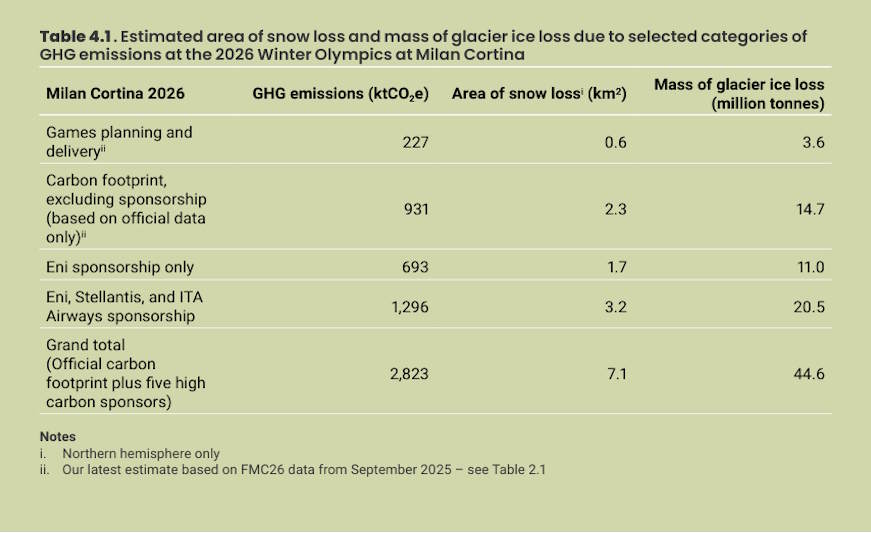
Yet, the math doesn’t add up: will it be the loss of the 5.5 square kilometers of snow cover and 34 million tons of glacial ice or the fact that, without the three main sponsors, these numbers would be halved, reaching 2.3 square kilometers and 14 million tons?
Yes, because both Eni, Stellantis and ITA Airways are certainly not free from blame. The new study by does the math Scientists for Global Responsibility and of New Weather Institute published in collaboration with the athlete-led campaign Champions for Earthwhich, once the quantity of snow that is lost due to a certain quantity of carbon dioxide released into the atmosphere has been estimated, has established that those three main sponsors, alone, manage to double the environmental impact of the Olympic Games.
The research
The research focuses on the three main sponsorship agreements with high greenhouse gas content. According to the data, Eniwhich is responsible for over half of the total “sponsorship” emissions, Stellantis And ITA Airways together they will cause further emissions of around 1.3 million tonnes of carbon dioxide: 40% more than the direct footprint of the Olympics, estimated at around 930 thousand tonnes.
This will lead to an additional loss of 3.2 square kilometers of snow cover and more than 20 million tons of glacial ice, on top of the 2.3 square kilometers of snow and 14 million tons of ice already caused by the Olympics themselves.
Numbers which in any case aggravate an emergency already underway. In the last five years, Italy has lost 265 ski resorts; France, which will host the 2030 Winter Olympic Games, has more than 180 in the Alps. In Switzerland, 55 ski lifts and cable cars have been closed. The disappearance of snow due to global warming undermines the very foundations of winter sports, with the Games increasingly dependent on artificial snow.
It’s obvious to anyone who visits the real mountains – explains Stuart Parkinson, director of Scientists for Global Responsibility and lead author of the report. Yet we continue to organize the Winter Olympics as if nothing is happening.
The question then is simple: would Milano Cortina 2026 be more sustainable without high-emission sponsors?
According to the report, yes. And a lot too. Without the weight of large polluters, overall emissions would be 22% lower than at Pyeongchang 2018. Spectators have the greatest impact, as they alone represent 44% of emissions (414 thousand tonnes of CO₂), followed by infrastructure (290 thousand tonnes) and the planning and organization of the event (227 thousand tonnes).
Excluding the anomalous case of Beijing 2022, conditioned by the pandemic and the absence of spectators, Milano Cortina could become one of the most sustainable editions in the recent history of the Winter Games. The reason? The reuse of existing structures.
Only 2 new venue permanent, compared to 6 in Pyeongchang and 14 in Sochi. Result: a 60% cut in infrastructure-related emissions compared to 2018.
The real revolution would be to say goodbye to fossil sponsors
From an economic point of view it would not be suicide, on the contrary. Eliminating carbon-intensive sponsorships and replacing them with low-carbon partners would avoid around 1.4 million tonnes of CO₂ without reducing available funds.
The Games cannot be said to be sustainable if they are sponsored by those mainly responsible for the climate crisis – says Andrew Simms, co-director of the New Weather Institute. And he adds a sobering fact: over 60% of Olympic revenues come from television rights, only a smaller share depends on sponsors.
The scientific community is clear: the IOC and the organizing committees should stop all collaboration with high-emitting companies, choosing only partners that:
It wouldn’t be historical news. In 1988, at the Calgary Games, tobacco multinationals were told no. Today the challenge is the same, only bigger: to free the Olympics from dependence on fossil fuels.
But are only the sponsors the problem?
Another crucial front is that of travel: mobility, transport, spectator travel.
Since tickets represent only 13% of overall revenue, there is enormous scope to drive:
And above all, enough with the tale of compensations. Planting trees cannot become an alibi for continuing to pollute and proclaiming the Games to be “carbon neutral” only on paper. Since 2018, with more transparent reporting of emissions, it has finally been clear how great the responsibilities of the Olympics are. And perhaps already in 2030, in the French Alps, we could see the first truly Games.”fossil free”, without fossil fuel-related sponsors.
Meanwhile, movements like Save The Winter Games, Ski Fossil Free and the athlete-led Fossil Free Declaration continue to say it bluntly: without snow, there are no winter sports.
