
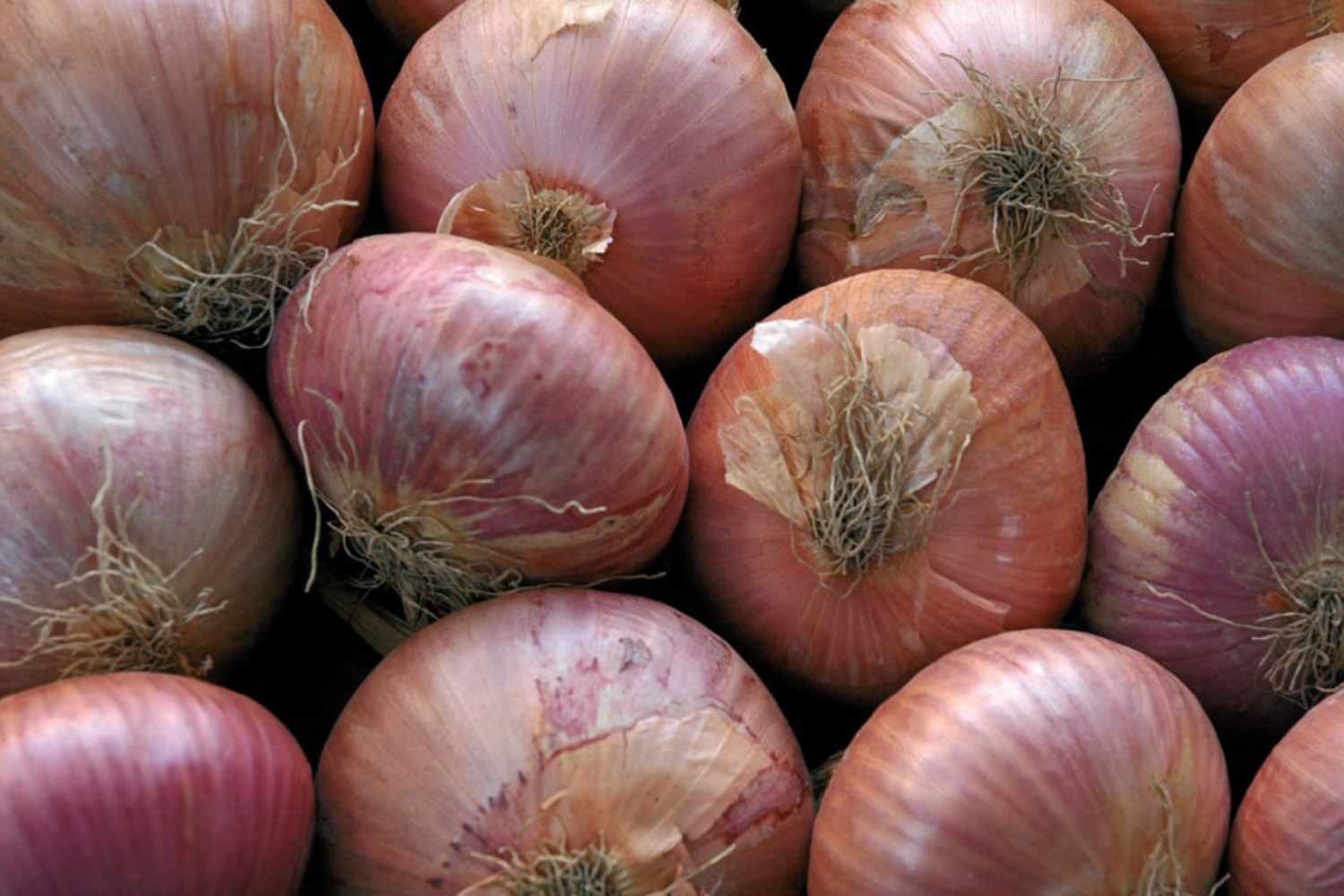
In the heart of Irpinia, between the provinces of Avellino and Salerno, a vegetable grows that tells of centuries of peasant tradition, the famous Cipolla Ramata di Montoro, which owes its name to the copper-colored reflections of the external tunics that cover it. The sweet and intensely aromatic flavor makes it unique in the panorama of Italian vegetables.
A territory dedicated to cultivation
The volcanic soils of the Irno Valley offer ideal conditions for the development of this bulb. The mild and ventilated climate, combined with well-drained and nutrient-rich soils, has favored the natural selection of an ecotype with exceptional characteristics. The very etymology of the name Montoro derives from the Latin “Mons Aurus”, or Monte d’Oro, testifying to the fertility of these lands.
Cultivation follows ancient methods, handed down from generation to generation. Sowing takes place between late summer and early autumn on special seedbeds called “porconi”, transplanting in the field takes place between January and February, while harvesting begins in the second half of June. After the harvest, the onions are left to dry directly in the fields for about two weeks. The tunics must remain intact: even small injuries could compromise their preservation.
A story that spans the centuries
The Roman presence in the Montore area was very strong, as attested by the numerous Latin toponyms and the remains of monumental works. The copper onion has represented a fundamental resource for local communities for centuries. During world wars, this bulb allowed starving families to survive: they ate bread, when there was any, with Montoro’s copper onion.
In January 2025, the request for registration as a Protected Geographical Indication was registered with the Campania Region, the result of over twelve years of work by the Promotion Committee led by Nicola Barbato.
Characteristics and nutritional properties
The globular shape, slightly flattened at the poles, hides a pulp with white and purple streaks. The high percentage of dry matter guarantees an extraordinary conservation capacity: if kept cool in ventilated rooms, the Montoro onion can last until March of the following year.
The bulb contains sulphur, iron, potassium, magnesium, calcium, manganese and phosphorus, as well as vitamins A, C and E which help to increase immune defenses. The concentration of flavonoids in the peel, in particular quercetin (responsible for the copper color), exerts an anti-inflammatory and protective action for the cardiovascular system.
In the kitchen: from tradition to winter preparations
The particular sweetness of this onion allows it to also be consumed raw, in a salad with Sorrento tomatoes or beef heart. Those who can’t tolerate raw onions will find this variety surprisingly delicate: it’s an onion that “doesn’t make you cry”, as local chefs explain.
It has a tough and resistant fibre, perfect for long cooking. Neapolitan Genoese pasta represents the apotheosis of this ingredient: two kilos of onion are used for every kilo of veal, left to cook over a low heat for four or five hours until it reaches a beautiful copper colour.
For the winter, onion soup is an invigorating dish that grandmothers prepared to feed entire families. You need half a kilo of copper onions, homemade bread for the croutons and Gruyère to gratin in the oven. The onions should be stewed slowly until they become pale, then vegetable broth is added and completed with a sprinkling of pepper.
Other preparations perfect for the cold season include baked onions, seasoned with a thin layer of oil and a pinch of pepper, or caramelized with butter until obtaining a soft and fragrant side dish.
A heritage to be protected
The Slow Food Foundation has included the Montoro Copper Onion in the Ark of Taste, the catalog that collects products belonging to the culture, history and traditions of the entire planet. Today this variety is increasingly in demand and production is increasing, with almost two hundred hectares dedicated to cultivation.
