
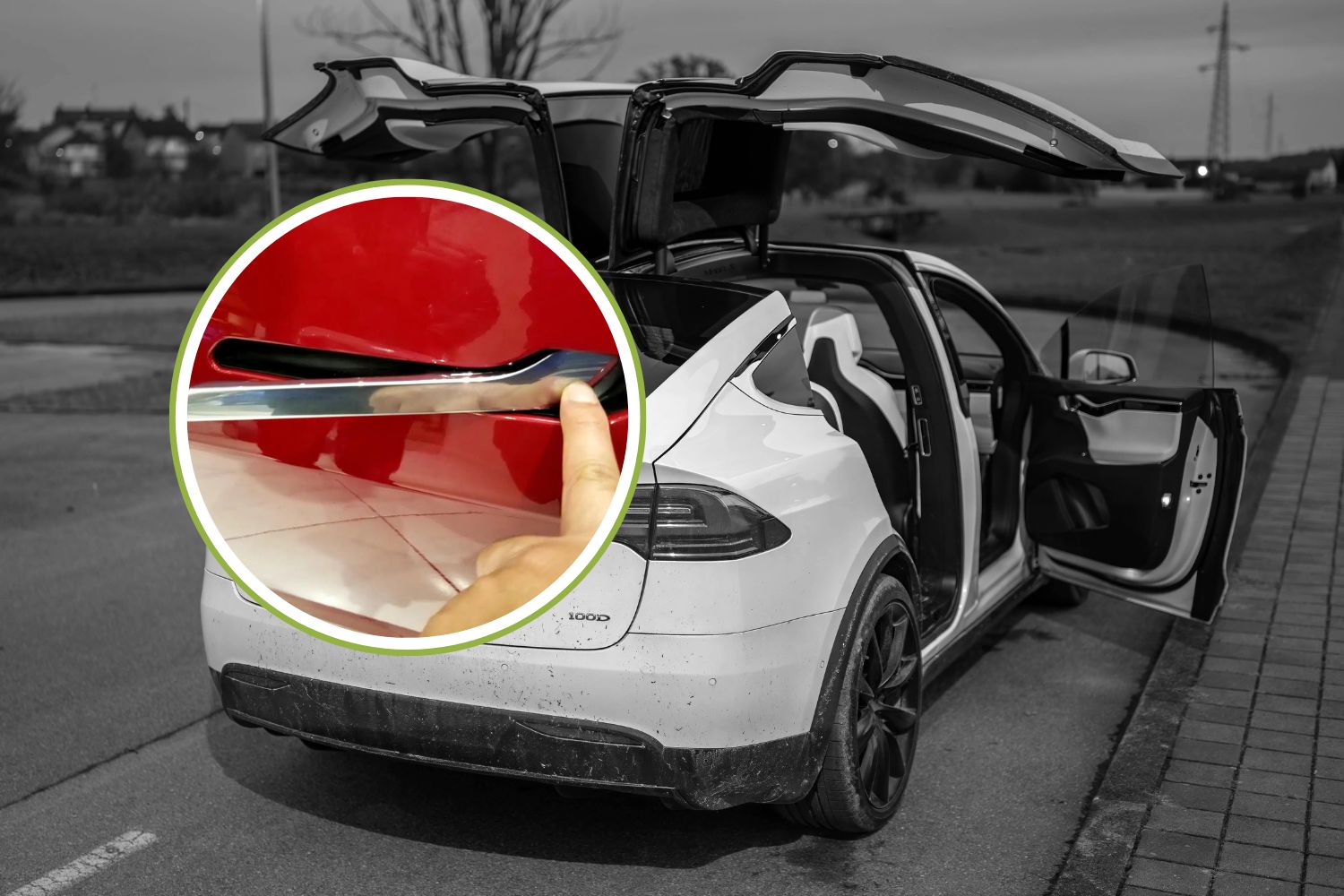
There is a moment, in stories that talk about technology, when innovation stops being fascinating and becomes a practical, almost banal question: how do I get out of here? In the case of many Tesla cars, the answer isn’t as obvious as you might think.
The retractable handles, which have become one of the symbols of the brand’s futuristic design, work almost exclusively thanks to electricity. As long as everything goes well, they are elegant, fluid, perfectly integrated into the bodywork. But when the battery runs out completely, or the car is involved in an accident, that same design choice can turn into a real problem. And not everyone knows how to deal with it.
The issue was raised by an investigation launched by the National Highway Traffic Safety Administration, the American road safety body, after numerous reports of motorists unable to open the doors from the outside on some models, in particular the 2021 Tesla Model Y, in the event of an electrical blackout.
When design meets everyday reality
Since 2018, in the United States, there have been over 140 official reports of locked Tesla doors. Some stories make us think more than any statistical data. There are those who have experienced the anguish of not being able to get a child out of the car after a sudden breakdown, and those who, after the episode, have decided to completely give up a high-tech electric car to return to more traditional models, such as the Honda CR-V, with the classic mechanical handles.
The point is not so much the absence of a solution. In fact, even Teslas are equipped with emergency manual systems to open the doors from the inside. The problem is that many owners don’t know where they are or how to use them. And they often discover it only when the discomfort has already begun.
In a car that promises simplicity, assisted driving and automatic updates, having to study an exit procedure in advance may seem counterintuitive. Yet that is exactly what is happening.
Between awareness and adaptation
Some drivers have started to change their habits. There are those who always keep small emergency tools at hand and those who, as a precaution, explain to passengers how to open the door before even leaving. It happens especially among professional drivers, such as those who work for Uber, who are used to transporting people who may have never set foot in a Tesla before that trip.
These are scenes that raise a smile, but they also tell something deeper: technology, when it becomes invisible, risks becoming incomprehensible. And the misunderstanding, in certain cases, turns into insecurity.
In the meantime, these stories also contribute to fueling doubts on the second-hand market, already under pressure due to the very rapid evolution of models and other reliability issues that have emerged in recent years, as in the case of the recall of the Powerwall 2.
A simpler future?
Tesla is aware of the problem. The design manager publicly admitted that the handles could change, focusing on a hybrid system that combines electronics and mechanics, capable of working even without energy. A choice that would meet the requests of the authorities and the concerns of users, without completely giving up the visual identity of the brand.
A question remains that goes beyond Tesla and concerns the entire mobility of the future: how much are we willing to sacrifice simplicity in the name of innovation? Perhaps, in a car truly designed for people, getting out should always be the easiest thing of all.
You might also be interested in:
