
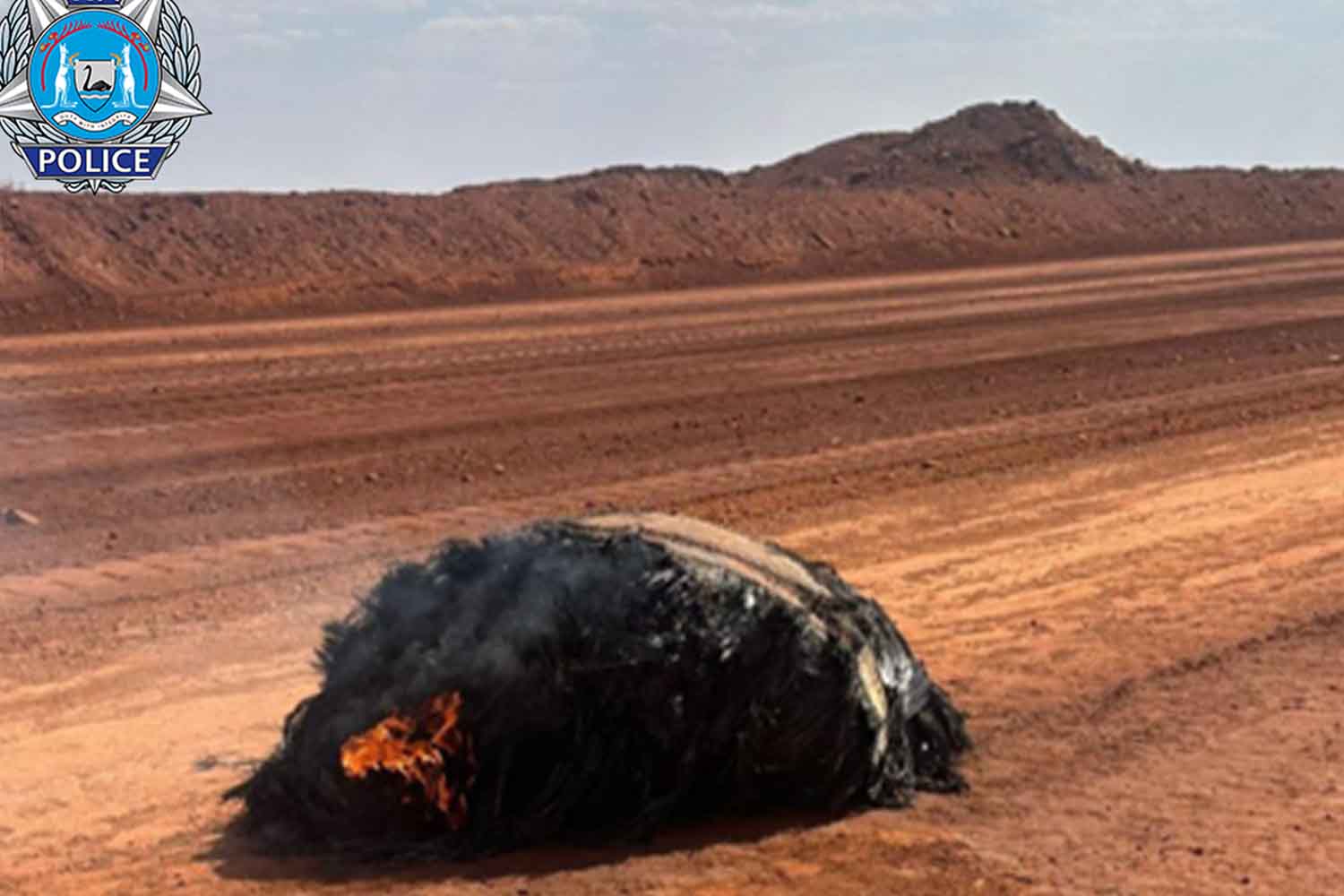
That discovery in the Australian desert is a new alarm bell on a topic that is still little talked about: space junk. Today, they orbit the Earth over 130 million fragmentsaccording to estimates from the European Space Agency. Most are tiny, but they’re there too large objectshow rocket stages, decommissioned satellites And old probes.
In theory, all spacecraft should be designed for a controlled returnto a remote area of the Pacific Ocean called Nemo Pointthe official “space dump”. In practice, not all launchers follow the same rules: some remain in orbit until gravity calls them back, often without control.
And when this happens, . In 2022, fragments of a Chinese rocket Long March 5B they had ended up in Malaysia and the Philippines. Now, in 2025, it’s Australia’s turn.
A silent threat also for the environment
The problem is not only about security, but also the environmental impact. Many space debris contain toxic materials such as hydrazine and ammonia, or composite fibers and resistant metals which do not degrade easily”, as a technician from the Australian Space Agency explains:
Every piece that falls in is a potential contaminant. It’s not just iron falling from the sky: it’s often pressurized tanks that can release chemical residues.
In the Australian case, the risk was minimal: the Pilbara area is sparsely populated and devoid of vegetation. But in a different context — near a town or in a forested area — the impact could have caused fires or dangerous emissions. Today, most space missions involve private companies And new national agencies. But the management of “after launch” still remains gray territory, regulated by dated agreements.
The European Space Agency and NASA are developing protocols for designing more “eco-friendly” rocketscapable of self-destruct safely. However, many countries do not apply the same rules, e.g every new rocket in orbit is potential debris in free fall.
The object is now in custody and does not pose a danger
There Western Australia Police confirmed that the item was made safe. There Australian Space Agency launched an investigation with the collaboration of theESA and of NASA to determine with certainty the origin of the fragment.
Meanwhile, residents of Newman say they are still surprised, as a local miner told ABC News:
We heard a rumble in the sky, then an orange light and the ground shaking. We thought it was a meteorite.
In fact, it was a reminder of our own progress that came back to knock on the planet’s door. This episode shows how space is no longer “out there”, but a concrete part of our ecosystem.
Every launch, every satellite, every fragment is a piece of history that, sooner or later, come back down. And as we look to the sky dreaming of Mars, perhaps we should start thinking about how to stop sowing scrap on Earth.
WA Police Force is leading a multi-agency response after suspected space debris was found burning at a mine site ~30km…
Posted by Pilbara District – WA Police Force on Saturday, October 18, 2025
