
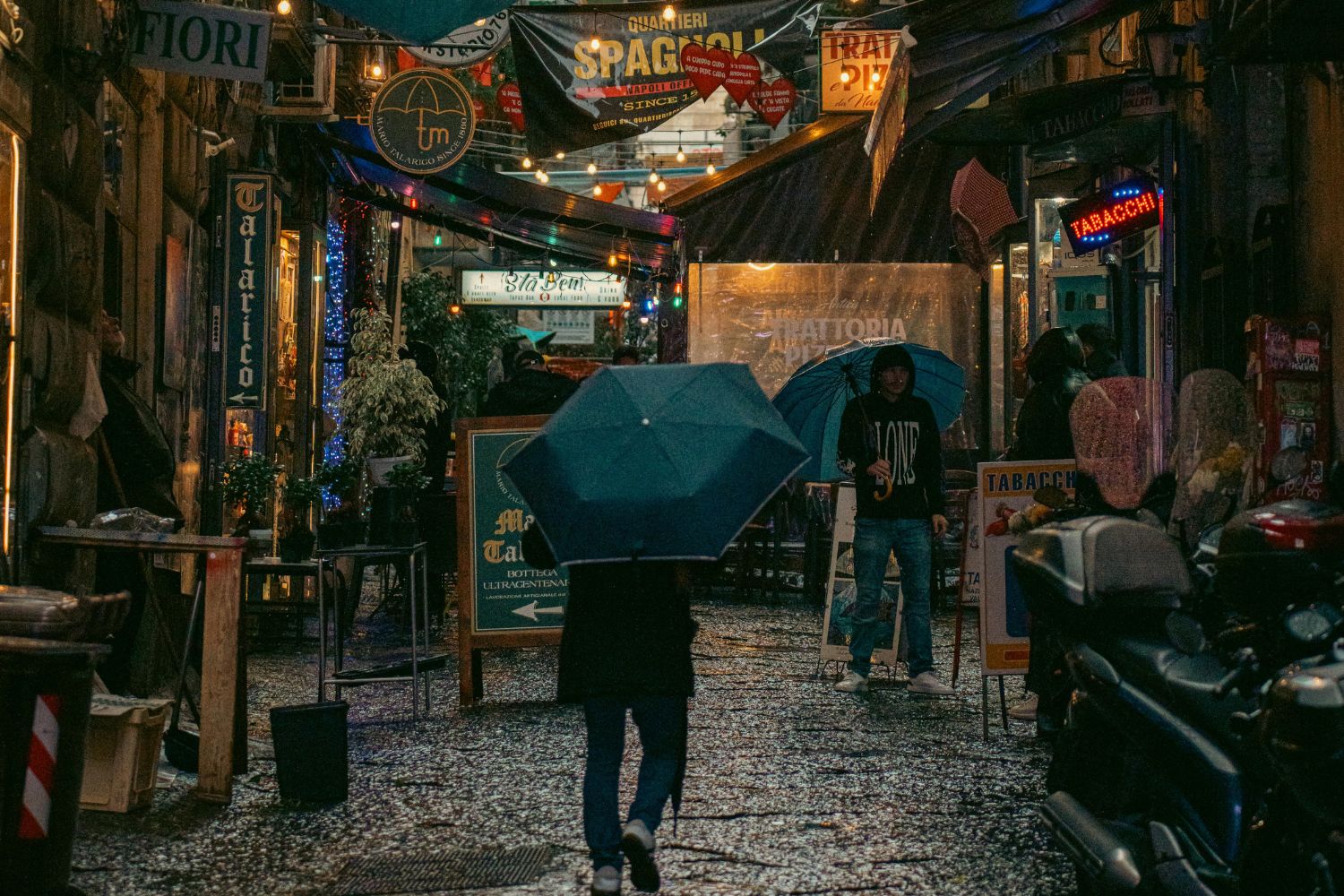
A historic center that has become a world heritage site continuum of B&Bs and places to eat quickly. Indeed, the one in Naples is now a real open-air fryer, with very few residents and thousands of tourists every day of the year.
Yet, when UNESCO describes the historic center of Naples – included in the World Heritage List since 1995 – it spoke of churches, historic buildings and decumani and wonderful architectural stratifications, in a continuity of urban and social functions unique in the world.
Now the Administration’s management plan would have among its objectives that of keeping Naples a “alive and vital” city, preserving the quality of life and the co-presence of different functions. But the gap is right here: a city can continue to have its buildings, its squares and its streets intact, and at the same time progressively lose what makes it cityi.e. the people who live there? And it is exactly on the border between tourism and residentiality that Naples is intervening. Or at least he tries.
When the historic center becomes a widespread hotel
In recent days the city council approved the urban planning variant which aims to limit the further expansion of tourist activities in the historic center. The rule essentially provides that in the buildings concerned a minimum threshold of 70% is preserved for the residential function, leaving up to 30% for the tourist-receptive uses envisaged by the regulations. For some activities, a change of intended use is also envisaged. The resolution was approved with the votes of the majority.
The numbers contained in the Municipality’s strategic document show how quickly Naples has changed. In 2016, there were 1,288 listings on Airbnb. In the first quarter of 2024 there were 10,760: an increase of 735% in eight years. About 90% of the ads were concentrated in the central area.
66.5% of the adverts concerned an entire house or apartment, for a total of 7,155 properties. If only entire apartments are considered, the increase between 2016 and 2024 reaches as much as 872%. A growth that was not evenly distributed across the city.
And this is exactly what tourism is: not simply having many tourists, but seeing a growing part of urban space change its function in response to tourist demand.
View this post on Instagram
What does that 70% really mean?
Be careful, because the new rule does not mean that from tomorrow every building in the historic center will have to go back to having seven apartments inhabited by residents for every three intended for tourists. The threshold is calculated on the surface of the building and the mechanism mainly concerns the possibility of adding new tourist uses. The Municipality clarifies in its documents that 70% derives from the evaluation of the necessary residential surface area in the areas considered most critical and is applied to each building unit. Above all, the variant is not retroactive: activities already legitimately started will be able to continue and those that obtained the previous regional code before the new system came into force will still be counted to establish how much “tourist capacity” remains in the building. The effects will come into force after a further provision from the Council which will concretely define the verification system.
So, essentially, the Municipality tries to prevent the process from continuing at the same pace, but it does not automatically bring back to residence what has already become touristy.
Meanwhile, the associations of non-hotel operators have contested the variant, arguing that it risks penalizing the sector, and have announced an appeal to the TAR. The administration instead claims the objective of protecting residentiality and managing tourism growth which in some areas has reached very high levels. This is probably the terrain on which the game will be played in the coming years: understanding once and for all how much space the city can give up to the tourist economy before changing its nature.
A historic center full of trolleys, key boxes, places to eat, but without residents, local shops and daily life could continue to be beautiful. But would it still be the historic center of a unique city in the world or just its scenography?
