
When you think about space it is natural to imagine it as an immense and immobile place, governed by laws that humanity observes from afar with increasingly sophisticated telescopes. In recent years this view has begun to change. Scientific research has reached a point where human beings are able to interact with the cosmic environment with a precision that until recently belonged to fiction.
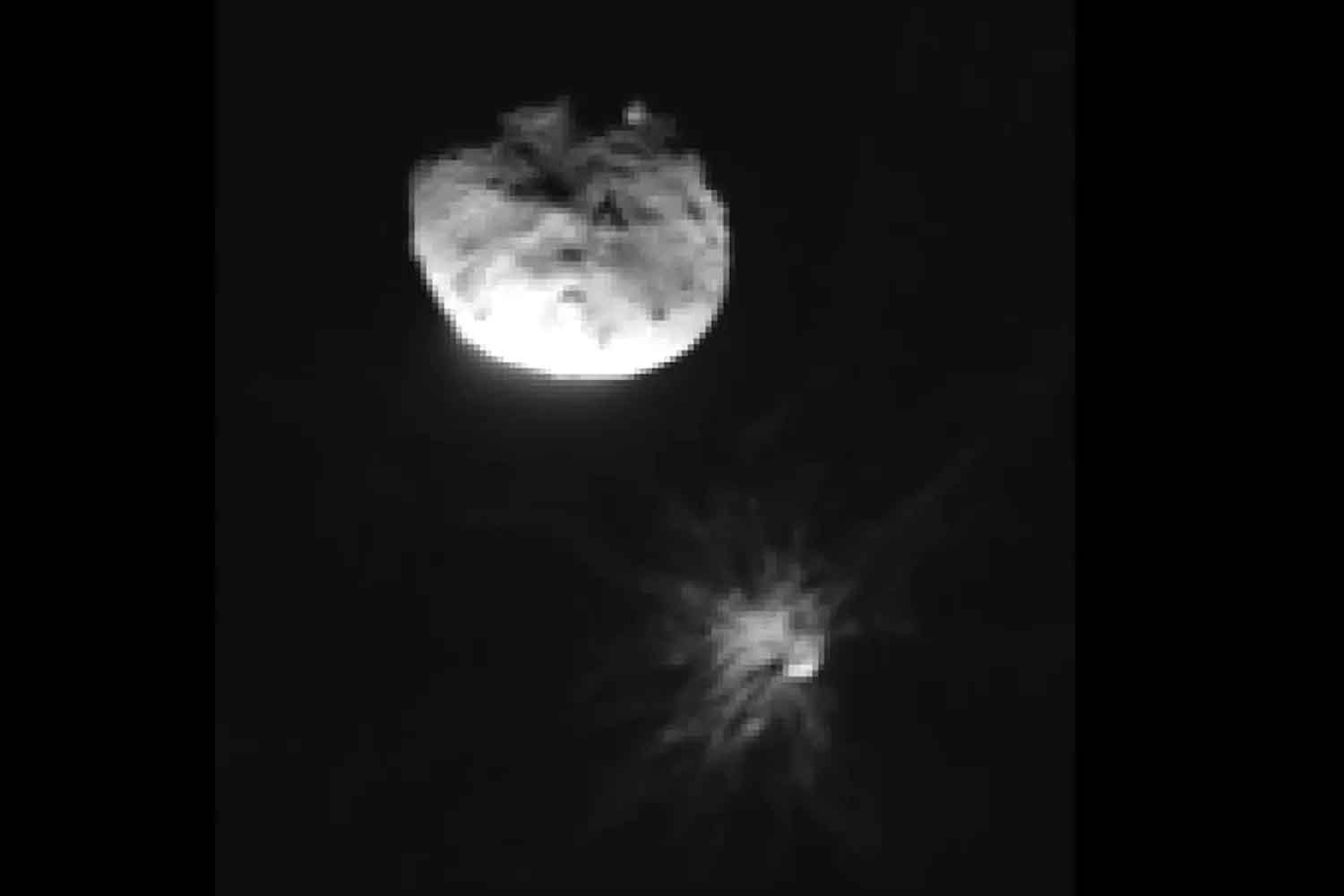
The mission NASA DART it marked one of those moments destined to remain in the history books of space exploration. A probe was deliberately guided into an asteroid millions of kilometers away from Earth. The impact changed its movement in space. Scientists measured the effect carefully, and the data tells something surprising: the asteroid’s orbit actually changed.
The target of the experiment is located within a particular system made up of two asteroids orbiting each other. The larger body is called Didymoswhile the smallest is called Dimorphos. The latter is similar in size to a stadium and revolves around its cosmic companion with a regular rhythm that astronomers have been monitoring for years.
The details of the DART mission
The mission DARTan acronym for Double Asteroid Redirection Test, targeted Dimorphos. The probe left Earth with a clear task. The engineers programmed the trajectory to reach the asteroid and hit it at over twenty thousand kilometers per hour. On September 26, 2022, the onboard camera transmitted the last images of the asteroid’s rocky surface as it increasingly filled the screen. After a few seconds the signal stopped. The impact had happened.
Astronomers have observed the Didymos-Dimorphos system with telescopes around the world. Attention was focused on the time needed for the small asteroid to complete one revolution around its companion. Before the collision the orbit lasted almost twelve hours. After the impact the orbital cycle shortened by approx thirty-two minutes.
The result exceeded the scientists’ expectations. The energy of the crash raised a gigantic cloud of debris that dispersed into space like a luminous tail. This ejected material amplified the push exerted on the asteroid, increasing the effect of the impact and accelerating its orbital motion.
The scene observed by telescopes reminded many researchers of a laboratory experiment on a cosmic scale. A small initial variation generated a measurable change in the behavior of a celestial body.
A decisive step in planetary defense
Astronomers catalog thousands of asteroids passing through the inner solar system. Some of these objects follow trajectories that pass close to Earth’s orbit. The scientific community studies these bodies with great attention and precisely calculates their movement over the years.
The DART mission was born precisely within this context. The Dimorphos deviation proves that a small push applied well in advance can change the path of an asteroid in space. The principle resembles the gesture of someone who slightly changes the direction of a newly thrown ball. The difference in trajectory becomes noticeable only after a long distance.
The most recent analyzes have added a fascinating detail. Scientists have also identified a variation in the movement of the entire Didymos-Dimorphos system around the Sun. The effect remains tiny on an astronomical scale and is still detectable with very precise instruments. This data confirms the sensitivity of cosmic orbits to small perturbations.
The story of this experiment continues with the mission Hera of the European Space Agencywhich will reach the asteroid system in the next few years. The probe will study the crater left by the impact and analyze the internal structure of the asteroid. These observations will help scientists better understand the nature of these ancient bodies and refine deflection techniques.
The DART mission showed a new scene in the relationship between humanity and the cosmos. A probe that left Earth encountered an asteroid millions of kilometers away and changed its path in space. The universe continues to remain immense and mysterious, while human knowledge finds new ways to communicate with what happens beyond our planet.
