
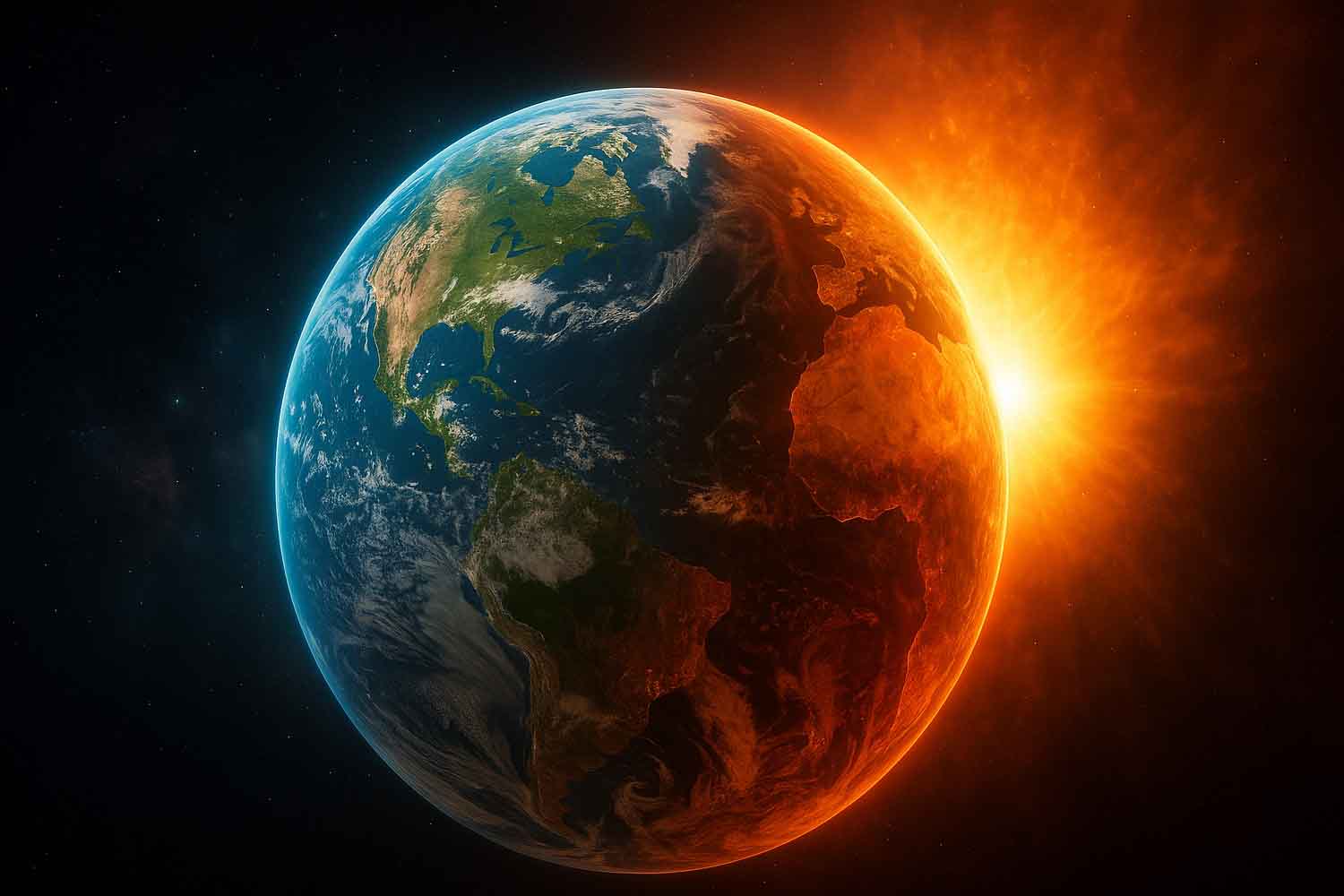
Put like this, it seems like the beginning of an apocalyptic film: scientists, supercomputers, NASA involved and an ending that doesn’t promise well. Yet, behind the catastrophic headlines there is a very serious study: a group of Japanese researchers from Toho Universitytogether with NASAused very powerful supercomputers to answer a question as old as it is disturbing:“When will the world end?” The answer, unfortunately, .
The simulations tell a future in which the Sun, becoming increasingly brighter and hotter, will transform the Earth into a cosmic oven. We are not talking about a few decades from now – but not even an eternity: according to projections, in about a billion years the atmosphere will lose almost all its oxygen and life, even microbial life, will disappear forever.
The study, published under the title “The Future Lifespan of Earth’s Oxygenated Atmosphere”shows that the fate of the Earth is closely linked to the evolution of the Sun. As solar activity increases, the seas will slowly begin to evaporate, the atmosphere will thin and the temperatures will make life impossible.
In other words: you will no longer need sunscreen, umbrellas or air conditioning. Simply, . According to calculations, the end will come around the year 1,000,002,021 — yes, you read that right, more than a billion years in the future. But here’s the thing: humans will never get there. Our planet is already showing the first signs of change: rising temperatures, declining oxygen, melting ice, and a Sun that — literally — He’s getting more and more nervous.
The Earth is already in its “crisis period”
Kazumi Ozaki, lead author of the research, explains that the old estimates they spoke of an Earth habitable for another two billion years. Now, thanks to the new models, that time has been halved.
The reason, according to Ozaki:
As the Sun ages, it becomes hotter and destabilizes our atmospheric balance. Oxygen will decrease, temperatures will increase and the planet will become inhospitable.
In short, we are witnessing the first symptoms of the planet’s old age. And as often happens, the human being – with his emissions, deforestation and profit obsessions – is speeding up the process. A bit like someone who adds oil to the fire… of an oven that is already lit.
We are closer to the end than the beginning
It’s not pessimism, it’s planetary biology. According to researchers, the signs are clear: the Earth’s magnetic field is weakening, solar storms are increasingly intense and our atmosphere is slowly changing composition. Of course, we won’t disappear tomorrow morning. But the Earth we know – that of blue seas and breathable air -.
Maybe we should start seeing the “end of the world” not as a sudden event, but as a slow transformation already underway. And even if we aren’t here to witness the grand finale, it’s worth remembering that the future is not yet written — but global warming is.
