
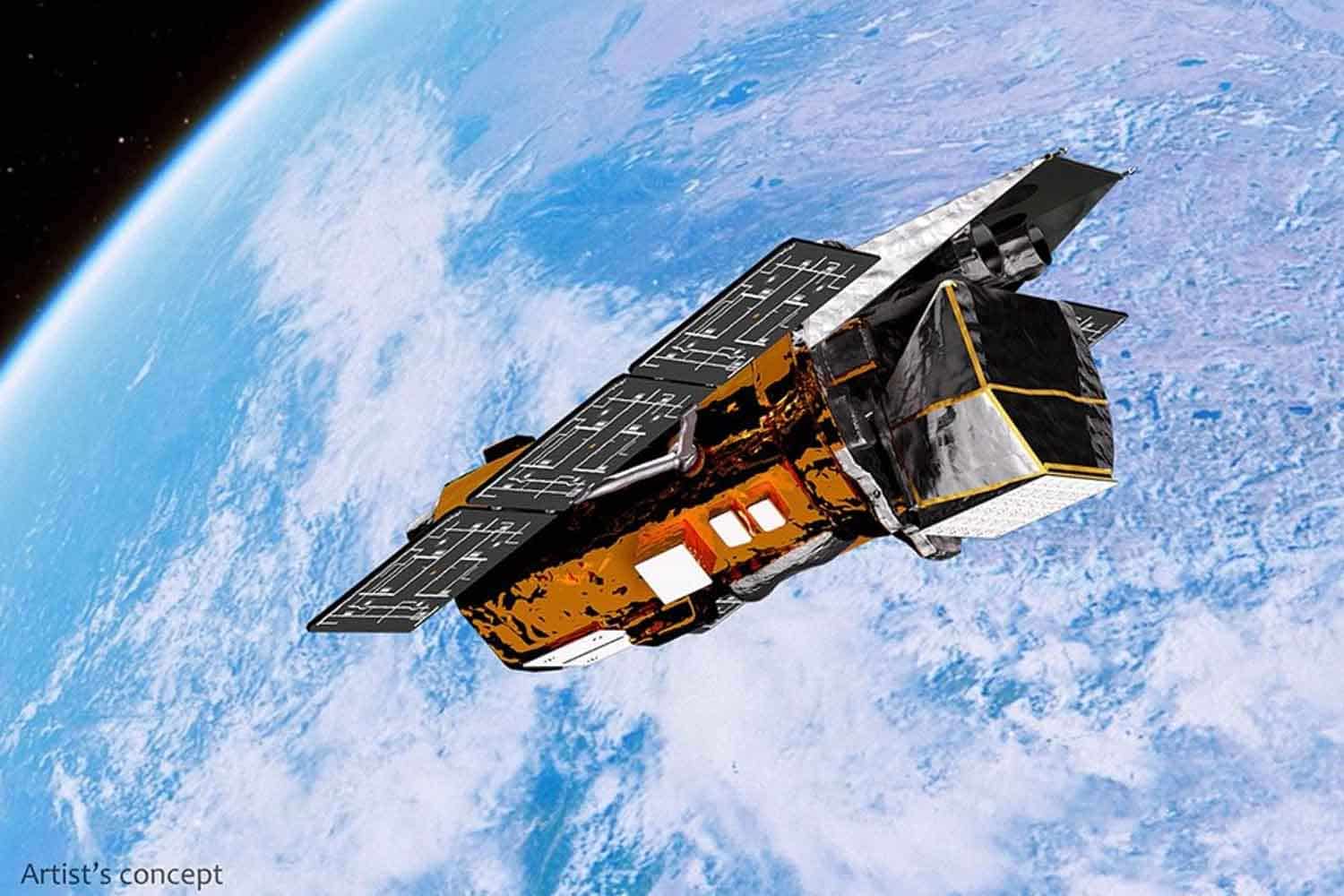
NASA’s Swift Space Telescope crashed into Earth’s atmosphere on Wednesday, November 4, 2026, at 1:39 pm ET, over the island of Sumatra, Indonesia. After nearly 22 years spent observing the most powerful explosions in the Universe, the approximately 1,450 kilogram satellite disintegrated during an uncontrolled re-entry. Much of the structure should have burned out in the atmosphere, but some components may have reached the ground. The problem is that, at the moment, we don’t know where they ended up. And not even whether they actually reached land.
NASA confirmed the reentry, located by the US Space Force at approximately 3.4 degrees north latitude and 98.6 degrees east longitude, in the North Sumatra region. Those coordinates indicate where the satellite re-entered the atmosphere, not where its remains may have fallen. A necessary distinction, especially when talking about an object the size of a small car crossing the sky at thousands of kilometers per hour.
The fragments may have landed on the ground, but no one knows where
During its descent, Swift encountered increasingly dense atmospheric layers. The extreme heating caused by its passage destroyed much of the structure, while some more compact and high-temperature resistant components may have survived.
The Aerospace Corporation, through its center specialized in the study of space debris, followed the trajectory until its return over Sumatra. Several light trails were also observed in the skies of Malaysia and Singapore, as documented by the National Institute of Astrophysics.
The images show the fragmentation of the satellite during its descent. However, they do not allow us to establish which components survived and where they may have arrived. Some pieces may have worn away completely, others may have ended up in the sea or on land. As of November 6, there are no official communications on the discovery of fragments attributable to Swift.
Dangerous fragments? The risk estimated by NASA was 1 in 2,100
Before the crash, NASA had estimated a probability of approximately 1 in 2,100 that the fragments could cause harm to a person. An estimate referring to the overall risk for the world population, therefore very different from the individual probability of being affected.
The eventuality was considered unlikely, but sufficiently concrete to require monitoring of the trajectory until return. For Italy, however, there is no direct risk. Swift orbited within a band between 20.6 degrees north latitude and 20.6 degrees south latitude, so our territory was completely outside the potentially affected areas.
The area mainly included tropical regions and vast ocean surfaces. There have been no reports of damage or injuries attributed to the telescope’s return at this time.
Swift returned to Earth, but what happened to his materials?
Swift’s fall also raises an environmental question. The telescope has now left Earth orbit, so it no longer represents an obstacle for other satellites. Its materials, however, have not necessarily disappeared together with the light trails observed over Sumatra.
According to the European Space Agency (ESA), during re-entry the most resistant components, made for example of steel or titanium, can survive extreme temperatures and reach the ground. In the case of Swift, NASA had foreseen this possibility, but without indicating which parts of the telescope could reach Earth. Without confirmed findings, we cannot know how much debris survived or what environmental consequences it may have caused.
Then there is another, less visible aspect. Burning up in the atmosphere does not mean disappearing without a trace. During reentry, the metals present in the satellites can vaporize and transform into particles that remain suspended in the upper layers of the atmosphere.
A study published in 2023 in Proceedings of the National Academy of Sciences, also conducted by researchers from the American agency NOAA, found that approximately 10% of sulfuric acid aerosol particles analyzed in the stratosphere, with a diameter greater than 120 nanometers, contained aluminum and other metals attributable to the reentry of satellites and rocket components.
The research concerns the accumulation produced by space activities as a whole, therefore it does not allow us to attribute a specific impact to Swift’s fall. The effects of these particles on atmospheric chemistry are still being studied.
ESA itself, in the 2026 report on the state of the space environment, drew attention to the air pollution produced by increasingly frequent re-entries. Reducing the debris that remains in orbit is necessary, but we also need to understand what happens to materials when they are destroyed in the atmosphere.
For Swift, at the moment, two unknowns remain: how many components possibly reached the ground and what quantity of materials was dispersed during combustion. Neither has yet been publicly quantified.
NASA sent a satellite to save Swift: the mission failed
Swift’s fate had long been known. The telescope was in low Earth orbit and did not have a propulsion system capable of stably counteracting the progressive loss of altitude. Furthermore, in recent years, intense solar activity had heated and expanded the outer layers of the atmosphere, increasing the resistance encountered by the satellite. Swift slowed down, descended and encountered an increasingly dense atmosphere, which further accelerated its descent.
NASA had decided to attempt a rather ambitious recovery: sending a second satellite to hook Swift and push it into a higher orbit. The operation, called Swift Boost Missionhad been entrusted to the American company Katalyst Space. On July 3, 2026, LINK was launched, a robotic vehicle equipped with three mechanical arms and a propulsion system to reach the telescope.
The rescue, however, stopped before hooking. LINK developed orientation control system problems, including reaction wheel and thruster malfunctions. The technicians managed to continue some operations and bring the vehicle within about 12-15 kilometers of Swift, without being able to attempt capture.
NASA then gave up on recovery. And there is a rather curious detail: LINK, the satellite sent to save Swift from falling, also re-entered the Earth’s atmosphere on September 25, 2026. In its official assessment of the mission, NASA acknowledged the failure to achieve the objective, explaining that the experience will still be used to develop new technologies for the maintenance of satellites directly in space.
Swift continued working for a few more weeks, until on October 20, having dropped to around 275 kilometers above sea level, it was no longer able to maintain the orientation necessary for observations. The operators concluded the scientific activities and prepared the vehicle for return. On November 4th came the fall.
Twenty-two years of discoveries, also thanks to Italy
Launched on November 20, 2004, Swift was supposed to run for just two years. He spent nearly twenty-two years observing gamma-ray bursts, stellar explosions, black holes and other astronomical phenomena. Its strong point was speed: when it detected a gamma-ray burst, it could quickly orient the instruments towards the source and follow the evolution of the event, simultaneously sending the information to the other astronomical observatories. During the mission it observed over 2,000 gamma-ray bursts and more than 1,400 supernovae, contributing to approximately 7,000 scientific publications.
Italy also participated in its creation. As documented by the Italian Space Agency, our country provided the mirror module of the X-ray telescope, contributed to the calibration and scientific software and made the Malindi ground station, in Kenya, available for data transmission.
A work that has involved Italian researchers, including INAF scientists, for over two decades, and which will continue through the analysis of the enormous scientific archive left by the mission. Swift stopped observing the Universe on October 20 and finally left Earth’s orbit on November 4. From his almost 22 years of activity, thousands of astronomical observations remain. However, we still have no certain information about its possible fragments.
