
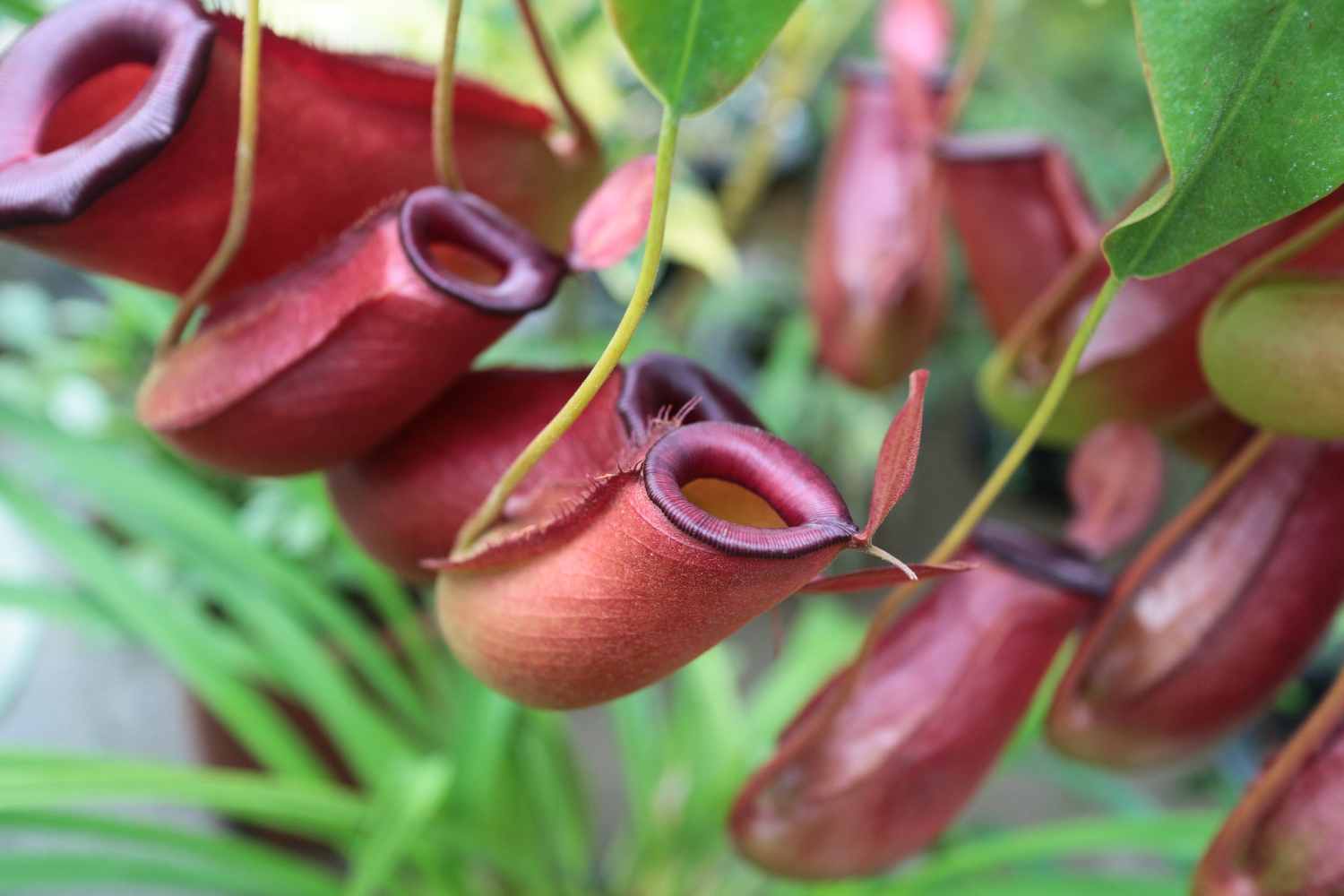
Nepenthes, as often happens with carnivorous plants, fascinate with their peculiar nature. With pendulous ascidians similar to colored jugs, these carnivorous plants attract the eye and stimulate curiosity. Unlike other insectivorous species, Nepenthes does not show obvious mechanisms of action, given that the ascidians do not suddenly close on the prey, there are no sudden shots, because the hunting strategy is based on cunning: the plant produces sugary substances that cover the edge of the ascidians, attracting the insects which, once protruding to feed, fall inside without the possibility of escape.
Origins and characteristics of Nepenthes
The family of Nepenthaceae includes a single genus which groups together over 180 species native to the Indian Ocean range, mainly widespread in south-east Asia. The name comes from ancient Greek and literally means “which eliminates pain”. Linnaeus chose this name imagining that a botanist, after a long and tiring journey in tropical forests, would feel such satisfaction in finding this plant that he would forget every difficulty faced.
Nepenthes predominantly show climbing or creeping behavior. In nature they grow as epiphytes, climbing on other trees from which they hang leaves and roots to absorb moisture from the air. They can reach 15 meters in length, with stems about a centimeter in diameter. Longevity is one of their advantages, and a well cared for plant can live for many years.
Ascidians: sophisticated traps
The intense green lanceolate leaves end with a hook-shaped formation that develops into a sort of pitcher called ascidium, the true trap of the plant. At the top is the operculum, a lid-like structure that regulates the amount of rainwater that can enter the ascidium. This mechanism prevents the digestive juices present in the jug from becoming excessively diluted, compromising the absorption of nutrients obtained from prey.
The nectar glands concentrated near the opening of the ascidian secrete sugary substances that are irresistible to insects, an aspect which, together with the bright colors and the excellent scent, complete the deception. Once they fall inside, the insects remain trapped in a digestive liquid containing pepsin, similar to our gastric juices, which allows the plant to assimilate nutrients.
The size of the ascidians varies from 8 to 30 centimeters. Nepenthes alata has compact and small ascidians, while Nepenthes miranda develops larger traps, characterized by a small decorative crest. Sea squirts maintain their vitality for 6-10 months if properly hydrated.
Where to place the Nepenthes
Nepenthes need a good level of shielded light, never direct. The myth that these plants live in the shade of the tropical forest must be dispelled: in nature they grow in open places where they receive sunlight for most of the day. The most frequent problem in domestic cultivation concerns the lack of light, which causes the interruption of the production of ascidians. Plants must be gradually accustomed to direct sunlight for several hours a day, and possible sunburn during adaptation is normal, while spots and red shades indicate good health.
Which soil to use for Nepenthes
Nepenthes grow naturally in poor environments with little substrate, for this reason repotting should be done rarely. The root system develops little and is very delicate. A sphagnum peat-based substrate is the ideal choice. Many growers use a mixture of equal parts peat moss and perlite, some add fine bark to make the compost airier, still others use pure sphagnum moss with perlite, which works well for several varieties. It is best to provide the plant with support to allow it to develop vertically.
How to water Nepenthes
These plants require a humid climate and must be watered frequently, preferably from above with a hand shower, a technique that always guarantees the ascidians a few centimeters of water, preventing them from drying out. It is recommended to mist the leaves with distilled or rain water to keep them healthy. The ideal air humidity is around 80%, although a garden with 50-60% humidity will still offer acceptable conditions. At home, where the humidity drops to 20%, nebulizations are of little use, because the dry air quickly reabsorbs the humidity. The soil should be kept moist in the growing season, drier in winter. Common plants found in shops can be kept with an inch of water in the saucer during growth, although this practice should be avoided with more delicate species.
How to fertilize Nepenthes
Like all insectivorous plants, Nepenthes do not require particular fertilization. The debate on this topic remains heated among enthusiasts. Those who wish to provide an additional nutritional supply can use very diluted foliar fertilizations during the plant’s maturity stages, away from moments of stress such as repotting.
Optimal temperature for Nepenthes
Native to tropical areas with constant temperatures, Nepenthes should be treated like true houseplants. The ideal temperature varies between 20 and 25°C. They can be kept indoors during the cold months and outside in summer, in shaded areas. Lowland plants (below 1000 metres) tolerate night temperatures of 15-20°C, while daytime temperatures can rise up to 30-40°C. Mountain species require night temperatures around 10°C all year round, making them more difficult to grow. Too low temperatures weaken the plant, making it vulnerable to parasites and diseases.
Nepenthes diseases and parasites
Mealybugs, aphids and thrips can attack Nepenthes. To prevent infestations it is necessary to maintain temperatures above 20°C and avoid excessively wetting the leaves. Stagnant water in the saucer weakens the plant and favors the attack of parasites. Leaf spots indicate fungal infections that require treatments with specific products.
Most famous varieties of Nepenthes
Nepenthes mirabilis represents the most widespread species, with populations extending from Indochina to Australia. Among the most common commercial hybrids we find Nepenthes ‘Miranda’, the result of multiple crosses with Nepenthes maxima, characterized by large spectacular ascidians, Nepenthes ventrata, a hybrid between alata and ventricosa, which enjoys great popularity in nurseries for its ease of cultivation, and Nepenthes ‘Bloody Mary’, a cross between ventricosa and ampullaria, which stands out for its intense reddish hues.
Catching insects
Understanding whether or not a Nepenthes has captured prey is complex: unless you regularly check each sea squirt, it is impossible to determine whether something has fallen into the traps. Let us remember how carnivorous plants do not survive thanks to the ingestion of insects, but by nourishing themselves like all other plants through photosynthesis. Insects represent a nutritional supplement that accelerates growth and increases the size of leaves and ascidians, and their possible absence will not compromise the survival of the plant. If you grew a Nepenthes in insect-free environments, you could fill each sea squirt a third full of water and occasionally add some prey.
