
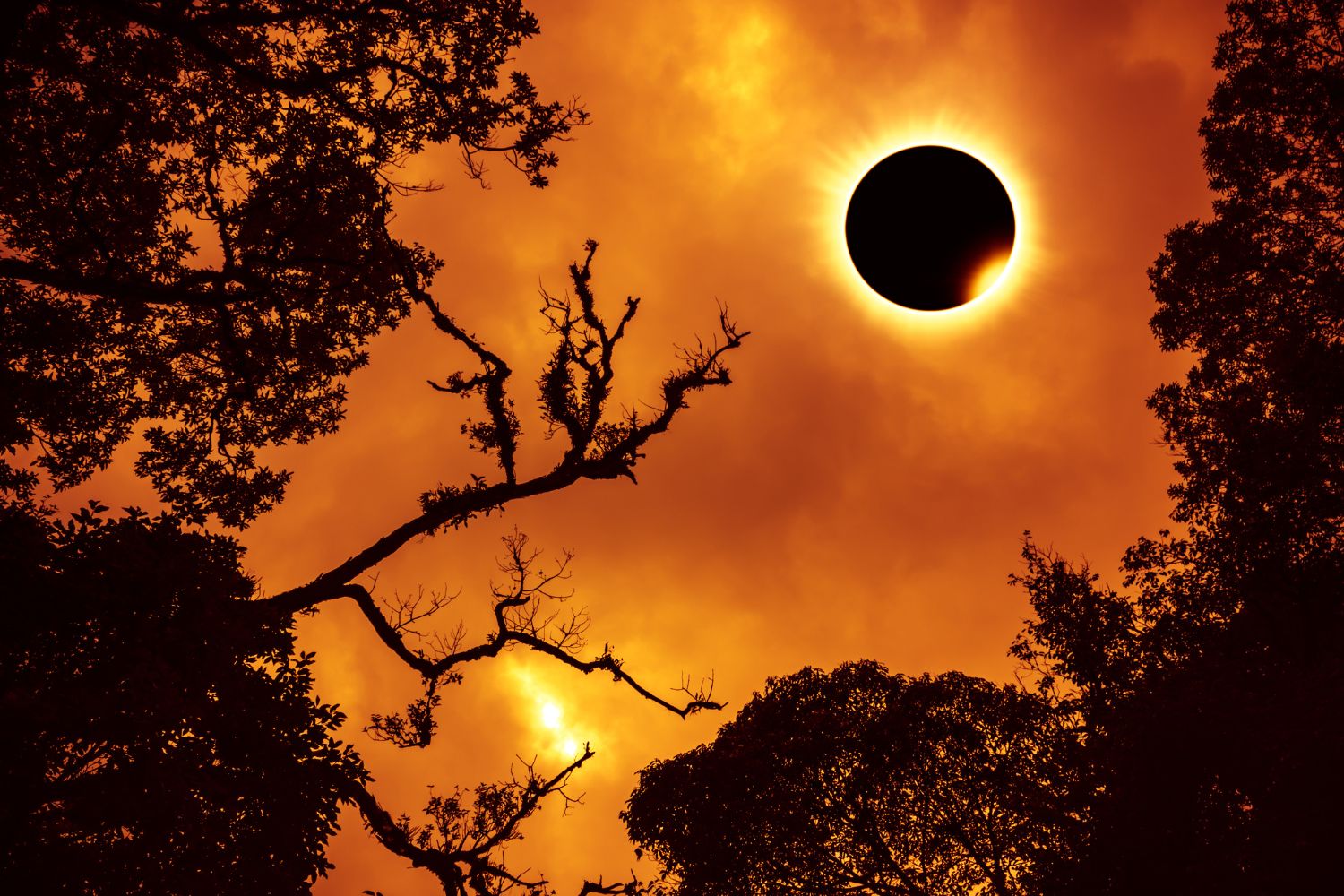
On February 17, 2026 the sky will prepare to offer one of the most evocative astronomical shows of the year: a Annular solar eclipsewith the appearance of the famous ring of fire. A rare, powerful event, capable of reminding us how small we are in front of the perfect movements of the cosmos.
THE’eclipse it will almost exclusively affect the southern hemisphere. The narrow band of territory from which it will be possible to observe the Sun transforming into a luminous circle will cross one of the most remote and inhospitable areas of the planet: Antarctica. That’s where the real thing will be formed ring of fire: the Moon will cover the center of the solar disk leaving only a bright corona visible along the edges. A spectacular effect, which occurs when our satellite is in a phase of its orbit in which it appears slightly smaller than the Sun.
Outside the annularity band, the eclipse will be visible in form partial only in some areas of the southern hemisphere. We are talking about the southern part of Africa – including Madagascar – the extreme south of Latin America, between Chile and Argentina, and some sub-Antarctic islands.
Italy, like the rest of Europe, will remain completely excluded. The shadow cone generated by the alignment between the Sun, Moon and Earth will not affect our latitudes. This means that on February 17, 2026, we will not notice any significant changes in sunlight in Italian skies.
Times and phases of the annular solar eclipse of February 17, 2026
According to data released by the astronomical portal Time and Date, the event will follow a precise sequence.
Numbers that are impressive, especially if you consider that only the 2.17% of the world population will be able to witness any phase of the eclipse. The percentage of those who will see a significant darkening is even smaller: just 0.03%. A rarity within a rarity.
Why does the ring of fire form?
Total and annular solar eclipses occur when the Sun, Moon and Earth are perfectly aligned. But the result is not always the same. The Moon orbits the Earth at an average distance of about 384,000 kilometers. However, this distance varies: when it is further away (closer to apogee), it appears slightly smaller in the sky. Under these conditions it cannot completely cover the solar disk. A thin luminous edge thus remains visible: the ring of fire.
Unlike total eclipses, in which the Sun is completely obscured for a few minutes, the annular eclipse does not produce total darkness. The light diminishes, but never disappears completely.
This is also why eclipses are localized events: the shadow cone draws a sort of curved stripe on the Earth’s surface, affecting only a small percentage of the planet. On average, a total or annular eclipse occurs in the same location approximately every 373 years. There is another curious aspect linked toAnnular solar eclipse of February 17, 2026. The phase of maximum splendor will take place in an extremely isolated Antarctic area.
Research stations on the continent, such as those coordinated by the British Antarctic Survey, typically reduce staff between the end of February and the beginning of March, when the southern summer ends and weather conditions deteriorate rapidly. It is therefore not a given that there are direct shots of the ring of fire. We will most likely be able to follow the event through animations and simulations spread online.
And in Italy?
If February 17, 2026 does not bring anything visible to the Italian skies, it does not mean that we will be left empty-handed. A solar eclipse is expected on August 12, 2026, also visible from Italy, with obscuration percentages that could exceed 90% in the northern regions. An appointment worth marking in your diary.
Because observing an eclipse is not just witnessing an astronomical phenomenon. It is remembering that we live within a delicate system, regulated by perfect balances, and that the Earth is not an immobile seabed but a celestial body in continuous movement.
THE’Annular solar eclipse of February 17, 2026 it will be an extraordinary event, but far from Italy. The Ring of Fire will form over Antarctica, while parts of southern Africa and southern Latin America will witness a partial phase.
For us, curiosity will remain, the wonder told by the images and the wait for the next great show visible from our skies. And perhaps this also makes sense: to remind us that not everything happens before our eyes, but everything is part of the same great plan.
