

An important turning point in the world of photovoltaic comes from a group of researchers from Fraunhofer Institute for Solar Energy Systems (Fraunhofer ISE) in Germany and the King Abdullah University of Science and Technology (Kaust) In Saudi Arabia. Scientists have designed one Solar cell tandem perovskite-silicio that, thanks to the use of Self -assessing monostrati (Sams)has reached arecord efficiency of 29.8% and a clear improvement in the reproducibility.
Because self -assessing monostrati improve solar cells
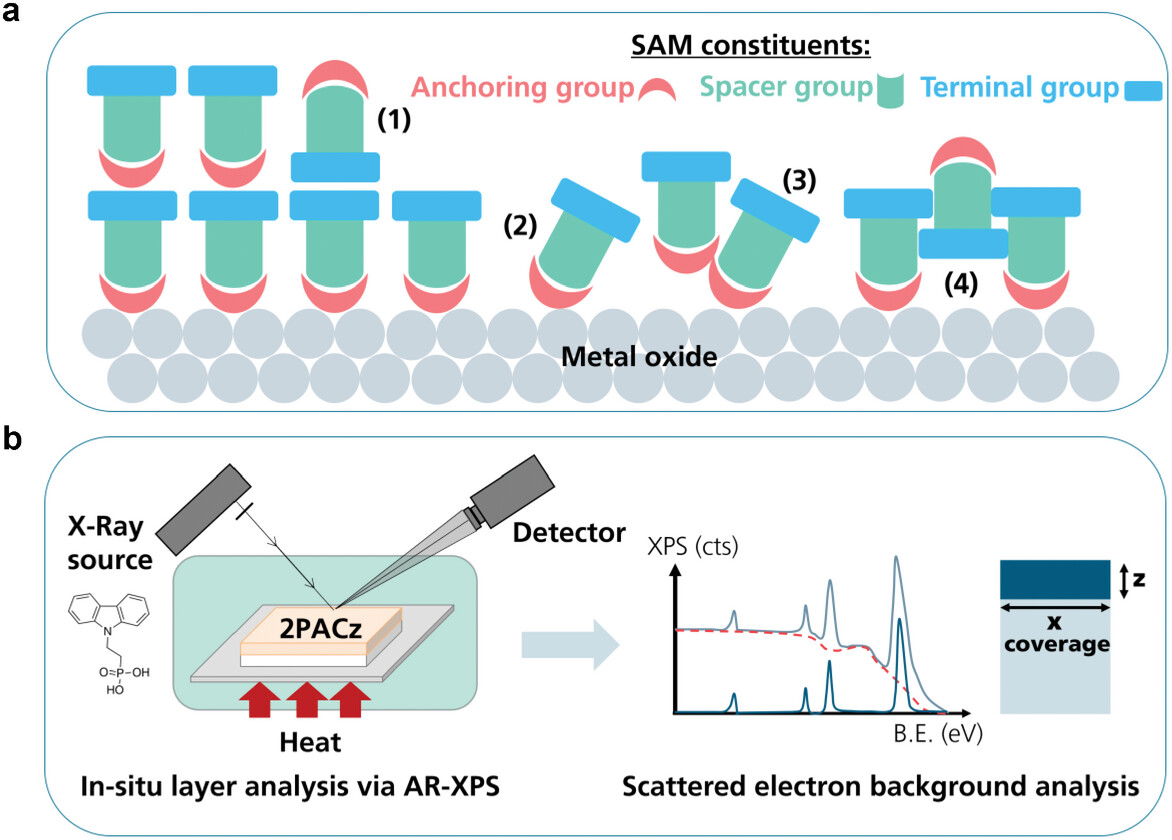
THE Self -assessing monostrati (Sams) are innovative materials used as Transport layers of the holes in the solar cells in Perovskite. Their ability to Reduce the parasite absorption, speed up the extraction of the offices and effectively pass the Perovskite interface It makes them particularly interesting for applications in advanced photovoltaics. However, theirs thickness, density of packaging and orientation They are parameters that are difficult to control, limiting the efficiency of the cells.
The research team deepened the role of a parameter so far little explored: the relief temperature. “We discovered that by increasing the relief temperature from 100 ° C at 150 ° Cthe thickness of the monostratus is reduced by about 5 Nm at 1 Nmwhile its density of packet improves. This allowed us to overcome two of the main challenges related to the Sams, “he explained Ossama Er-Rajithe main author of the study published on Small Methods.
To analyze these ultra-subtile layers, the researchers used an advanced technique, the X -ray photoelectronics spectroscopy in situwhich confirmed the benefits of this optimization. The result? A Passivation of the interface 2pacz/perovskite clearly improvedwith a direct impact on the performance of the solar cell.
The structure of the tandem cell and the results obtained
The solar cell developed by the team combines one Upper cell inverted perovskite with a Lower silicon cell in heterogyment (HJT). The upper part consists of:
- STRONG-STRONG-STAGNO OXIDE (ITO),
- 2pacz layer,
- Absorbitor in Perovskite,
- Electrons transport layer (ETL) in Fullerene (C60),
- Pond oxide buffer layer (Snox),
- Additional buffer layer in ito,
- Silver metal contact (AG),
- anti -reflective coating in magnesium fluoride (MGF2).
Tested in standard lighting conditionsthis cell has reached aPower conversion efficiency of 29.8%. “Thanks to our strategy, we got a increase of 1.3% Compared to traditional cells, with a clear improvement in reproducibility, “said scientists.
The study, entitled “Tuning Self-Assembly of Hole-Selective Monolayers for Reproduable Perovskite/Silicon Tandem Solar Cells”shows that the efficiency of the solar cells in Perovskite based on Sams still has room for improvement. This innovation could represent a decisive step towards A new generation of more performing and reliable solar cells.
The race for efficiency does not stop
Innovation in the field of solar cells Perovskite-Silicio Tandem It represents only one of the many directions in which photovoltaics is evolving quickly. In addition to the progress obtained by the team of Fraunhofer ISE and of the Kaustanother recent research has marked a new goal: Indian scientists have designed a 2D-3D perovskitic solar cell with record efficiency of 31.16%.
The panorama of research on sunscreen tandem is in turmoil all over the world. In Chinathe Polytechnic University of the North-West of Xi’an has developed one Tandem Perovskite-semi-trasplier four-term terminal cellswhich uses a protective layer in Indio oxide (in₂o₃) To improve efficiency and durability. TO Taiwanscientists ofAcademia Sinica have reached an efficiency of the 31.5% with a tandem cell with two terminals (2T)opening the way to a future industrialization of technology.
Currently, the efficiency record for Celle Tandem Perovskite-Silicio is held by the Chinese company Longiwhich reached the 34.6% In 2023. However, the research does not stop: according to the experts of the Fraunhofer ISEthe theoretical limit of efficiency for tandem cells could go up to 39.5%as long as you develop new architectures and more performing materials.
On the cells in Perovskite you may also be interested in:
