
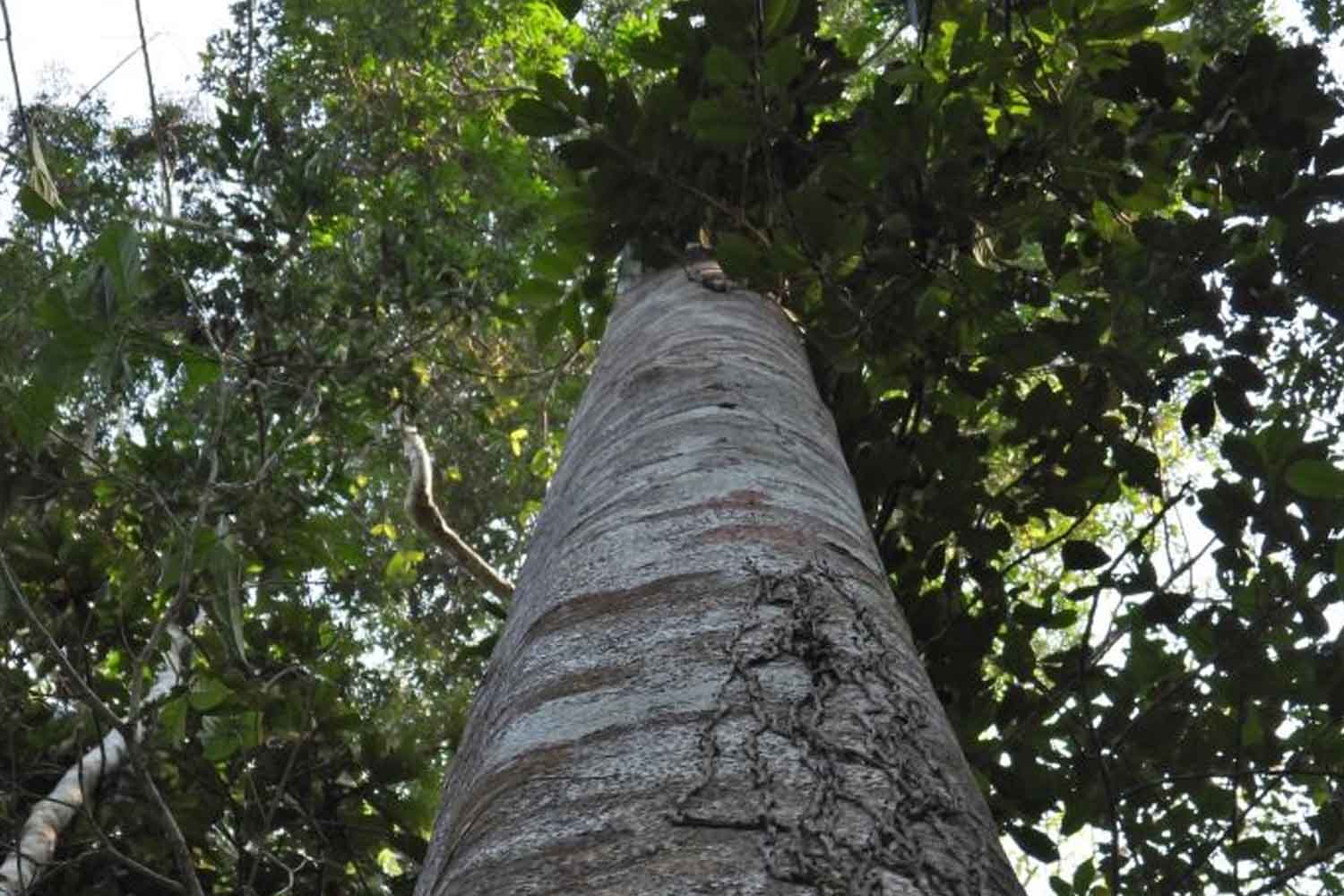
In the most intact heart of the Peruvian Amazon, in a protected area that on paper should have guaranteed safety and ecological continuity, scientists have finally given a name to a new species of tree that had remained invisible to science for over forty years. It is called Drypetes oliveri, it is a giant that can reach 35 meters in height (about 115 feet) and, paradoxically, at the time of its official identification it was already one step away from extinction.
The discovery occurred within the Tambopata National Reserve in southeastern Peru, one of the best-preserved areas of lowland rainforest in the country. Here, in an extremely limited pocket of the world, only very few adult specimens survive, all concentrated in an area covering less than 10 square miles. For an organism of such massive dimensions, its entire universe is surprisingly tiny, and the future already appears fragile.
How Drypetes oliveri was discovered
The formal description of the species was led by the botanist Rodolfo Vásquez Martínez, who has been involved for years in the census and study of tropical trees in Peru. His work focuses on identifying new species and understanding their role within Amazon ecosystems. Alongside him, a fundamental contribution came from Professor Oliver Phillips, tropical ecologist and international point of reference for the long-term monitoring of Amazon forests and their changes in response to climate and human activities.
Naming a species after a scientist is not just a symbolic homage: it means permanently linking the history of that organism to whoever made its discovery possible. In this case, the name Drypetes oliveri recognizes Phillips’ role in the creation and maintenance of the network of forest plots which, decades ago, had hinted at the presence of something unusual in the Tambopata forest.
Because Drypetes oliveri has remained invisible for over forty years
The story of this discovery begins about forty years ago, when the famous botanist Alwyn Gentry collected some leaves belonging to an anomalous tree in one of his permanent study plots in Tambopata. Gentry suspected it was a species not yet described, but with only fallen leaves it was not possible to prove this. In botany, in fact, flowers and fruits are essential to distinguish different species with certainty, especially when the leaves are very similar between even distantly related trees.
The problem is that these structures develop in the canopy, the highest part of the forest, which can exceed 30 meters in height and is difficult to access from the ground. The turning point came only in 2023, when Vásquez Martínez, together with Rocío Rojas and Abel Monteagudo, identified a fruiting specimen. The tree’s canopy attracted macaws and howler monkeys, a clear sign of ripe fruit.
Rojas tasted the pulp that fell to the ground, immediately recognizing the peppery flavor typical of the Drypetes genus. At that point, the leaves also matched perfectly with the sample collected by Gentry decades earlier. The puzzle was finally complete.
The characteristics of Drypetes oliveri
The official botanical description reveals that Drypetes oliveri is a dioecious species, with separate male and female individuals. The tree emerges above the surrounding forest canopy and has a trunk that can reach 55 centimeters in diameter, supported by robust buttress roots that extend for several meters at the base, ensuring stability in damp soils.
The species grows in raised lowland forests, on river terraces rich in clay, where the soil remains compact even during the most intense rainfall. All known specimens are endemic to this small area of Tambopata and are found within a few kilometers of each other.
The fruits are oval, just over two centimeters long, covered with velvety brown hair and contain a single hard seed. Animals capable of overcoming the bitter skin probably contribute to seed dispersal, assigning this species a discreet but significant role in the dynamics of the forest community.
The Drypetes genus belongs to a group of trees predominantly found in the Old World, with species more common in Africa and Asia than in South America. The thick bark and spicy fruits represent evolutionary adaptations that discourage some herbivores, while continuing to attract species specialized in frugivory.
An Amazon rich in rare and increasingly vulnerable species
A continental inventory estimated that the Amazon is home to around 390 billion trees, belonging to around 16,000 different species. However, the same study highlighted that 227 common species alone represent half of all individuals, while thousands of other species survive with extremely small and therefore vulnerable populations.
Long-term measurements also show that Amazon forests have absorbed billions of tons of carbon dioxide, functioning as a huge carbon sink. This role, however, is progressively weakening due to deforestation, fires and climate change.
Because Drypetes oliveri is already considered at risk of extinction
With only four known specimens and a distribution of less than 10 square miles, Drypetes oliveri fully meets the criteria to be classified as a threatened species. Botanists have in fact included it in the Endangered category of the Red List of species at risk.
In the Madre de Dios region, satellite images show how gold mining has destroyed tens of thousands of hectares of forest, leaving behind mercury-contaminated water basins, with serious consequences for wildlife and local populations. Added to this are new roads and trade routes, which facilitate access to previously isolated areas and accelerate deforestation for livestock and agriculture.
Dry seasons, increasingly hotter and drier, fuel fires that shroud the southern Amazon in smoke for weeks. The survival of this giant just described, over the next forty years, will depend on political and environmental choices related to mines, infrastructure, fire management and real protection of natural areas.
You might also be interested in:
