
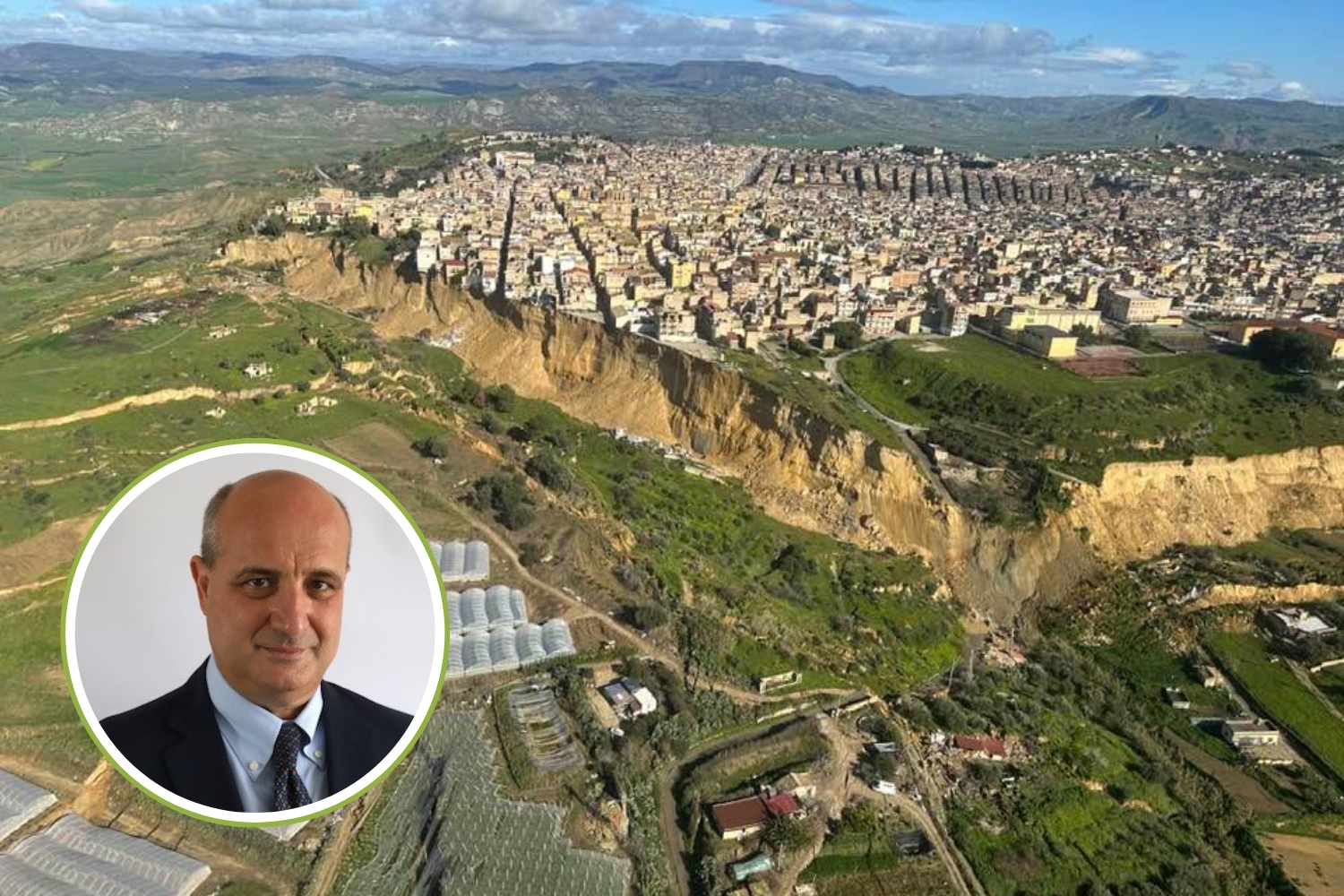
Niscemi rests on a geological contradiction which, in the last days of January 2026, manifested itself in all its violence. A sandy plateau, home to the historic center, overlooks clayey slopes subject to centuries-old movements. When these two worlds come into conflict, the outcome is instability that has already forced the evacuation of 1,500 people and the establishment of a red zone almost five kilometers long.
Nicola Casagli, professor of applied geology at the University of Florence and president of the National Institute of Oceanography and Experimental Geophysics (OGS), flew over the area immediately after the event. “We are faced with a phenomenon of colossal dimensions,” explains Casagli. “The landslide is made up of multiple bodies that have merged together, reactivating already known fronts. A very high slope has been created in the sand: these walls remain vertical as long as they are wet, but when they dry out or it rains too much, they fall apart. The edge regresses and will affect the first meters of the historic urban area. It is inevitable.”
The dynamics of “backward failure” and monitoring
The central issue lies in the escarpment generated by the event, a wall cut directly into the sand. As long as these retain moisture, they remain standing like the walls of a sandcastle on the shore, but one swing is enough for them to fall apart. The result is a progressive retreat of the edge: a “backward subsidence” that will end up affecting the perimeter of the historic center.
Currently, the focus is on modulating the red zone. “Initially a precautionary zone of 150 meters was established along the entire 4.7 kilometer front,” explains the professor. “But we are working to reduce it where possible, by combining geophysical investigations that explore the subsoil and radar satellite monitoring. Thanks to these satellites, we can measure the movements of buildings with millimeter precision, even going back in time to understand what was happening years ago.”
The role of aqueducts
“Niscemi has nothing to do with climate change,” says Casagli. “It occurred where there had already been landslides in 1778, 1790 and 1997. It was known that the area was subject to landslides.” The triggering factor is often anthropic and infrastructural. “A town loses water from the aqueduct networks which throughout Italy are a sieve. Half of the water is dispersed underground, filling the ‘sponge’ of the sand and softening the underlying clay. If we add the erosion of the Benefizio stream downstream, the picture is complete. A landslide of tens of millions of cubic meters cannot be stopped, but it can be slowed down: if instead of returning every 30 years, it returned every 100, it would already be a success.”
Resource management
Casagli’s analysis then moves on to national risk management. “It’s nice to say that with monitoring I can see the risk sooner. But then I have to do something”, urges the professor. The criticism of the priorities is clear: “A general framework is missing. We invest in weapons to protect ourselves from invasions that will never happen when we are already invaded by geological instability and there is not enough defense against that. Plans for hydrogeological protection in Italy have been made, like the De Marchi Commission in the 1970s: beautiful projects but never financed. The truth is that politics lives on votes: if citizens do not ask for hydrogeological safety as a priority, politics invests elsewhere. The emotional wave it goes out a few weeks after the catastrophe and no one remembers the landslides anymore.”
The drama of the evacuees
Beyond the technical data, Casagli brings with it the image of a wounded community. “Seeing the landslide from the Fire Brigade helicopter made me perceive uncommon dimensions,” he says. “I’ve seen bigger landslides, but never one this big in active movement. But what strikes me is the human side: being among the evacuated residents, seeing desperate people begging to be able to return to their homes even just to recover an object. Losing your home like this, from one moment to the next, leaves its mark on you. You never get used to it.”
Awareness: the message to citizens
The future of Niscemi passes through a paradigm shift. “Italy is the only country in the world to have mapped the entire territory at risk, but then they look for tricks to build where they shouldn’t. The risk of getting hurt from a landslide is one in a million, in a car one in a thousand. Yet in the car we know the rules.”
The reference to the events in Valencia is a warning: “The alarm was raised and many citizens went to get their cars from the underground. If you don’t know what to do, in that half hour notice you do the wrong thing. We must demand security, but also understanding: it’s not enough to know the phenomena, you have to understand how they work in order to live with them.” The final message is addressed to those who vote: “Citizens must establish priorities. They must demand geological safety, information and understanding of the phenomena. Only in this way will politics respond in the most appropriate way”.
You might also be interested in:
