
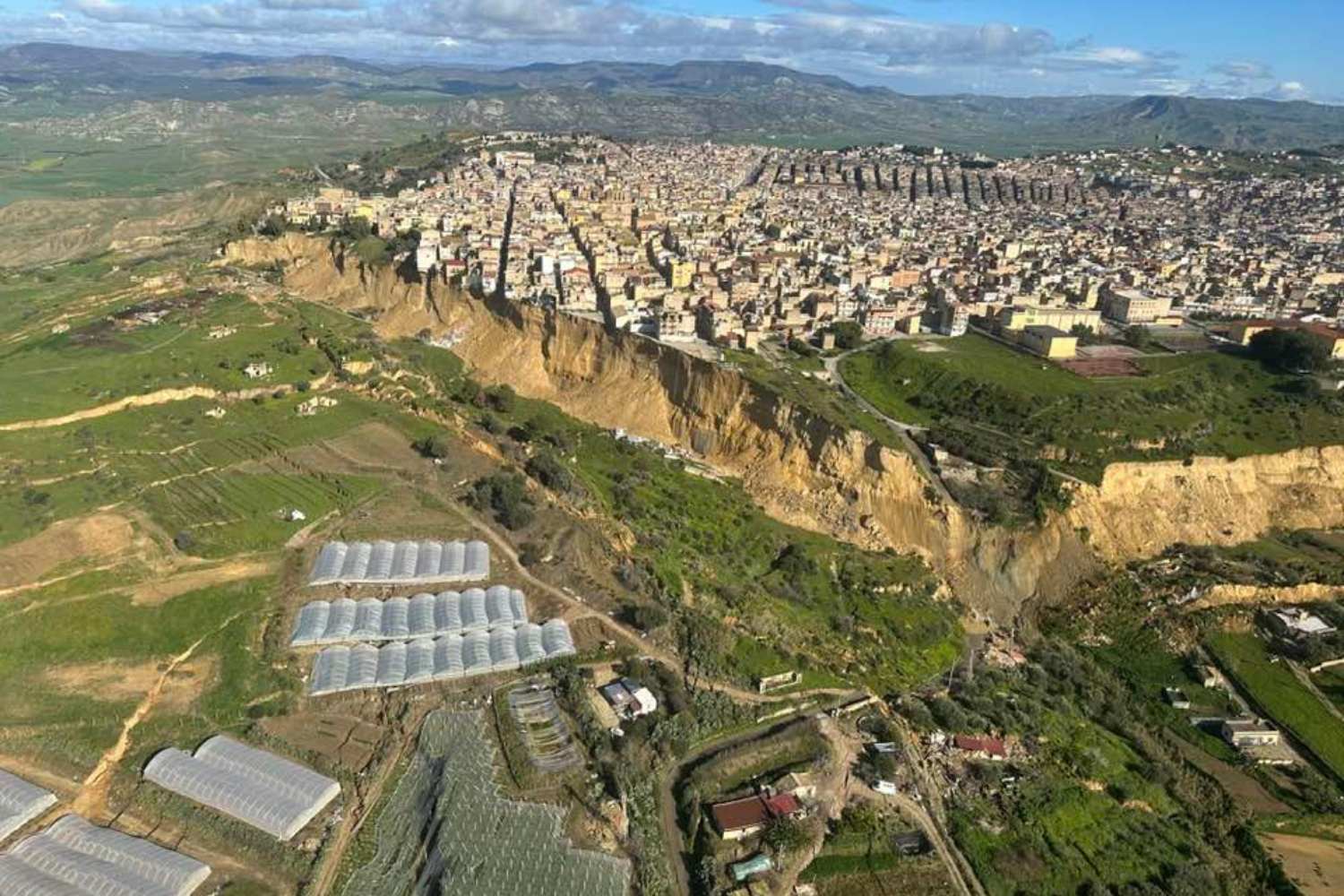
In Niscemi there was not a sudden roar but a front of over four kilometers that advanced, a hill that slipped towards the Gela plain and a country forced to deal with an uncomfortable truth: what is happening was known, studied, foreseen.
Over 1,500 people had to leave their homes due to the huge landslide. Entire neighborhoods – Sante Croci, Trappeto, via Popolo – were evacuated. Schools are closed, roads blocked, everyday life suspended.
“It’s a disaster, we’re losing everything. Houses and memories swallowed up by the earth and everyone knew that it’s a risk area” a citizen from Nisceme tells us.
The landslide is still active and, as the head of Civil Protection Fabio Ciciliano declared, “it’s not just what we see that is collapsing, but the entire hill that is descending towards the Gela plain”.
#Niscemi The landslide is still advancing, the images from the drone updated to Tuesday morning pic.twitter.com/GlAIUcGl2l
— Local Team (@localteamit) January 27, 2026
A landslide that was anything but sudden
The instability that today overwhelms Niscemi has its roots far back in time. And even before 1997, when a devastating landslide hit the same area. Scientists from the Italian Society of Environmental Geology recall, in fact, the existence of documents which already in 1790 described landslide movements on the western side of the city. A fragile territory, therefore, never truly secured.
The geological explanation is clear. The soil is composed of a sandy layer resting on waterproof clay. “The sandy soil – explained Riccardo Ferraro of the Italian Society of Environmental Geology – has a shear resistance angle of around 35 degrees”, while the slope reaches inclinations of up to 85 degrees. An unnatural condition, destined to rebalance sooner or later. The intense rains and Cyclone Harry accelerated a process already underway, saturating the surface layers with water and triggering the slide.
Houses on the edge of the void
The consequences are there for all to see. The red zone was progressively widened, from one hundred to one hundred and fifty meters from the landslide front. According to experts, many homes overlooking the crown will no longer be able to be inhabited. Ciciliano was clear: those who live there will never return.
After 1997 some houses were demolished and new construction was prohibited. But the unstable front has never been the subject of structural safety interventions. Meanwhile, urban planning disorder and uncontrolled stormwater management have aggravated the slope’s vulnerability. The runoff waters pass through the city and onto the hill, digging furrows that accelerate erosion.
The emergency and institutional responses
Civil Protection and the Region are working to manage the emergency. The government has allocated an initial economic contribution for displaced families, while there is talk of permanent relocations and new homes for those who have lost their homes. Necessary words, but which come after years of ignored reports.
National politics arrived in Niscemi with declarations of closeness and promises of funds. In the meantime, however, the city remains almost isolated: three of the four access roads are compromised and ordinary life, as the Civil Protection itself admitted, “is no longer ordinary”.
Niscemi and the weight of Sicilian history
Then there is a broader level, which goes beyond geology. Niscemi is also the symbol of a Sicily often sacrificed and left alone, called to pay the price for choices made from above. Over time, important US military infrastructures have been established in this fragile territory, from the telecommunications station to the MUOS – the high-frequency, narrow-band military satellite communications system managed by the US Department of Defense -, without the militarization corresponding to adequate care of the territory and its security.
As the hill crumbles, the feeling of a community that today asks for responsibility, not slogans, resurfaces. The Niscemi landslide is the result of a long chain of omissions. And until this issue is addressed, the earth will continue, meter after meter, to remember it.
