
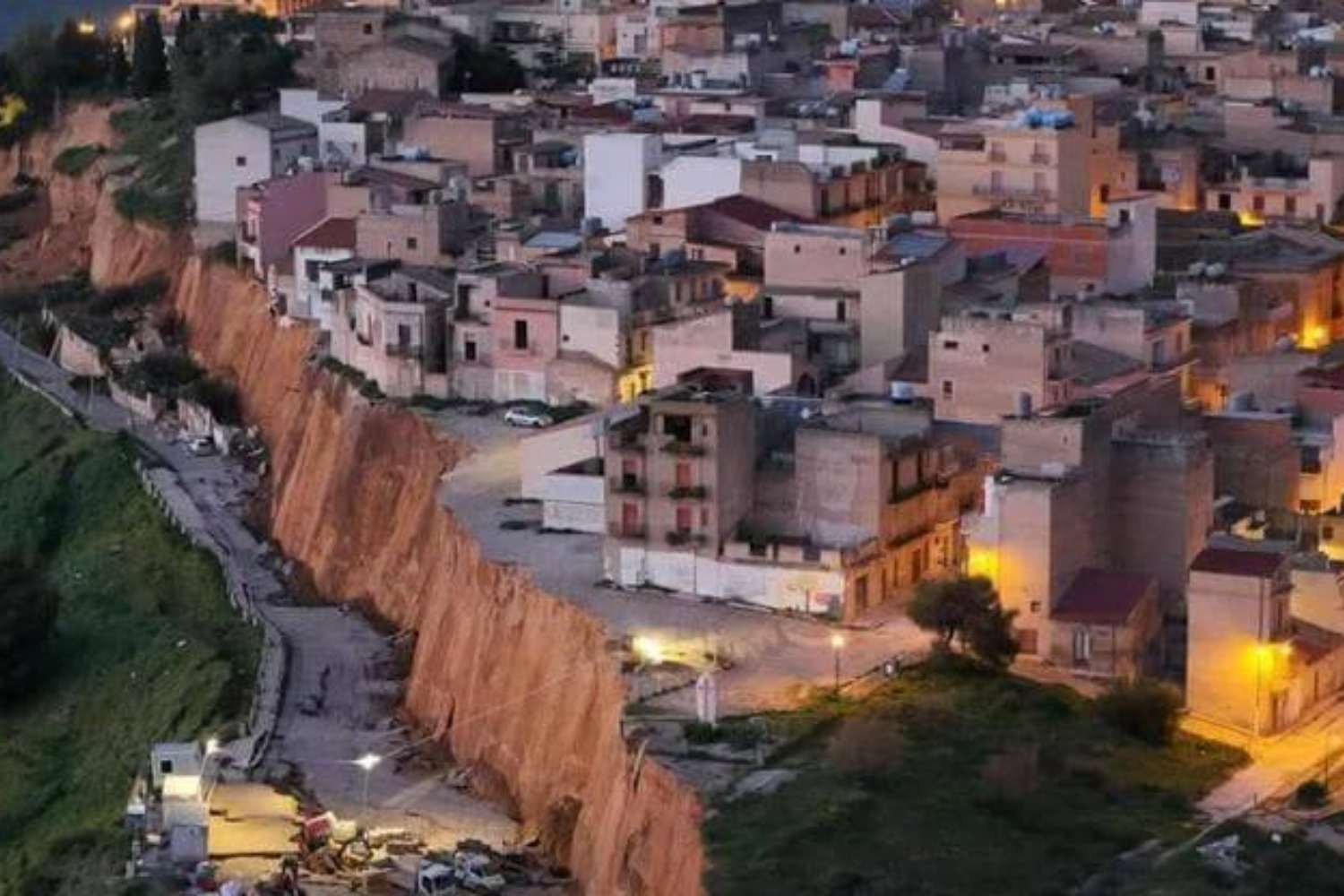
The earth has stopped moving, but beneath the surface there remains a tension that is difficult to ignore. In Niscemi the landslide that kept hundreds of families suspended for weeks has stopped. A truce, more than a solution. Fabio Ciciliano, head of the national civil protection and extraordinary commissioner appointed by the government to manage the emergency, was explicit: beyond 100 meters from the edge, homes can be considered safe. And so, after weeks of evacuation, many residents are preparing to return. But coming back doesn’t mean turning the page.
The return home, with caution
Municipal ordinances have reopened the doors of many homes. We are talking about hundreds of people who, with caution, are returning to their neighborhoods. Yet the return does not have the flavor of normality. The cracks in the walls, but above all those in trust, remain evident. The fear is that that mass of land, currently immobile, could start to fall again.
“The landslide is still unstable,” warns Ciciliano, “and therefore getting your hands on it would be particularly dangerous.” The slope that slides towards the Gela plain continues to be fragile, conditioned in particular by the presence of water underground. That’s where the security game will be played.
View this post on Instagram
Red zone and demolitions: an open wound
If on the one hand there are those who return, on the other there are those who will not be able to do so. The band within 100 meters from the edge remains a red zone. Here we are no longer talking about prevention, but about renunciation. The most exposed buildings will be demolished. A necessary step according to the technicians, but which has an enormous human impact. It’s about seeing a part of your history erased. The abatement plan is still being defined, as is the plan for the relocation of families. It is one of the most delicate issues: preventing the geological emergency from becoming a social fracture.
150 million to secure the territory
The government has allocated 150 million euros, divided into two equal chapters. The first 75 million will be used for hydraulic engineering works: drainage and canalization to reduce water pressure underground, the main factor of instability. The other 75 million will be allocated to demolitions and to support displaced families. The plan, once defined, will be examined by the Council of Ministers.
However, Ciciliano holds back on expectations of speed: “Being quick sometimes conflicts with the good. Speed must not be confused with haste.” A significant investment which however raises a question: will it be enough to intervene now to avoid new crises?
The weight of missed opportunities
The Gela Prosecutor’s Office is investigating the case, shining a light on a crucial element: the consolidation projects that were never carried out after the 1997 landslide. A past that once again weighs on the present. In a country where hydrogeological instability is a constant, the difference is often made by the interventions that are not carried out. Niscemi thus becomes an emblematic case for what could have been avoided.
A still fragile balance
Emergency management now enters a more complex phase: the urgency of prevention remains. “These are very important hydraulic works”, reiterates Ciciliano, “which must be designed precisely”. Intervening too quickly on unstable ground can compound the risk. We need accurate planning, technical times and a vision that goes beyond the emergency. Because the landslide has stopped, but the territory remains vulnerable. And while the lights of media attention begin to go out, a suspended community remains in Niscemi: between the relief of the return and the awareness that underfoot, the earth is not yet completely reliable.
You might also be interested in:
